
Why Willpower Doesn’t Work for Weight Loss

If your weight-loss plan works beautifully when you are rested, organized, home on time, and surrounded by exactly the food you planned to eat, I have a question.
What happens on Tuesday at 5:47 p.m. when you are starving, work ran late, somebody needs a ride somewhere, and the food you meant to cook is still frozen?
This is usually where women tell me:
“I need more willpower.”
I disagree.
You do not need to become better at fighting yourself.
You need a plan that requires fewer fights.
Willpower exists. Self-control matters. There are moments when you pause, make a choice, and do something different from what feels easiest.
But if your entire weight-loss strategy depends on winning those moments over and over, every day, under every condition, you have built a fragile system.
I want to help you build a better one.
Willpower Is a Tool, Not a Weight-Loss Plan
For years, popular psychology described willpower like a battery.
You start full.
You make decisions.
You resist temptations.
You deal with stress.
Eventually, the battery runs low and self-control disappears.
It is a wonderfully tidy explanation.
Science, inconveniently, is rarely tidy.
The classic theory is known as ego depletion. Later meta-analyses raised questions about the strength of the effect, and a large preregistered replication across 23 laboratories found an effect close to zero.[1,2]
So I am not going to tell you your willpower literally drains away by dinner.
What I will tell you is this:
Relying on repeated effortful resistance is a lousy system.
Your choices happen inside real situations. Hunger matters. Stress matters. Sleep matters. Habits matter. Your environment matters. Familiar routines matter. Competing priorities matter.
A system that works only when every decision receives your full attention is asking too much from real life.
My French-Fry Willpower Had a One-Question Limit
I used to joke about this.
I would order lunch in the hospital cafeteria.
They would ask if I wanted fries.
“No.”
Then someone would ask again.
“Are you sure?”
And somehow my second answer became yes.
Apparently, my French-fry resistance had excellent performance for one question.
My solution was not to become a stronger person.
I started bringing lunch.
Think about the difference.
One strategy says:
“Stand in front of a tempting option, while hungry, during a busy day, and repeatedly make the choice you planned.”
The other says:
“Bring lunch.”
One requires a fresh negotiation.
The other turns lunch into a routine.
I prefer fewer negotiations.
People With Good Self-Control Often Use Habits
This is one of my favorite pieces of behavior-change research because it flips the usual story.
We tend to imagine people with excellent self-control constantly resisting temptation.
Research by Galla and Duckworth found something different. Across six studies, people with stronger self-control also relied more on beneficial habits, including habits related to food, exercise, and sleep. Those habits were associated with less effortful inhibition.[3]
In plain English:
People who seem disciplined are not necessarily fighting harder all day.
They often have fewer fights.
The behavior has become familiar.
The shoes are by the door.
Breakfast is predictable.
Lunch is packed.
There is food in the freezer.
The walk happens after coffee.
The water bottle lives on the desk.
This is why I spend so much time talking about routines.
A routine moves a decision out of the dramatic category.
You do not wake up every morning and have a philosophical debate about whether teeth brushing aligns with your deepest values.
You brush your teeth.
I want more of your supportive health behaviors to feel like that.
Routine Reduces Negotiation
When I say routine, I am not asking you to live the same Tuesday forever.
I am also not asking you to follow an elaborate wellness schedule beginning at 4:37 a.m.
Please sleep.
I mean making some supportive choices predictable.
Maybe Monday dinner is almost always the same.
Maybe you order groceries on the same day.
Maybe you walk after lunch on work-from-home days.
Maybe your workout clothes live beside your bed.
Maybe you keep a reliable snack in your bag.
Each routine removes one decision from a future moment.
Research on health-habit formation supports repetition in stable contexts as a path toward greater automaticity. A 2024 systematic review found health habits strengthened through repetition, while the time required varied widely between people and behaviors.[4]
The goal is not instant autopilot.
The goal is repetition.
Why Willpower-Heavy Plans Fall Apart
A willpower-heavy weight-loss plan often looks impressive on paper.
It might include:
- A long list of foods you plan to avoid
- Three completely different meals every day
- A workout schedule built around your best week
- No backup meals
- No plan for restaurants
- No plan for a late workday
- No response for unexpected hunger
- An expectation of perfect adherence
- Constant exposure to foods you are trying to resist
- A promise to “be good”
Then real life arrives.
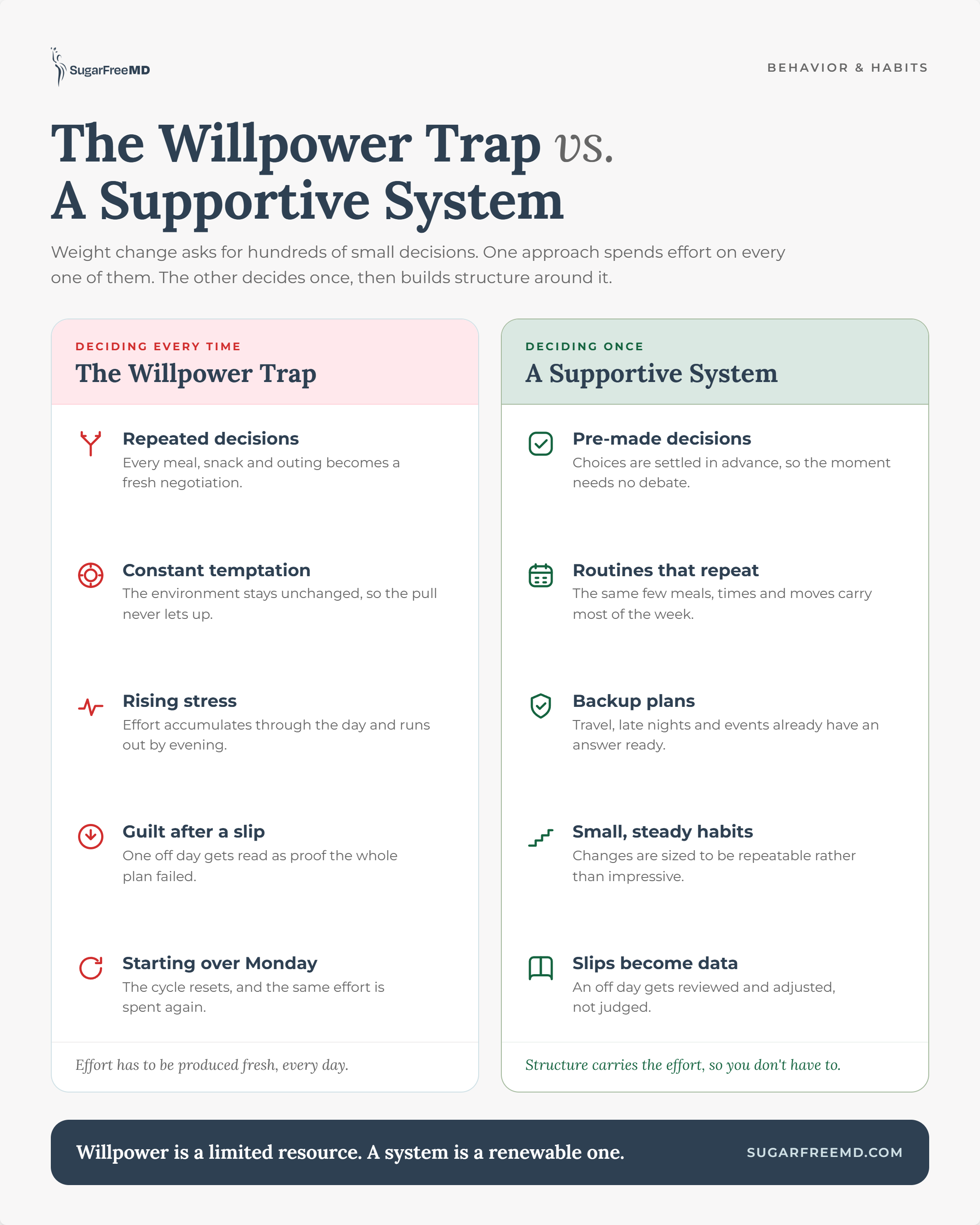
Now every supportive action requires a decision.
Do I exercise?
What should I eat?
Should I have the office treat?
What if everyone else orders dessert?
Should I stop at the store?
Should I cook?
What if I am tired?
What if I missed yesterday?
What if I already ate something I did not plan?
That is a lot of negotiating.
Then one decision goes differently than planned and the story becomes:
“I have no willpower.”
No.
Your plan has too many decision points.
Make the Plan Easier Before You Make Yourself Stronger
One question I use is simple:
“How easy does this plan feel?”
If you look at tomorrow and think your plan has roughly a coin-flip chance of happening, I do not want you promising yourself you will try harder.
Change the plan.
Make dinner simpler.
Shorten the workout.
Pack something.
Move the tempting food.
Add a backup.
Decide earlier.
Your plan should feel realistic while you are writing it, not inspirational in a way that requires Future You to become a completely different human by 6 p.m.
Future You has enough going on.
Help her out.
Pre-Decide the Moments That Usually Trip You Up
Some problems are not surprises anymore.
The meeting runs late most Tuesdays.
You get hungry while driving home.
Your family orders takeout on Fridays.
Someone brings food into the break room.
Travel mornings are chaotic.
You struggle to exercise after a poor night of sleep.
If the same situation keeps appearing, stop meeting it like a stranger.
Make a plan before it happens.
Behavior researchers call one version of this an implementation intention.
The structure is:
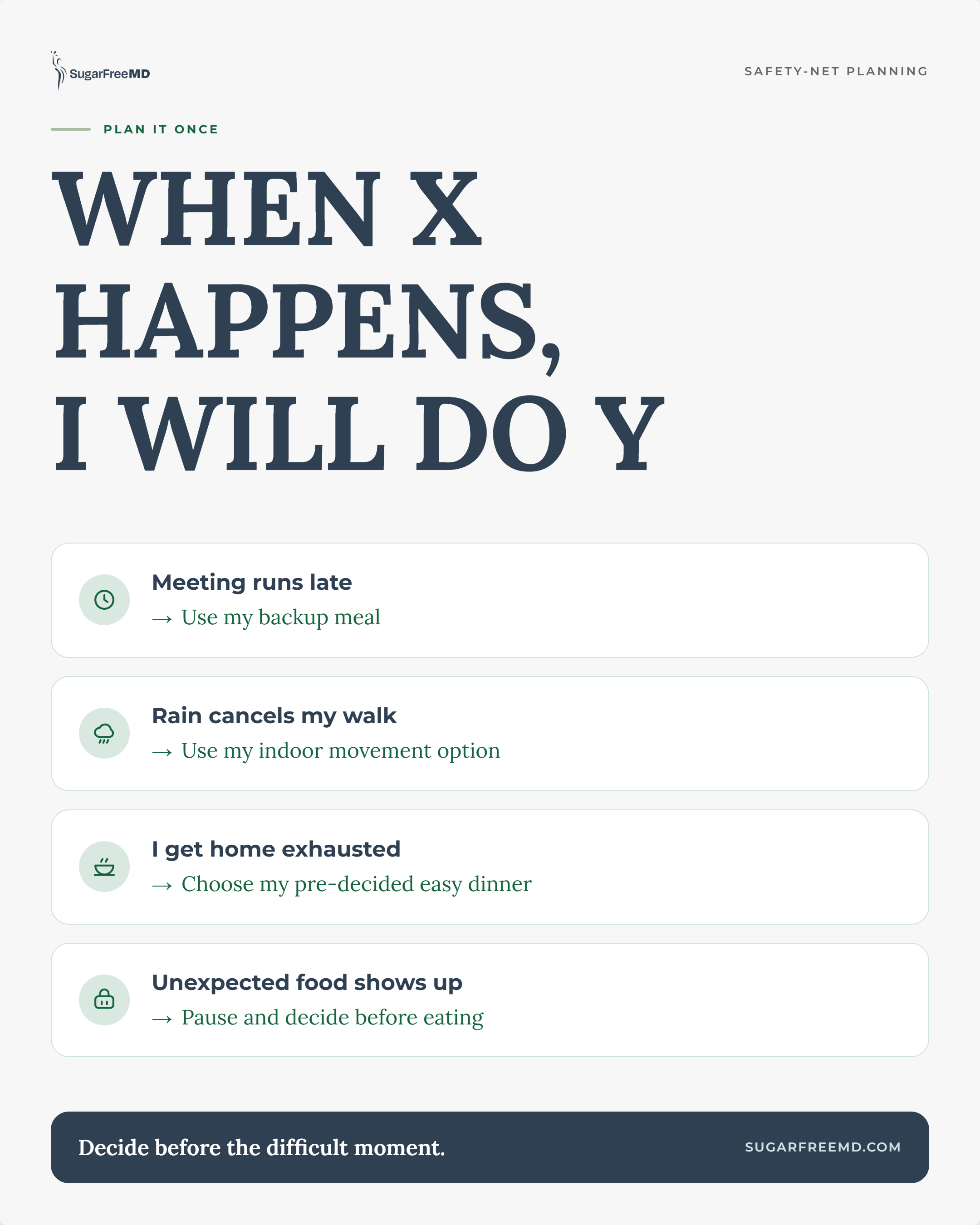
“When X happens, I will do Y.”
Research on implementation intentions has found benefits for goal follow-through, including healthier eating behaviors, although effects differ by target behavior.[5]
Your version might look like this:
“When clinic runs through lunch, I will eat the backup food in my desk.”
“When everyone orders takeout, I will choose from one of my three regular orders.”
“When it rains during my walking time, I will do ten minutes of movement indoors.”
“When I get home too tired to cook, I will use the meal in my freezer.”
“When someone brings dessert to work, I will decide whether I want it before I stand beside it discussing my entire life with a brownie.”
Pre-decisions reduce uncertainty.
Less uncertainty means less need for an in-the-moment battle.
Use Safety Nets, Not Perfect Plans
A realistic plan needs a backup.
I call these safety nets.
Your first plan might be:
“I am making dinner.”
Your safety net might be:
“If work runs late, I am using the freezer meal.”
Or:
“I am walking for 30 minutes.”
Your safety net:
“If I miss the longer walk, I am walking around the block.”
The safety net does not need to match the original plan.
Its job is to keep one disruption from becoming abandonment.
This matters because perfection tends to produce a strange response.
You miss the full workout, so you do nothing.
You cannot make the planned dinner, so the entire evening becomes unplanned.
You eat one unexpected food, so you decide the whole day is ruined.
A smaller option protects consistency.
If this pattern sounds familiar, read Why You Keep Starting Over With Weight Loss, and How to Stop.
Make One Thing Automatic Before Adding Five More
This is where ambitious women get themselves into trouble.
We get excited.
We decide Monday will include:
A new breakfast.
A new workout.
More water.
Meal prep.
Meditation.
Earlier bedtime.
Journaling.
A completely different grocery list.
And perhaps world peace before lunch.
Then we wonder why the routine feels exhausting.
Pick one thing.
Start small enough to repeat it.
If you want a walking habit, your first version does not need to prove your cardiovascular fitness.
Put on your shoes.
Walk outside.
Go around the block.
Repeat.
If you want a meal-planning routine, plan two dinners instead of seven.
If you want a hydration routine, put the bottle where you work before worrying about the perfect number of ounces.
Habit strength grows through repetition, not through making the first attempt impressive.[4]
Change Your Environment Before Blaming Your Character
Your environment influences how many choices demand your attention.
If you have to remember your walking shoes every morning, put them by the door.
If afternoons get chaotic, keep a reliable snack where you work.
If you repeatedly forget water, keep a bottle in sight.
If a food feels intensely distracting when it sits on the counter, put it somewhere less visible.
This is not cheating.
You do not earn extra health points for making supportive behavior harder.
One of the odd messages in diet culture is the idea that success counts more when temptation is inches from your face and you heroically refuse it.
Why?
Move the thing.
Make life easier.
Delay Is Different From Deprivation
One strategy I use when something feels unusually tempting is delay.
I do not tell myself:
“You are never allowed to have this.”
I decide I will have it later, often after I have planned for it.
This came up for me once when brownies showed up at work. Rather than turning the moment into an internal wrestling match, I decided I would take one home and plan it for later.
Then work got busy.
I forgot about the brownie.
The urgency disappeared.
Sometimes I still want the food later. Fine.
Delay is useful because it gives the moment room to change without turning food into a forbidden object.
The point is not to prove how long you can resist.
The point is to move from reaction to intention.
Learn From the Choice Instead of Punishing It
A plan will fail sometimes.
I want you expecting this.
You will forget lunch.
You will eat something you did not plan.
You will skip movement.
You will have a week where the routine feels weird.
None of this requires punishment.
Use the information.
Ask:
- What happened?
- What made the moment harder?
- Was I hungry?
- Was I tired?
- Did I have a realistic option?
- Was the food sitting directly in front of me?
- Did my plan fit my actual schedule?
- Which safety net was missing?
- What would make the same situation easier next time?
This is where Nothing Has Gone Wrong becomes useful.
A difficult choice is data.
Use it.
Stop Asking “Why Am I So Undisciplined?”
Try a better question:
“Where am I relying on willpower when I need a system?”
Look at one part of your day.
Maybe breakfast is easy, but lunch depends on what happens at work.
Maybe weekdays work, but weekends have no structure.
Maybe dinner is fine until someone brings dessert.
Maybe movement only happens if you wake up motivated.
Find the part requiring the most negotiation.
Then remove one decision.
That is behavior change.
Not tougher.
Easier to repeat.
What Willpower Is Good For
I am not declaring willpower useless.
It helps in individual moments.
It might help you pause long enough to remember your plan.
It might help you put your shoes on the first few mornings.
It might help you walk past the break room once.
It might help you interrupt an old pattern.
But I do not want every supportive choice to require a heroic act of resistance.
Use self-control to help build the system.
Then let the system carry more of the load.
Try This Willpower Audit
Pick one health behavior you keep struggling to repeat.
Then answer five questions:
1. Where does the behavior usually break down?
Name the situation.
Not your personality.
2. Which decision are you repeatedly making in the moment?
Identify the negotiation.
3. What could you decide earlier?
Choose the meal, time, backup, route, or response in advance.
4. What would make the supportive option easier?
Change your environment, reduce steps, prepare something, or shrink the habit.
5. What is your safety net?
Finish this sentence:
“When __________ happens, I will __________.”
Now you have something more useful than:
“I will try harder tomorrow.”
Frequently Asked Questions
Is willpower useless for weight loss?
No. Self-control helps in individual choices. The problem appears when your entire strategy depends on repeated effortful resistance. Planning, habits, routines, environmental support, and backup options reduce how often you need to rely on willpower.
Does willpower literally run out during the day?
The old ego-depletion theory described self-control as a limited resource, but later meta-analyses and large replication efforts questioned a simple depletion model.[1,2] Self-control is influenced by context, motivation, fatigue, competing goals, habits, and environmental cues, so the “empty battery” explanation is too simple.
Why do healthy choices feel harder at the end of a busy day?
Evening often arrives after hours of work, decisions, hunger, interruptions, stress, and competing priorities. Instead of assuming weak willpower, look for places where advance planning, routine, nourishment, or an easier default would reduce the number of decisions left for the hardest part of your day.
How do I stop relying on willpower around food?
Pre-decide meals where possible, keep useful backup food available, identify predictable triggers, use if-then plans, and adjust your environment. The goal is to reduce repeated negotiation around food.
How small should a new habit be?
Small enough to repeat consistently. Research shows health habits develop on different timelines for different people, so focus on repetition rather than rushing toward automaticity.[4] If your first version feels intimidating, shrink it.
What should I do after my plan falls apart?
Get curious before getting stricter. Identify what made the plan difficult, choose one supportive next step, and adjust your system for the next similar situation. You do not need to wait for Monday.
References
- Carter EC, Kofler LM, Forster DE, McCullough ME. A Series of Meta-Analytic Tests of the Depletion Effect: Self-Control Does Not Seem to Rely on a Limited Resource. Journal of Experimental Psychology: General. 2015;144(3):796-815.
https://doi.org/10.1037/xge0000083 - Hagger MS, Chatzisarantis NLD, Alberts H, et al. A Multilab Preregistered Replication of the Ego-Depletion Effect. Perspectives on Psychological Science. 2016;11(4):546-573.
https://doi.org/10.1177/1745691616652873 - Galla BM, Duckworth AL. More Than Resisting Temptation: Beneficial Habits Mediate the Relationship Between Self-Control and Positive Life Outcomes. Journal of Personality and Social Psychology. 2015;109(3):508-525.
https://doi.org/10.1037/pspp0000026 - Singh B, Murphy A, Maher C, Smith AE. Time to Form a Habit: A Systematic Review and Meta-Analysis of Health Behaviour Habit Formation and Its Determinants. Healthcare. 2024;12(23):2488.
https://doi.org/10.3390/healthcare12232488 - Adriaanse MA, Vinkers CDW, De Ridder DTD, Hox JJ, De Wit JBF. Do Implementation Intentions Help to Eat a Healthy Diet? A Systematic Review and Meta-Analysis of the Empirical Evidence. Appetite. 2011;56(1):183-193.
https://doi.org/10.1016/j.appet.2010.10.012
Want to Go Deeper?
Listen to Episode 73 of Weight Loss Made Simple, The Truth About Willpower: Why It’s Not the Key to Weight Loss.
Build a System You Do Not Have to White-Knuckle
Knowing what to do is rarely the whole problem.
The harder part is setting up your food, movement, mindset, and routines so they still work on an ordinary Wednesday when your energy is lower and life did not follow your calendar.
This is exactly the kind of work we do inside SugarFreeMD Lifestyle Support Monthly.
We focus on simple habits, real-life troubleshooting, ongoing support, and consistency without calorie counting or perfection.
You do not need someone to tell you to try harder.
You need a place to figure out what keeps breaking down and build a system that fits your life.
Dr. Stacy Heimburger
Author
I'm a doctor and an advanced certified life and weight loss coach. I am board certified in internal medicine as well as lifestyle medicine and have additional training in anti-aging medicine. I'm passionate about helping women over 40 use a holistic approach to lose weight for the last time.
