
Why You Keep Starting Over With Weight Loss, and How to Stop

You eat one unplanned snack after dinner, and the thought appears:
“I blew it. I’ll start tomorrow.”
By the next morning, tomorrow has become a fresh plan. More rules. More promises. A stricter food plan. A longer workout. This time, you are going to do everything perfectly.
Then work runs late. A child gets sick. You forget your lunch. The weekend loses its structure. You get tired, stressed, hungry, or overwhelmed.
And here you are again.
The snack was one moment. The decision to abandon the rest of the day turned it into a restart.
This is not proof you lack discipline. It does not mean you do not care enough. It does not mean something is wrong with you.
It means your plan needs a better way to handle real life.
The Start-Over Cycle Begins After the Imperfect Moment
Most people focus on the food they ate, the workout they missed, or the habit they skipped.
Those moments matter, but they are rarely where the larger pattern begins.
The cycle usually looks more like this:
- You begin with a plan built for a normal or ideal day.
- Something changes.
- The original plan no longer fits.
- You do not have a simple next step.
- You fall back on something familiar.
- You judge yourself for it.
- You decide the day is ruined.
- You promise to restart tomorrow, Monday, or next month.
- You make the next plan stricter.
- Life changes again.
One difficult meal becomes a difficult day. One difficult day becomes a week. Soon, you feel as though you are always starting and never following through.
The problem was not one imperfect decision.
The problem was the absence of a plan for what came next.
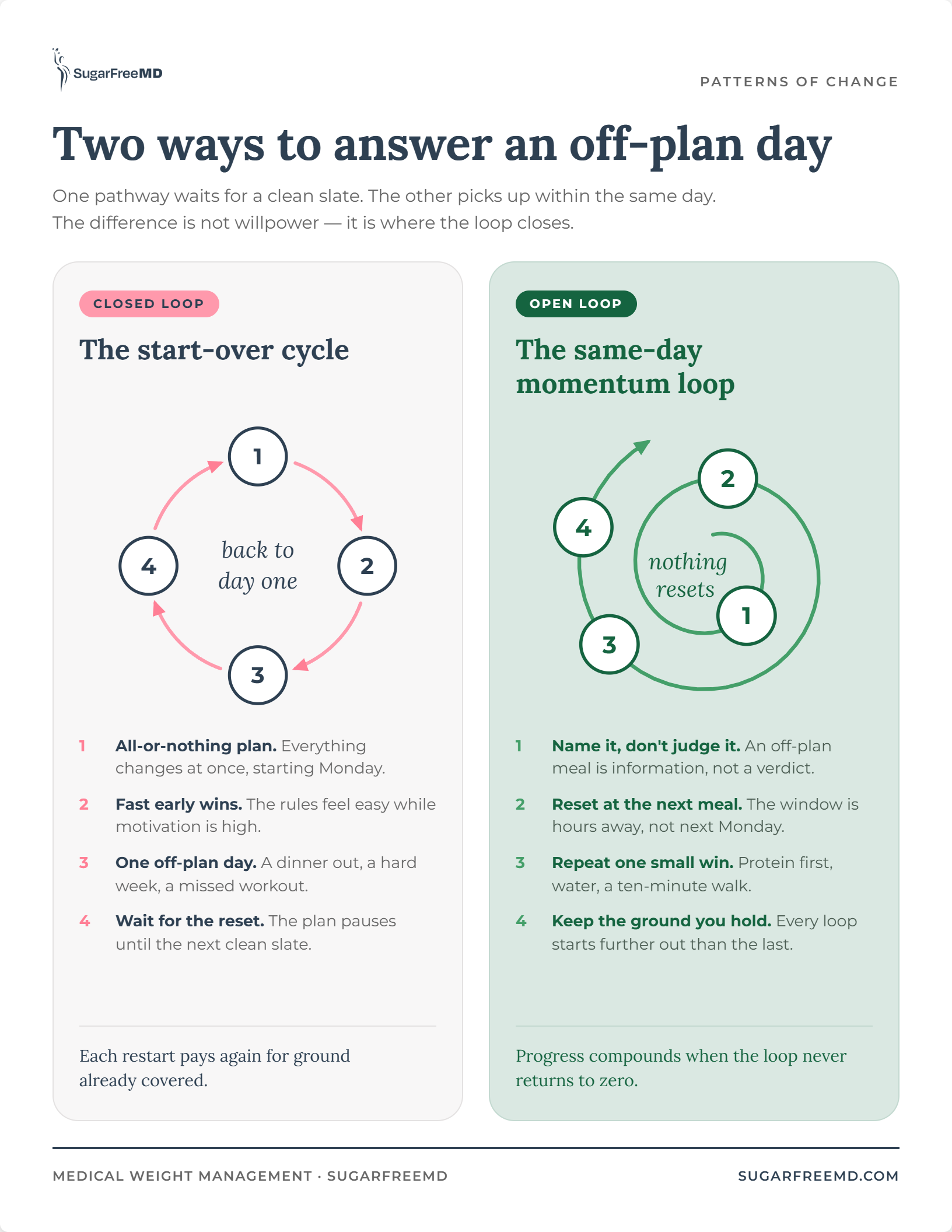
Diagram comparing the weight-loss start-over cycle with a same-day momentum loop.
Your Plan Only Works When Life Behaves
Structure helps.
A predictable weekday gives you natural cues. You wake up around the same time. You eat in familiar places. You know when work begins. You know where movement fits. Fewer choices require active thought.
Research on habit formation shows repeated actions in a consistent context become more automatic over time. The same study found one missed opportunity did not materially derail the habit-formation process.[1]
Translation: missing once does not erase your progress.
The trouble starts when your routine is the only reason your habits work.
A plan designed for quiet mornings, stocked refrigerators, full nights of sleep, and cooperative schedules will feel fragile during travel, illness, deadlines, holidays, weekends, and family chaos.
Life is not going to politely wait while you finish your meal prep.
Your plan needs flexibility.
You do not need the full routine every day. You need a version of your routine for the day you are living.
This is also why willpower is not the answer. Willpower asks you to solve every difficult moment in real time. A realistic system makes fewer decisions necessary in those moments.
Why a Stricter Restart Usually Makes Things Worse
After an off-plan meal or missed habit, the all-or-nothing brain has an interesting solution:
Make everything harder.
Eat less tomorrow. Add more food rules. Exercise longer. Remove every enjoyable food. Track more closely. Start earlier. Be more disciplined.
This feels responsible because it creates a sense of control.
It also makes the plan more difficult to repeat.
The next disruption now carries even more weight. If success requires perfect execution, one change threatens the entire system.
You do not need to earn your way back through punishment.
You also do not need to return to a routine which felt restrictive, exhausting, or unsustainable. Sometimes resistance holds useful information. A habit you remember as “successful” might have required hunger, excessive exercise, or constant mental effort.
Ask whether you miss the habit itself or only the result you associated with it.
A supportive walk you enjoyed is different from a crash diet you endured.
Return Instead of Restart
A restart treats the earlier part of your day as lost.
A return begins where you are.
Here is what a return looks like.
1. Name the Moment Without Naming Yourself
Replace:
“I am so inconsistent.”
“I have no discipline.”
“I always mess this up.”
Try:
“I had a hard moment.”
“My plan stopped fitting the day.”
“I did not know what to do next.”
This is not an excuse. It is a more accurate description.
Calling yourself inconsistent gives you nothing useful to solve. Naming the moment helps you find the missing support.
2. Reduce the Urgency
When you feel guilty, stressed, or overwhelmed, do not rush into another food rule.
Pause.
Take a few slow breaths. Step into another room. Drink some water. Walk outside for a minute. Put your hand over your heart and let the emotional intensity come down.
You do not need to solve your entire weight-loss journey in this moment.
You only need enough space to choose what comes next.
3. Choose the Next Best Action
Do not search for the next perfect action.
Choose the next supportive one.
If lunch did not go as planned, eat the dinner you already intended to eat.
If you missed your workout, walk for five minutes or stretch before bed.
If you had an unplanned snack after dinner, finish another normal evening anchor. Drink water, brush your teeth, prepare for sleep, or lay out what you need for tomorrow.
The goal is not to undo what happened.
The goal is to remain connected to yourself.
4. Use Same-Day Re-Entry
Return during the same day whenever an opportunity remains.
Do not wait for tomorrow simply because tomorrow feels cleaner.
If the moment happens at breakfast, return at lunch.
If it happens at lunch, return at dinner.
If it happens shortly before bed, complete one supportive evening habit instead of declaring the entire day lost.
Every same-day return gives your brain evidence:
“I do not quit after one hard moment.”
5. Skip Punishment and Overcorrection
Do not skip your next meal to compensate for overeating.
Do not add an intense workout as penance.
Do not tighten every rule.
Continue from where you are.
Punishment keeps the moment emotionally charged. A calm return helps make it ordinary.
And it is ordinary. Human beings eat differently than planned, miss habits, and have unpredictable days.
Nothing has gone wrong. You have reached the part where your real-life plan matters.
Build Three Versions of Your Weight-Loss Plan
Most people have one plan: the ideal one.
A plan built for real life needs more than one setting.
Your Normal-Day Plan
This is the fuller version of your routine.
It might include planned meals, a longer walk, food preparation, journaling, or a regular bedtime routine.
Use it when your schedule and energy support it.
Your Busy-Day Plan
This is the simplified version.
It might include:
- A pre-decided meal from your freezer
- A reliable restaurant order
- A shorter walk
- A filled water bottle at your desk
- An emergency snack in your bag, car, or office
- One meal built around food you find satisfying and nourishing
The busy-day plan is not a failed normal-day plan.
It is a successful busy-day plan.
Your Bare-Minimum Plan
Your bare minimum is the smallest action which helps you remain connected to your goal during a difficult day.
Examples include:
- Walk to the mailbox
- Take one flight of stairs
- Stretch for three minutes
- Fill your water bottle
- Eat one planned meal
- Pack one reliable snack
- Read one supportive thought from a note on your mirror
- Refuse to speak harshly to yourself
A bare-minimum habit is not your long-term aspiration.
It is your safety floor.
It gives you evidence you did not quit.
Your minimum still counts, even when your brain argues otherwise.
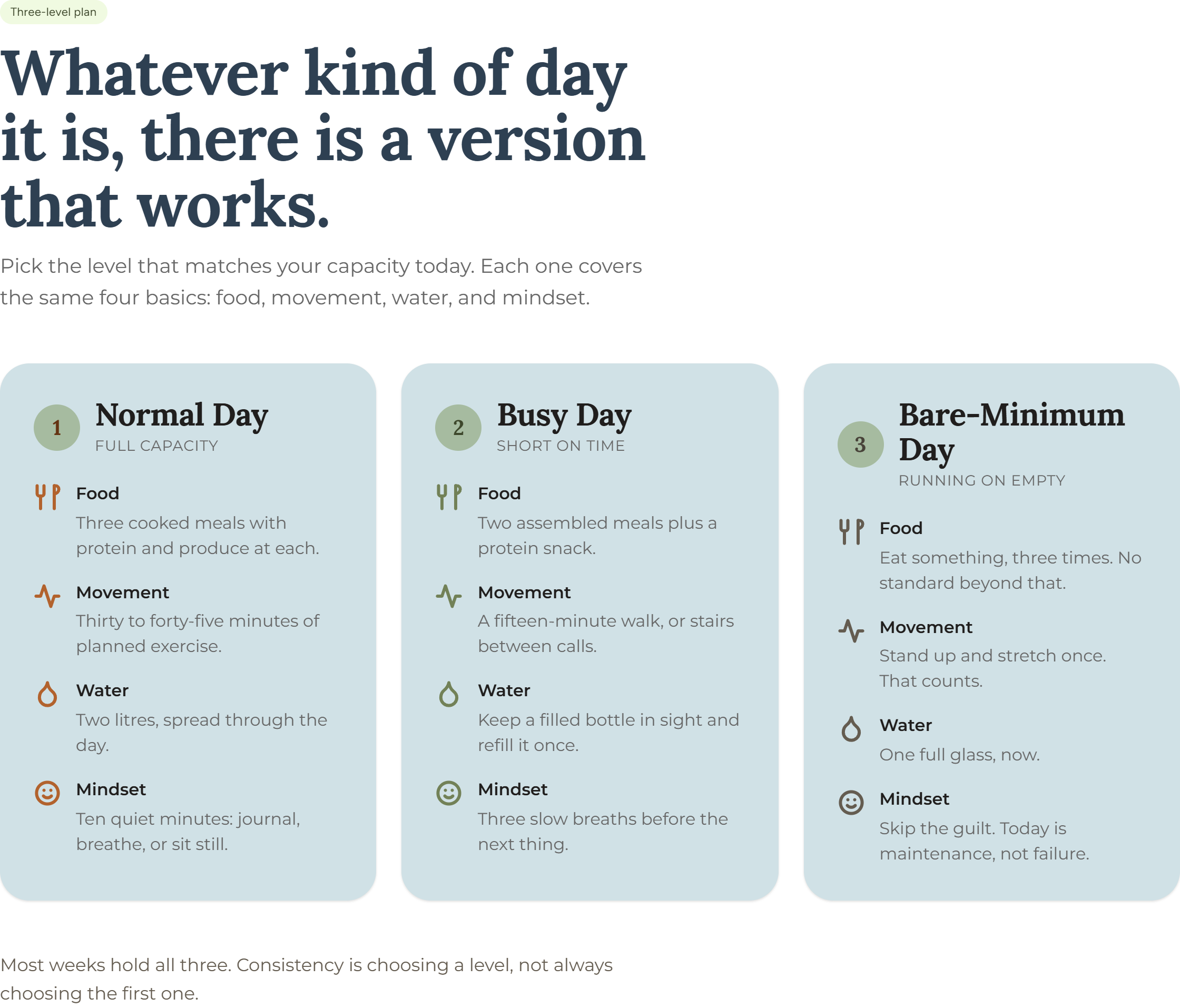 Three versions of a realistic weight-loss plan for normal, busy, and bare-minimum days.
Use Safety Nets for Predictable Problems
A safety net is a pre-decided response to a problem you already expect.
Researchers call a similar strategy an implementation intention. It follows a simple structure:
“When X happens, I will do Y.”
A meta-analysis of 94 independent tests found these if-then plans improved goal attainment.[2]
Your safety nets might sound like this:
- When a meeting runs through lunch, I will use the meal or snack stored in my office.
- When I miss my planned walk, I will stretch while my coffee brews.
- When the weekend loses its weekday structure, I will decide on breakfast and movement Friday evening.
- When I forget the lunch I packed, I will order one of my three default meals.
- When I hear, “I’ll start tomorrow,” I will choose one supportive action before bed.
- When I feel too tired for my full routine, I will switch to my bare-minimum plan.
You do not need a backup plan for every possible event.
Start with the problem which happens most often.
Then make the response simple enough to follow on a bad day. Your safety net should feel at least eight out of ten easy.
A complicated rescue plan is not much of a rescue plan.
Make Re-Entry Ridiculously Small
Restarting often feels hard because people try to return at 100 percent.
If you used to walk for 30 minutes, you think a return must also be 30 minutes.
If you used to prepare every meal, you think you must plan the entire week.
If you used to track everything, you think every detail must be tracked again.
Start smaller.
Walk for three minutes. Put your shoes on and check the mailbox. Fill the water bottle without setting a hydration goal. Put one planned item into your lunch bag. Open the journal and write one sentence.
The first job is to restart movement, not prove your fitness.
Small actions reduce the distance between intention and action. They also provide evidence of follow-through. Tiny commitments help rebuild trust because you are more likely to repeat them.
Visual cues help too.
Place your shoes by the door. Leave the water bottle on your desk. Keep your journal open. Put a reminder where your usual routine begins.
Make the supportive choice easier to notice.
“Never miss twice” is a useful reminder for protecting momentum, but it is not a moral rule. Missing two days, two weeks, or longer does not disqualify you.
Begin where you are. Make the first action small enough to do today.
Review the Moment With Curiosity
Once the urgency has passed, look back.
Ask:
- What changed?
- What was I feeling?
- Was I hungrier or more tired than expected?
- Which part of my plan became unrealistic?
- What option was missing?
- What would make this easier next time?
- Which safety net would help?
Curiosity gives you information.
Judgment gives you another uncomfortable emotion to manage.
A meta-analysis involving 94 peer-reviewed articles found positive associations between self-compassion and health-promoting behavior.[3] Compassion does not mean pretending every choice supports your goal. It means responding in a way which helps you learn and continue.
You are not letting yourself off the hook.
You are giving yourself a better hook.
Your 10-Minute Anti-Restart Plan
Use this simple process today.
Step 1: Name One Predictable Disruption
Choose the situation which most often leads to “I’ll start tomorrow.”
Examples include a busy workday, after-dinner eating, a loose weekend, forgotten lunch, poor sleep, or emotional overwhelm.
Step 2: Write Your Normal Plan
What do you usually intend to do when the day goes smoothly?
Keep it specific.
Step 3: Write Your Bare-Minimum Version
What is the smallest supportive version you are willing to count?
Choose something realistic for a difficult day.
Step 4: Add One If-Then Safety Net
Write:
“When __________ happens, I will __________.”
Choose a response which feels simple, available, and clear.
Step 5: Choose Your Same-Day Re-Entry Action
What action will remind you the day is not over?
Pick one now, before the next hard moment arrives.
What Consistency Actually Looks Like
Consistency is not perfect repetition.
It is not following the same routine under every condition.
It is staying in relationship with yourself as conditions change.
It is saying:
“This is not the routine I planned, but I am still here.”
A missed habit does not require a new identity.
An off-plan meal does not require a new Monday.
A difficult week does not require a harsher plan.
Your job is not to become a woman whose life never gets interrupted.
Your job is to become a woman who knows how to return.
Frequently Asked Questions
Why do I keep starting over every Monday?
Monday feels like a clean beginning, so it offers temporary relief from guilt and uncertainty. The cycle continues when you wait for Monday instead of choosing a small, supportive action during the current day. Same-day re-entry breaks this pattern.
What should I do after an off-plan meal?
Do not skip your next meal or punish yourself through exercise. Continue with your next planned meal or habit. Later, review what led to the moment and decide whether a safety net would help next time.
Do small habits count toward weight loss?
Small habits support consistency, self-trust, and the gradual development of routines. They do not need to produce a dramatic result in one day. Their value comes from being realistic enough to repeat.
How do I stay consistent when life is busy?
Build a busy-day plan before the busy day arrives. Decide on default meals, shorter movement, emergency food options, and one bare-minimum habit. Use fewer decisions, not more pressure.
Should I try never to miss two days in a row?
“Never miss twice” works as a momentum reminder. It should not become another perfection rule. One missed opportunity does not erase habit progress. If you have missed several days, return through one small action today.
References
- Lally P, van Jaarsveld CHM, Potts HWW, Wardle J. How are habits formed: Modelling habit formation in the real world. European Journal of Social Psychology. 2010;40(6):998-1009. https://doi.org/10.1002/ejsp.674
- Gollwitzer PM, Sheeran P. Implementation intentions and goal achievement: A meta-analysis of effects and processes. Advances in Experimental Social Psychology. 2006;38:69-119. https://doi.org/10.1016/S0065-2601(06)38002-1
- Phillips WJ, Hine DW. Self-compassion, physical health, and health behaviour: A meta-analysis. Health Psychology Review. 2021;15(1):113-139. https://doi.org/10.1080/17437199.2019.1705872
Want to Listen Instead?
Listen to Episode 137 of Weight Loss Made Simple, Why “I’ll Start Tomorrow” Keeps You Stuck.
Get Support for the Part Between Knowing and Doing
You might already know what to eat, how to move, and which habits support your health.
The difficult part is continuing when your schedule changes, your motivation drops, or one hard moment makes you want to quit.
This is exactly what we work on inside SugarFreeMD Lifestyle Support Monthly.
Inside the Membership, you receive doctor-led teaching, practical behavior-change support, accountability, and realistic systems for food, movement, mindset, and the messy days in between.
You do not need another perfect restart.
You need support building a plan you know how to return to.
Dr. Stacy Heimburger
Author
I'm a doctor and an advanced certified life and weight loss coach. I am board certified in internal medicine as well as lifestyle medicine and have additional training in anti-aging medicine. I'm passionate about helping women over 40 use a holistic approach to lose weight for the last time.
