
Why Trying to Lose Weight Alone Can Keep You Stuck

If you are used to being the person who figures things out, weight loss can be uniquely irritating.
You handle your career.
You manage schedules.
You solve problems.
People ask you for advice.
Then there is this one area where you know plenty about what you “should” be doing, yet you keep ending up in the same place.
So your brain gives you a perfectly logical solution:
“I just need to figure this out.”
Maybe you need to read one more book.
Find a better meal plan.
Listen to another podcast.
Get more disciplined.
Try harder.
And underneath all of that, there may be another thought you rarely say out loud:
“I should be able to do this by myself.”
I know that thought well.
For a long time, I believed needing help meant I had somehow failed to figure out something I should have been smart enough to solve.
But knowing a lot and seeing your own patterns clearly are not the same skill.
Sometimes the reason you are stuck is not a lack of knowledge.
You are simply too close to the problem.
“I Should Be Able to Do This Myself” Sounds Responsible
This thought is especially convincing if independence has served you well.
You studied harder.
You worked harder.
You solved the problem.
You figured things out.
That approach may have helped you build an entire life.
So when weight loss feels difficult, it makes sense that your first instinct is to apply the same strategy.
More effort.
More thinking.
More research.
More self-correction.
The problem is that behavior change is not an exam where knowing the correct answer automatically changes what happens Tuesday night after a stressful day.
You may already know that vegetables are good for you.
You may know movement matters.
You may know sleep matters.
You may know the difference between physical hunger and emotional eating.
You may know exactly what you intended to eat for dinner.
Knowledge is useful.
But knowledge cannot always show you why you keep abandoning your own plan in the same situation.
It Is Hard to Read the Label From Inside the Bottle
One analogy I use is trying to read a label from inside the bottle.
You are living inside your own thoughts.
You have repeated some of them so many times they no longer sound like thoughts.
They sound like facts.
“I never follow through.”
“I’m terrible at weekends.”
“I have no self-control around that food.”
“I should be further along by now.”
“I’m too busy.”
“I just need to get serious.”
“I need to lose the weight before I can feel confident again.”
If you have repeated a thought for years, you do not wake up every morning and evaluate whether it remains useful.
You simply operate from it.
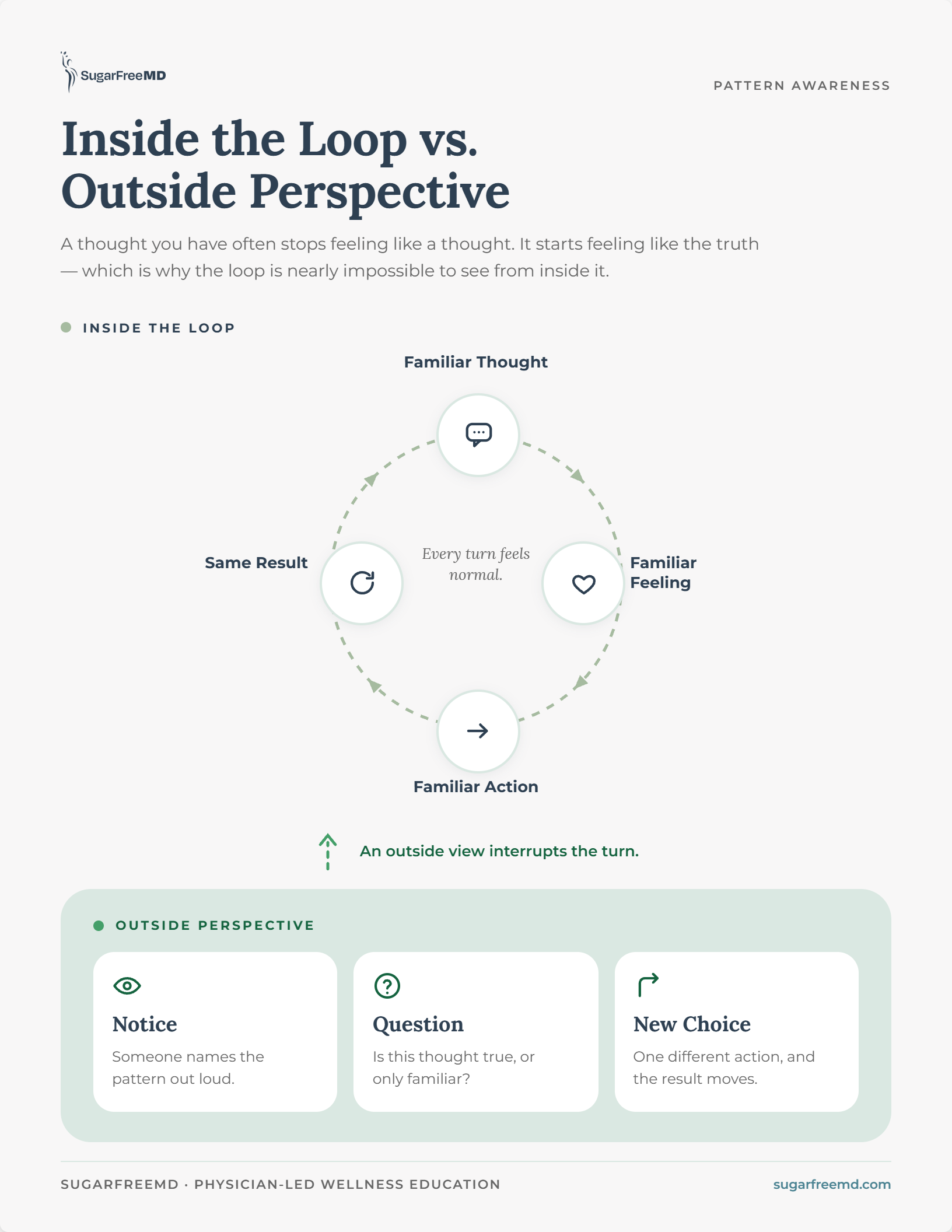
That thought influences how you feel.
How you feel influences what you do.
What you do produces a result.
Then the result appears to prove the original thought.
This is where THINK → FEEL → DO becomes incredibly useful.
A familiar thought creates a familiar emotional response.
That emotional response makes familiar behavior easier.
Then you keep getting familiar results.
Sometimes an outside person hears the sentence you have repeated for ten years and says:
“Wait. Why are we assuming that is true?”
And suddenly you see it.
Not because the other person is smarter than you.
They are simply not inside the bottle.
More Information Is Not Always the Missing Piece
There is an enormous amount of weight-loss information available.
You could spend the rest of your life reading about protein, metabolism, walking, strength training, hormones, meal timing, glucose, sleep, supplements, and whatever someone on social media discovered this morning.
Information can help.
It can also become a very sophisticated form of waiting.
You research instead of practicing.
You design another plan instead of examining why the last five plans collapsed in the same place.
You save recipes instead of asking why dinner becomes impossible every Wednesday.
You listen to another podcast instead of asking why one difficult eating decision turns into three days of giving up.
At some point, another piece of information has a smaller return than better feedback on the pattern you already have.
That is often where support becomes useful.
Support Does Not Mean Someone Tells You What to Eat
I want to separate support from another diet plan.
Support does not have to mean someone hands you a list of foods and watches whether you obey.
That is not what I mean.
Useful behavior-change support might help you:
- Notice a thought you have stopped questioning
- Identify where your plan keeps breaking down
- See an all-or-nothing pattern earlier
- Recognize when you are making a hard day mean something about your character
- Plan for predictable obstacles
- Separate physical hunger from emotional urges
- Build a smaller habit instead of quitting
- Follow through on something you already decided matters
- Stop turning every difficult week into a new beginning
You still make decisions.
You still build the skill.
The support gives you another angle.
Accountability Helps Because Follow-Through Is Hard
There is also a practical part of support.
Knowing that someone will ask how things went changes the structure around a behavior.
Research on weight-loss interventions has found higher adherence in programs that include supervised attendance and social support compared with programs lacking those elements.[1]
A 2023 systematic review of lifestyle-intervention adherence also identified social support, social accountability, individualized goals, and opportunities for social engagement among common facilitators of follow-through.[2]
That does not mean accountability is magic.
And it does not mean every supported program produces better weight loss.
A 2024 systematic review of social-support-based weight-loss interventions found mixed effects across different follow-up periods and concluded that stronger studies are still needed.[3]
So I am not promising that having a coach or accountability partner automatically changes your body.
I am saying that support changes the environment in which you are trying to change your behavior.
That matters.
Sometimes Independence Is Protecting You From Something
This is the part people do not talk about enough.
“I want to do it on my own” may genuinely reflect independence.
It may also protect you from discomfort.
Because asking for help means someone might see the part you are struggling with.
That feels vulnerable.
You might worry about judgment.
You might worry about spending money on yourself.
You might worry about investing time and then failing anyway.
You might worry that asking for support proves you are not as capable as everyone thinks you are.
Your brain looks at all of that uncertainty and says:
“Actually, let’s just keep Googling.”
Fair enough.
That feels safer.
You cannot fail at a program you never joined.
You cannot feel exposed in a conversation you never have.
You cannot regret an investment you never make.
But safety and progress do not always point in the same direction.
Sometimes waiting protects you from the possibility of disappointment while also protecting the current pattern from changing.
Waiting Has a Cost Too
We usually think of support in terms of what it costs.
Time.
Money.
Energy.
Vulnerability.
Those are real considerations.
But doing the same thing also has a cost.
Maybe you spend hours each week researching new approaches.
Maybe you repeatedly buy foods, supplements, books, programs, or apps hoping the next one will solve the problem.
Maybe you lose Sundays planning the perfect Monday.
Maybe the biggest cost is emotional.
You tell yourself you will start.
You stop.
You get frustrated.
You promise to get serious.
You start again.
Every round chips away at your trust in yourself.
This is why I want you to look at the full equation.
Not dramatically.
Factually.
What are you already spending on staying in the current cycle?
Time?
Mental energy?
Money?
Confidence?
Attention?
How long have you been waiting for the moment when you will finally feel ready to do something different?
High-Functioning Women Are Excellent at Normalizing Overload
There is another reason support matters.
If you are capable, you get used to carrying a lot.
You handle the work.
You manage the family.
You remember the appointments.
You solve the problem.
You make the reservation.
You bring what everyone forgot.
Then your habits begin slipping and your interpretation is:
“I need to get it together.”
You rarely ask:
“Is this actually too much?”
This is one of the strange side effects of being capable.
Your capacity becomes evidence that you should continue carrying more.
Then overload becomes normal.
When you are inside that life, you are often focused on getting through the day.
Someone outside the situation has a different view.
A spouse might notice you are exhausted before you name it.
A friend might hear how harshly you are talking about yourself.
A coach might notice that every “discipline problem” appears on days when you have no margin.
Support helps because another person has information you do not have.
They have the view from outside your day.
Control and Strength Are Not the Same Thing
“It is easier if I do it myself.”
I understand this thought too.
Sometimes it is absolutely true.
Explaining a task to someone else feels more difficult than doing it yourself.
But over time, control becomes expensive.
If you have to hold every plan, every responsibility, every decision, every health habit, and every emotional problem yourself, there is no margin left.
And then when something slips, you blame yourself for not controlling that too.
Strength is not measured by how little help you need.
One of the lines from my podcast I want you to remember is:
“Strength does not mean isolation.”
Being supported does not erase your capability.
It gives your capability somewhere to breathe.
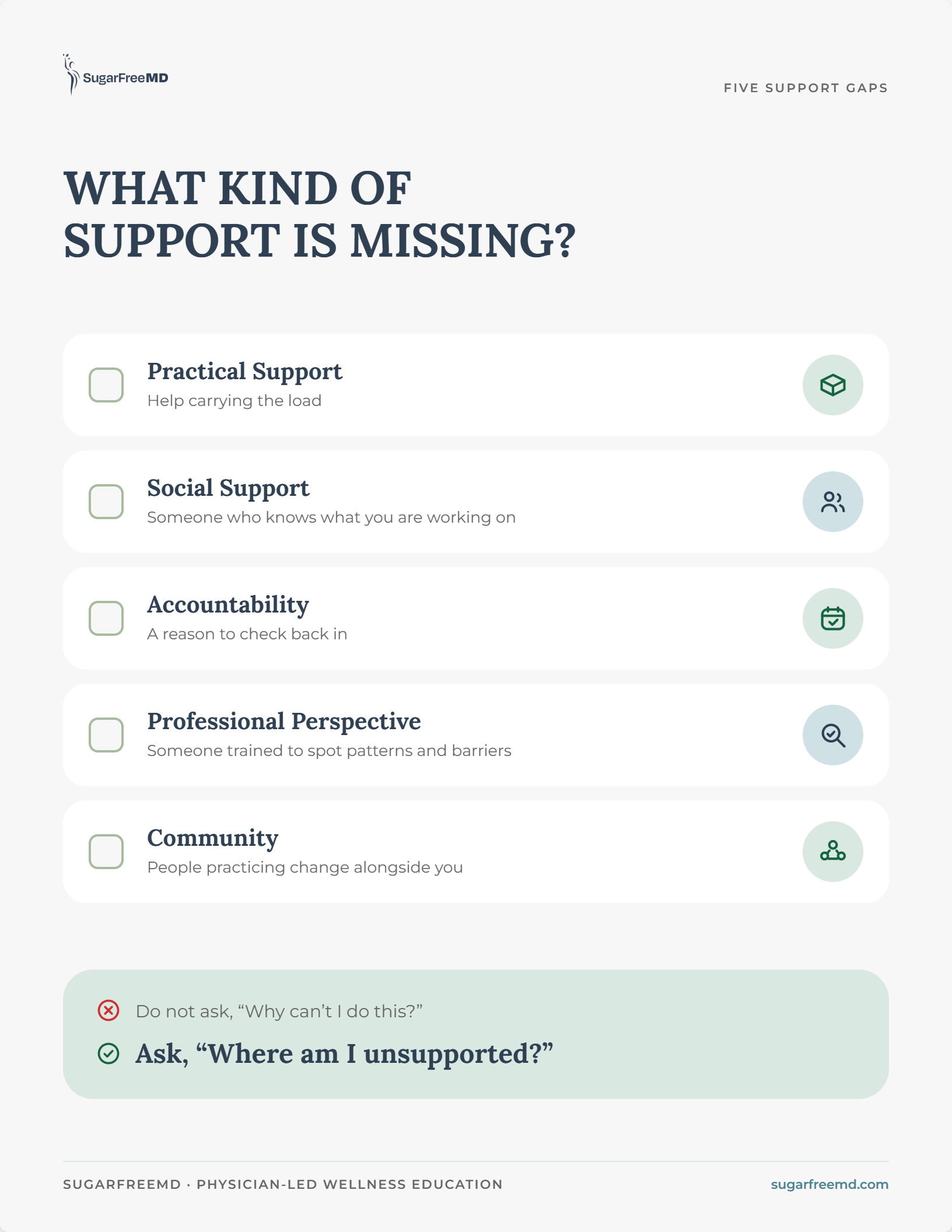
Not All Support Looks the Same
You also do not need the most intensive form of support for every problem.
Different gaps need different solutions.
You Might Need Practical Support
Maybe dinner keeps falling apart because you are doing every household task yourself.
Support might look like delegation.
You Might Need Social Support
Maybe your habits disappear because the people around you do not know what you are working on.
Support might be one honest conversation.
You Might Need Accountability
Maybe you make plans and quietly abandon them because nobody knows they existed.
A scheduled check-in might help.
You Might Need Professional Perspective
Maybe you understand the tactics but keep repeating the same thinking, emotional eating, perfectionism, or restart cycle.
This is where a coach, therapist, dietitian, physician, or another qualified professional might be useful depending on the problem.
You Might Need Community
Sometimes hearing another woman describe the exact thought you assumed belonged only to you is enough to change how you see the problem.
The point is not to collect people.
The point is to identify the gap.
Ask: Where Am I Unsupported?
Instead of asking:
“Why can’t I do this?”
Try:
“Where am I unsupported?”
Be specific.
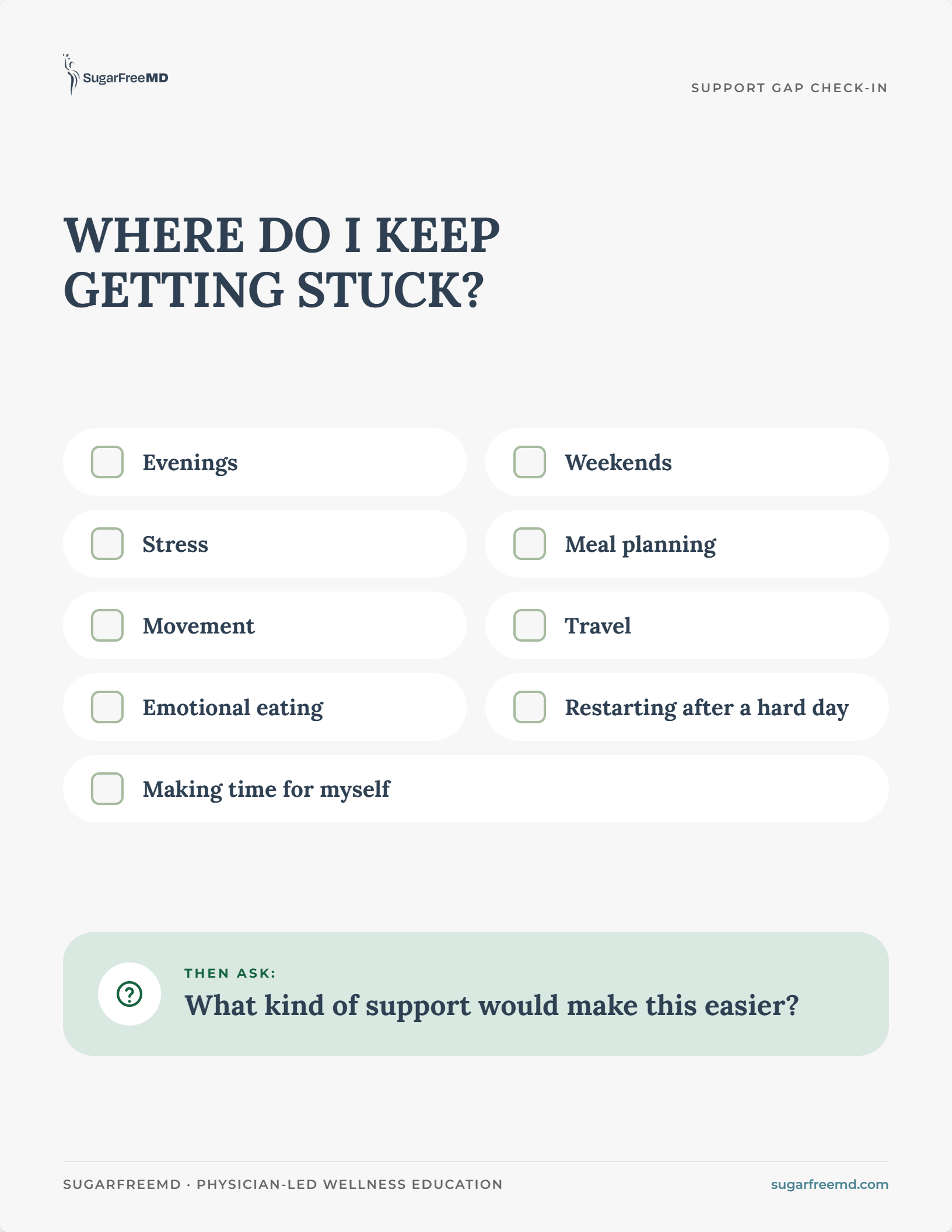
Is it evenings?
Weekends?
Meal planning?
Travel?
Stress?
Emotional eating?
Movement?
Following through after an imperfect day?
Making time for yourself?
Knowing whether your expectations are realistic?
Seeing the way you talk to yourself?
Then ask:
“What type of support would make this easier?”
That question is much more useful than another round of self-criticism.
Start With One Honest Conversation
Support does not have to begin with a giant commitment.
Start small.
Tell your spouse what you are struggling with.
Ask a friend to walk with you.
Tell someone the habit you are practicing this week.
Write your thoughts down and revisit them later.
Join a structured community.
Speak with a professional if the pattern feels bigger than the tools you currently have.
You do not have to solve the entire weight-loss problem in one conversation.
The first step is simply allowing the problem to exist somewhere outside your own head.
What Support Should Not Feel Like
Support should not make you feel smaller.
It should not rely on shame.
It should not make you afraid to admit what actually happened.
It should not require pretending every week went perfectly.
It should not take every decision away from you.
And it should not train you to believe you only succeed when someone else is watching.
Useful support should help you understand yourself better.
Over time, you should develop more skill, more awareness, more self-trust, and more ability to make decisions that fit your real life.
That is the goal.
You Are Still the One Doing the Work
Getting support does not mean someone else loses the weight for you.
Someone else cannot take your walk.
They cannot feel your feelings.
They cannot decide what you believe.
They cannot practice your habits.
They cannot build your self-trust for you.
You are still doing the work.
Support simply means you do not have to do all of the seeing, questioning, planning, troubleshooting, and recovering alone.
There is a difference.
A Simple Support Audit
Take five minutes and answer these questions.
1. Where do I keep getting stuck?
Name the situation rather than labeling yourself.
Not:
“I am inconsistent.”
Try:
“My evenings become unplanned after stressful workdays.”
2. What have I already tried?
Be honest.
How many times have you tried solving the same problem using the same type of solution?
3. What am I assuming I should be able to do alone?
Write the thought down.
4. What am I afraid support would mean?
Would it mean you failed?
That you are weak?
That someone might judge you?
That you might invest and still struggle?
5. What support gap exists?
Perspective?
Accountability?
Planning?
Community?
Clinical guidance?
Emotional support?
6. What is one way to close that gap?
One conversation.
One appointment.
One check-in.
One person.
Start there.
Frequently Asked Questions
Do I need a coach to lose weight?
No. People lose weight through many different approaches, and coaching is not required. The useful question is whether your current approach gives you enough structure, feedback, accountability, and perspective to make the changes you want.
Why do I know what to do but still struggle to do it?
Knowledge and behavior are different. Your actions are influenced by habits, environment, emotions, expectations, routines, stress, and repeated thought patterns. Knowing the desired behavior does not automatically remove those barriers.
Does accountability actually help with weight loss?
Research suggests supervised programs and social support are associated with better adherence to weight-loss interventions.[1] Evidence on weight outcomes from social-support interventions is more mixed, so accountability should be viewed as one useful component rather than a guaranteed solution.[3]
What kind of support is best for weight loss?
It depends on the problem. Some people need practical help or social support. Others benefit from structured accountability, nutrition guidance, medical evaluation, mental-health support, or behavior coaching. Start by identifying the specific place where you are stuck.
Is asking for help a sign that I failed?
No. Asking for help is a strategy. You still make your own decisions and practice your own habits. Support gives you access to feedback and perspective that are difficult to generate alone.
What if I am embarrassed to talk about my weight?
That discomfort is understandable. Start with someone you trust and choose a professional or support setting where the approach is respectful and non-shaming. You do not need to share everything at once.
References
- Lemstra M, Bird Y, Nwankwo C, Rogers M, Moraros J. Weight loss intervention adherence and factors promoting adherence: a meta-analysis. Patient Preference and Adherence. 2016;10:1547-1559.
https://pubmed.ncbi.nlm.nih.gov/27574404/ - Deslippe AL, Soanes A, Bouchaud CC, et al. Barriers and facilitators to diet, physical activity and lifestyle behavior intervention adherence: a qualitative systematic review of the literature. International Journal of Behavioral Nutrition and Physical Activity. 2023;20(1):14.
https://pubmed.ncbi.nlm.nih.gov/36782207/ - Jensen MT, Nielsen SS, Jessen-Winge C, et al. The effectiveness of social-support-based weight-loss interventions: a systematic review and meta-analysis. International Journal of Obesity. 2024;48(5):599-611.
https://pubmed.ncbi.nlm.nih.gov/38332127/
Want to Listen Instead?
Listen to Episode 130 of Weight Loss Made Simple, Why Trying to Lose Weight Alone Keeps You Stuck: https://weightlossmadesimple.buzzsprout.com/2259978/episodes/18999024-130-why-trying-to-lose-weight-alone-keeps-you-stuck
Maybe the Next Step Is Not Another Plan
If you have spent years trying to figure this out on your own, I do not want you leaving this article thinking you have failed because you needed support.
I want you to ask one question:
“Would an outside perspective help me see what I keep missing?”
If the answer is yes and you are looking for individualized support, I offer Private Coaching for women who want to work directly with me on the thoughts, habits, obstacles, and patterns keeping them stuck.
This is not another rigid diet plan.
It is a place to look closely at what is happening in your real life and figure out what would actually move you forward.
Email me at drstacy@sugarfreemd.com to ask about Private Coaching.
You are still responsible for your change.
You simply do not have to carry every part of it alone.

Dr. Stacy Heimburger
Author
I'm a doctor and an advanced certified life and weight loss coach. I am board certified in internal medicine as well as lifestyle medicine and have additional training in anti-aging medicine. I'm passionate about helping women over 40 use a holistic approach to lose weight for the last time.
