
Overstimulation and Emotional Eating: When Your Brain Needs Relief, Not Food

Dinner is over.
You ate enough.
You are not sitting there thinking, “Wow, my stomach feels empty.”
You are thinking:
“I need something.”
Something sweet.
Something crunchy.
Something comforting.
Something requiring absolutely nothing from you.
Before you turn this into another food problem, I want you to look at the rest of your day.
How many questions did you answer?
How many decisions did you make?
How many tabs were open on your computer?
How many were open in your brain?
How many times did someone need something?
How much noise, information, conversation, scrolling, driving, working, planning, remembering, and responding happened before you finally sat down?
Sometimes the food is not where the story starts.
Sometimes food is where an overloaded day ends.
What I Mean by Overstimulation
I am using overstimulation as a practical word here.
I mean a day filled with more input than feels manageable.
Noise.
Screens.
Notifications.
Conversations.
Decisions.
Work.
Children.
Schedules.
Errands.
News.
Podcasts.
Emails.
Texts.
An internal list of twelve things you need to remember tomorrow.
None of these things is automatically a problem.
The issue appears when there is no gap.
No transition.
No moment where your brain stops receiving, processing, planning, or responding.
By evening, you are tired of participating.
Then food appears.
Food is easy.
Food is immediate.
Food tastes good.
Food gives your attention somewhere else to go for a few minutes.
Of course it becomes appealing.
Mental Load Is More Than Being Busy
Being physically busy and carrying mental load are not quite the same.
Mental load includes the thinking behind everything.
Remember the appointment.
Buy the birthday gift.
Schedule the dentist.
Figure out dinner.
Respond to the school email.
Notice the dog needs medication.
Remember who needs to be where Thursday afternoon.
Research on mental labor in households has found women often carry a larger share of this cognitive work, especially around childcare and family management. Studies also link this unequal mental labor with greater stress and lower well-being.[1]
This is one reason “me time” sometimes does not feel restorative.
You left work.
Your body is sitting down.
Your brain is still running the household.
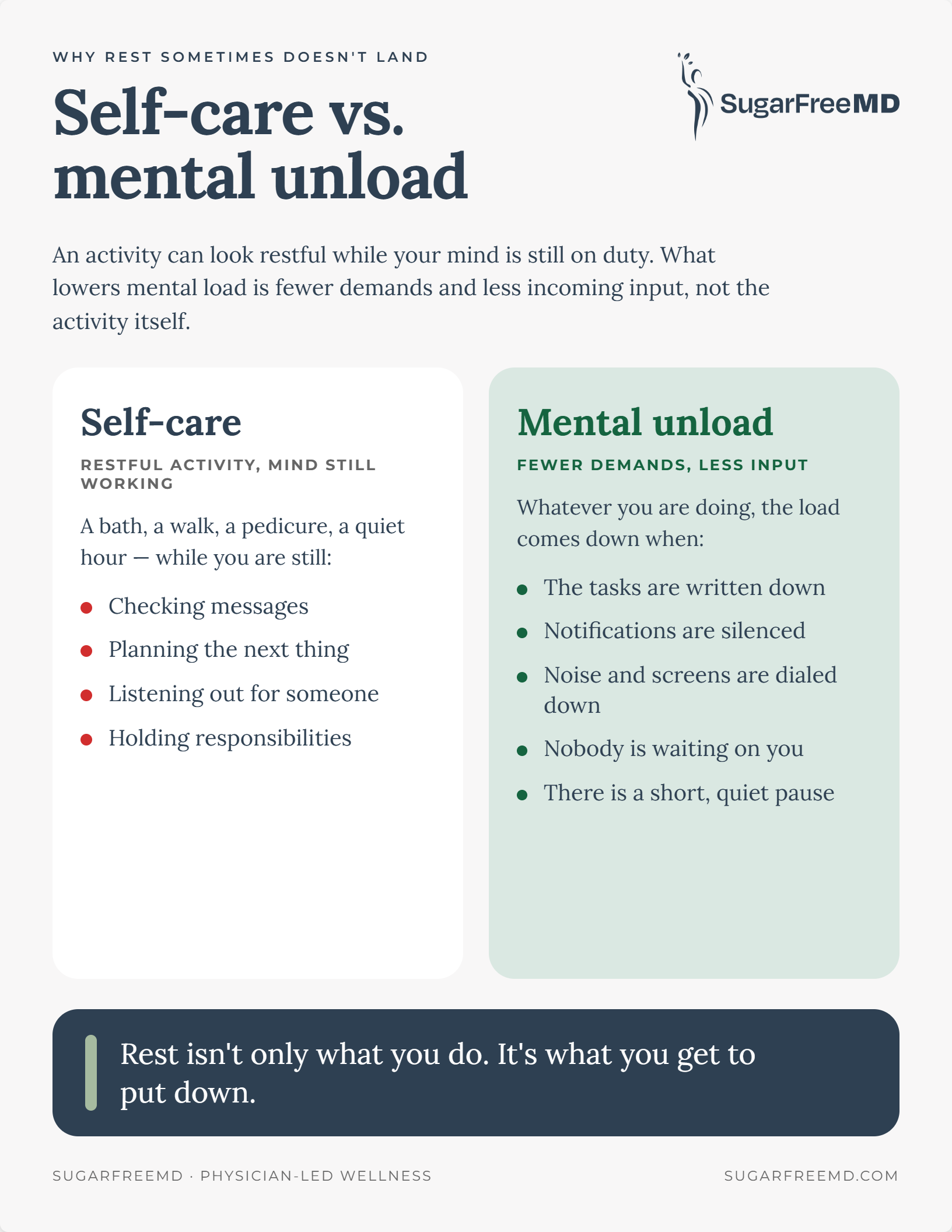
Self-Care and a Mental Unload Are Different
I talked about this in Episode 84 because I realized some activities I called self-care were not giving my brain much rest.
You might be getting a pedicure while answering emails.
Taking a bath while someone knocks on the door.
Walking while listening to an educational podcast because apparently even your walk needs professional development.
You are technically doing something for yourself.
Your brain is still working.
A mental unload is different.
The goal is fewer demands.
Less input.
Less responsibility for a short period.
You put down the invisible list instead of carrying it into a prettier room.
Your Brain Needs Somewhere to Put the Open Tabs
One reason mental load feels relentless is the number of unfinished loops you are carrying.
The appointment you need to schedule.
The email you need to answer.
The thing you are afraid you will forget.
The conversation you need to have.
The problem you have not solved.
Your brain keeps bringing them back because it does not want them disappearing.
So give them somewhere else to live.
Write them down.
Use a planner.
Make a brain dump.
Put the tasks somewhere you trust.
You do not have to finish them right now.
The point is giving yourself permission to stop holding them in active memory for a little while.
Then lower the input.
Five quiet minutes counts.
A silent drive counts.
Sitting outside counts.
Walking around the block without listening to anything counts.
You do not need a wellness retreat every Wednesday.
Why Food Feels So Good After an Overloaded Day
Food is rewarding.
It also provides sensory input of a different kind.
Taste.
Texture.
Smell.
Pleasure.
A familiar ritual.
Most important for this discussion, eating shifts your attention.
For a moment, you are no longer thinking about the email.
You are thinking about the cookie.
The problem did not disappear.
Your attention moved.
This helps explain why emotional eating works well enough to become a repeated pattern.
It gives temporary relief.
Research supports a relationship between stress and eating behavior, although the average effects are modest and people respond differently. A systematic review and meta-analysis involving more than 100,000 adults found stress was associated with slightly higher overall food intake, greater intake of less nutritious foods, and lower intake of healthier foods.[2]
Another recent meta-analysis found a moderate association between difficulty regulating emotions and emotional eating.[3]
Neither finding means every craving comes from stress.
It means stress and emotional regulation belong in the conversation.
Food Might Be Solving a Problem
This is where I want you to become curious.
Do not ask:
“Why do I keep doing this?”
Ask:
“What is the food doing for me?”
Is it giving you:
Relief?
Quiet?
Reward?
Comfort?
Something pleasurable after taking care of everyone else?
A transition between work and home?
A reason to sit down?
A way to stop thinking?
A moment where no one asks you for anything?
Those are real needs.
If we only remove the food, the need remains.
Then you are tired, overstimulated, and now also annoyed because you took away the thing your brain expected to help.
We need another source of relief.
First, Check the 3 F’s
Before deciding an urge is emotional eating, check what is happening.
I teach the 3 F’s of Eating:
Fuel
You are physically hungry.
Maybe lunch was six hours ago.
Maybe you were too busy to eat enough.
Maybe dinner did not satisfy you.
If you are hungry, eat.
The goal is not learning to ignore hunger.
Feelings
You want relief, comfort, distraction, reward, connection, or a change in how you feel.
This is where overload often shows up.
Flavor
You want something because eating it sounds enjoyable.
You are allowed to enjoy food too.
Sometimes more than one F is present.
The goal is not perfectly categorizing every bite.
The goal is understanding what is influencing the choice.
For a deeper explanation, read Why Do I Eat When I’m Not Hungry? Understanding Emotional Eating.
Work Backward From the Urge
Suppose you regularly want sweets around 8:30 p.m.
Most people begin the investigation at 8:29.
“What should I do instead of eating?”
I want you to rewind.
What happened at 7?
At 5?
At 3?
Was lunch rushed?
Did you work straight through the afternoon?
Was the drive home another hour of information?
Did everyone start talking to you the second you walked inside?
Did dinner happen in front of a screen?
Did you move directly from one role into another without a pause?
The eating moment gives you data.
Work backward until you find the place where adding a little space might help.
The Transition Is Often the Best Place to Reset
Transitions are incredibly useful.
Work to home.
School pickup to dinner.
Dinner to evening.
Kids’ bedtime to your bedtime.
Instead of waiting until the urge feels enormous, put a small reset earlier.
For example:
Work ends.
Before driving home, put your phone on focus for a few minutes.
Or drive without a podcast.
Sit in the car for two minutes before walking into the house.
Take one quiet loop around the block.
Lower the lights after dinner.
Put the phone somewhere else while you eat.
Step outside.
Take several slow breaths.
The exact activity matters less than the function.
You are intentionally reducing input.
You are telling yourself:
“We are not processing anything new for a minute.”
Make the Reset Small Enough to Use
Do not turn this into another elaborate self-care routine.
You do not need candles, special music, a matching journal, and 45 uninterrupted minutes.
If all of those sound delightful, enjoy them.
But your everyday reset needs to survive Tuesday.
Start with 90 seconds.
Three minutes.
Five minutes.
There is no scientifically magical number here.
You are testing whether a short interruption helps you arrive at the next part of your day less reactive.
That is useful information.
Try a Mental Unload Before Dinner
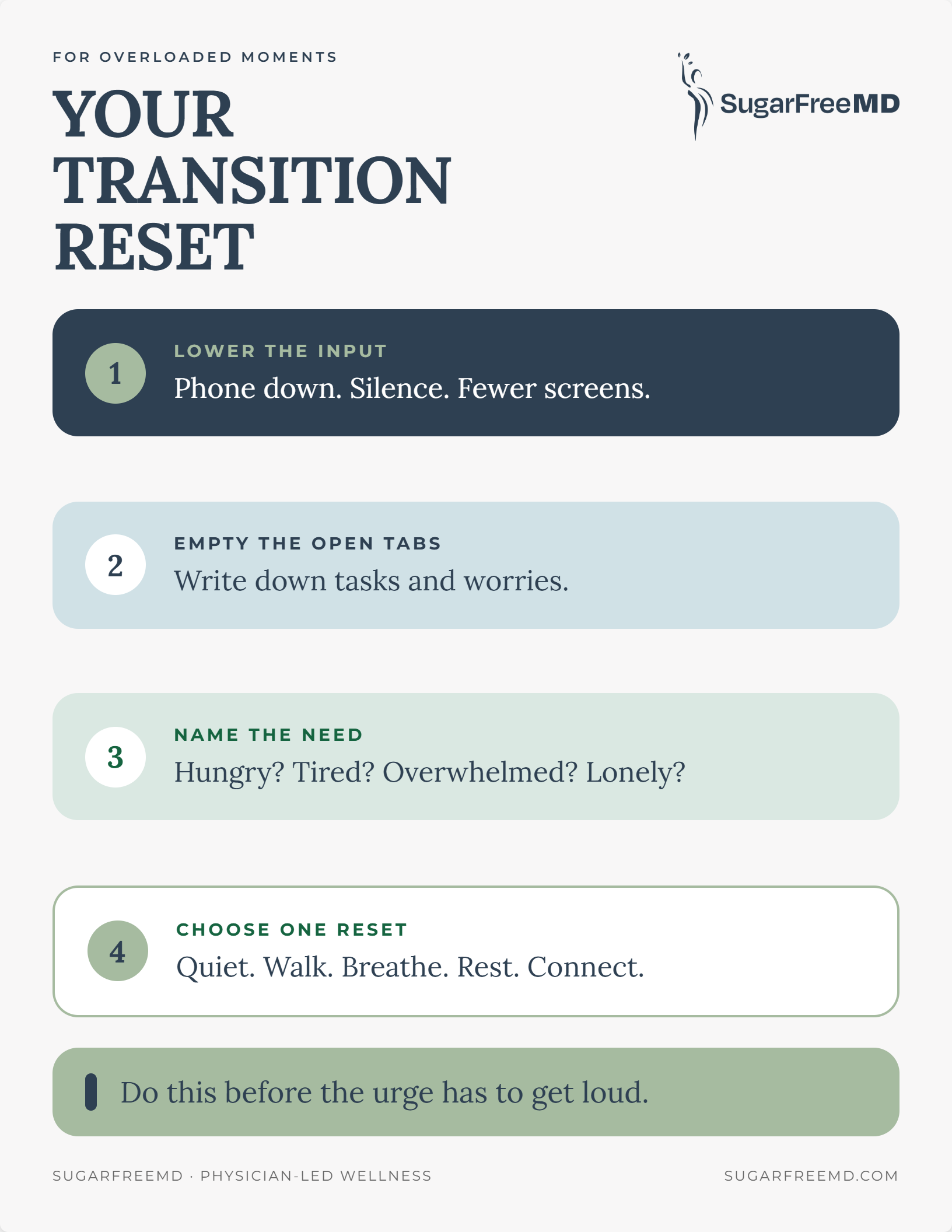
If your brain feels crowded, use this simple sequence.
1. Get It Out
Write down everything your brain keeps rehearsing.
Tasks.
Worries.
Reminders.
Things you need tomorrow.
No organizing required yet.
2. Decide What Does Not Need Attention Right Now
Some things genuinely need action tonight.
Many do not.
Give tomorrow’s problem permission to remain tomorrow’s problem.
3. Lower the Input
Put your phone down.
Turn off the news.
Skip the educational podcast.
Choose quiet.
4. Pause Before Moving Into the Next Role
You do not have to become employee, parent, partner, cook, cleaner, and emotional-support department in the same six seconds.
Give yourself a transition.
5. Check What You Need
Hungry?
Eat.
Exhausted?
Rest.
Lonely?
Connect.
Overloaded?
Reduce input.
Want dessert because dessert sounds delicious?
Decide intentionally.
The goal is choice.
Relief Does Not Have to Look Productive
This is difficult for high-achieving women.
We sometimes turn rest into another performance.
Our walk needs to hit a step goal.
Our bath includes a podcast.
Our quiet time becomes planning.
Our day off becomes errands.
Our journal becomes a self-improvement project.
Sometimes rest works better when nothing is being accomplished.
No multitasking.
No optimization.
No educational content.
No productivity disguised as wellness.
Your nervous system does not award bonus points because your downtime produced a spreadsheet.
Mindfulness Helps Most When It Helps You Notice
Mindfulness often gets presented as a fix for everything.
I do not need it to do everything.
I need it to help you notice sooner.
A 2026 systematic review and meta-analysis found mindfulness and mindful-eating interventions reduced food intake modestly in controlled studies, but they did not produce a significant effect on hunger or fullness. The authors also noted larger effects in laboratory settings and called for stronger real-world research.[4]
I find the practical takeaway much more useful than promising mindfulness will erase cravings.
Pause long enough to notice:
“I am overloaded.”
“I am physically hungry.”
“I want comfort.”
“I want quiet.”
“I am reaching for food because I need the day to stop.”
Now you have information.
What If the Food Urge Is Already Loud?
You do not need to wrestle it.
Pause before reacting.
Name what is happening.
“My brain wants relief.”
Then ask:
“What would give me relief besides food?”
Try one thing for a few minutes.
Silence.
A shower.
Walking outside.
Calling someone.
Changing clothes.
Music.
Lying down.
Writing everything on paper.
Turning off the screen.
Then check again.
You still get to eat.
This is not a delay tactic designed to prove you deserve food only if the craving disappears.
You are giving yourself more than one option.
What If You Eat Anyway?
Then you ate.
We do not turn this into a personality assessment.
We also do not respond by creating stricter food rules tomorrow.
Instead, look backward.
What was the day like?
Where did your mental load peak?
When did you first notice yourself running out of space?
What might have helped earlier?
Maybe next time the reset happens before the drive home.
Maybe you protect lunch.
Maybe Wednesday needs an earlier bedtime.
Maybe the television stays off during dinner.
Maybe everyone survives five minutes without access to you.
This is behavior-change work.
Notice.
Learn.
Adjust.
Emotional Eating Is Not Always About a Big Emotion
Sometimes emotional eating sounds dramatic.
People imagine grief.
Rage.
Heartbreak.
But the feeling might be:
Annoyed.
Over it.
Bored.
Touched out.
Mentally tired.
Unable to answer one more question.
Wanting something pleasant.
Wanting everyone to leave you alone.
Those experiences matter too.
You do not need a dramatic emotional crisis before relief-seeking makes sense.
Build Relief Into the Day Before You Need Rescue
This is the bigger shift.
Do not wait until 9 p.m. to discover you needed a break at 2.
Look for small places to reduce input earlier.
Close the laptop during lunch.
Take a short walk without your phone.
Turn one drive into quiet time.
Stop filling every empty minute with information.
Write down the tasks instead of mentally rehearsing them.
Put your phone on focus.
Take three minutes before entering the house.
Protect one small pocket where nobody needs anything from you.
You are not wasting time.
You are reducing the chance food has to become your only reliable off-switch.
A Five-Minute Overstimulation Audit
Look at the last time you ate for relief rather than physical hunger.
Then ask:
1. What happened during the three hours before the urge?
List the input.
2. What was I feeling?
Overwhelmed?
Tired?
Irritated?
Restless?
Lonely?
3. What did I want the food to give me?
Comfort?
Reward?
Quiet?
Distraction?
4. Where was the earliest place I might have paused?
Lunch?
Drive home?
Before dinner?
After bedtime?
5. What reset fits there?
Pick one.
Not five.
Practice the same one for a week and see what you learn.
Frequently Asked Questions
What does overstimulation feel like?
It often feels like having too much input and too little mental space. You might feel irritable, mentally tired, reactive, distracted, desperate for quiet, or unable to make one more decision.
Why do I crave food after a stressful day even if I ate dinner?
Physical hunger is only one reason people eat. Stress, emotional discomfort, habit, reward, food cues, and a desire for relief also influence eating behavior. Look at what happened before the craving instead of focusing only on the food.
How do I know whether I need food or a break?
Check your physical hunger first. Then ask what you hope eating will change. If you want energy or nourishment, food makes sense. If you want silence, comfort, distraction, or a transition out of work mode, another need might also be present.
Is emotional eating always bad?
No. Eating for comfort sometimes is part of being human. The pattern deserves attention when food becomes your main or only response to stress, creates distress, or repeatedly interferes with how you want to care for yourself.
How long should a mental unload take?
There is no required duration. Start small. A few minutes spent writing down open tasks and reducing incoming stimulation gives you a realistic place to begin.
What if I still want food after I take a break?
Decide from there. A reset is not a rule saying you are forbidden to eat. The goal is understanding the urge and giving yourself more than one possible response.
References
- Reich-Stiebert N, Froehlich L, Voltmer JB. Gendered Mental Labor: A Systematic Literature Review on the Cognitive Dimension of Unpaid Work Within the Household and Childcare. Sex Roles. 2023;88(11-12):475-494. DOI: 10.1007/s11199-023-01362-0. PMID: 37283733.
- Hill D, Conner M, Clancy F, et al. Stress and eating behaviours in healthy adults: A systematic review and meta-analysis. Health Psychology Review. 2022;16(2):280-304. DOI: 10.1080/17437199.2021.1923406. PMID: 33913377.
- Mendia J, Quiles Y, Pascual A, et al. Uncovering the association between broad emotional dysregulation and emotional eating: A meta-analysis. Appetite. 2026;221:108490. DOI: 10.1016/j.appet.2026.108490. PMID: 41643943.
- Ahmadyar K, Zhang Q, Ferriday D, et al. Effects of mindfulness and mindful eating on food intake and appetite: a systematic review and meta-analysis. Clinical Psychology Review. 2026;128:102780. DOI: 10.1016/j.cpr.2026.102780. PMID: 42341365.
Want to Go Deeper?
Listen to Episode 132 of Weight Loss Made Simple, Overstimulation Is Sabotaging Your Habits: Here’s How to Reset:
Before You Make Another Food Rule, Give Your Brain Somewhere to Land
If your hardest eating moments tend to happen after long, stressful, overstimulating days, I do not want your next solution to be another list of foods you are forbidden to eat.
Start earlier.
Look at where the noise builds.
Look at where you lose your recovery space.
Give yourself one real transition.
If evenings, stressful days, or emotional eating are where things tend to unravel, come join me for How to Stay Out of the Pantry at Night.
It is my free live teaching where we work through why these moments happen and how to build a realistic Safety Net for them.
Join the free Pantry workshop:
Dr. Stacy Heimburger
Author
I'm a doctor and an advanced certified life and weight loss coach. I am board certified in internal medicine as well as lifestyle medicine and have additional training in anti-aging medicine. I'm passionate about helping women over 40 use a holistic approach to lose weight for the last time.
