
Decision Fatigue and Food: Why Deciding What to Eat Every Day Makes Healthy Eating Harder
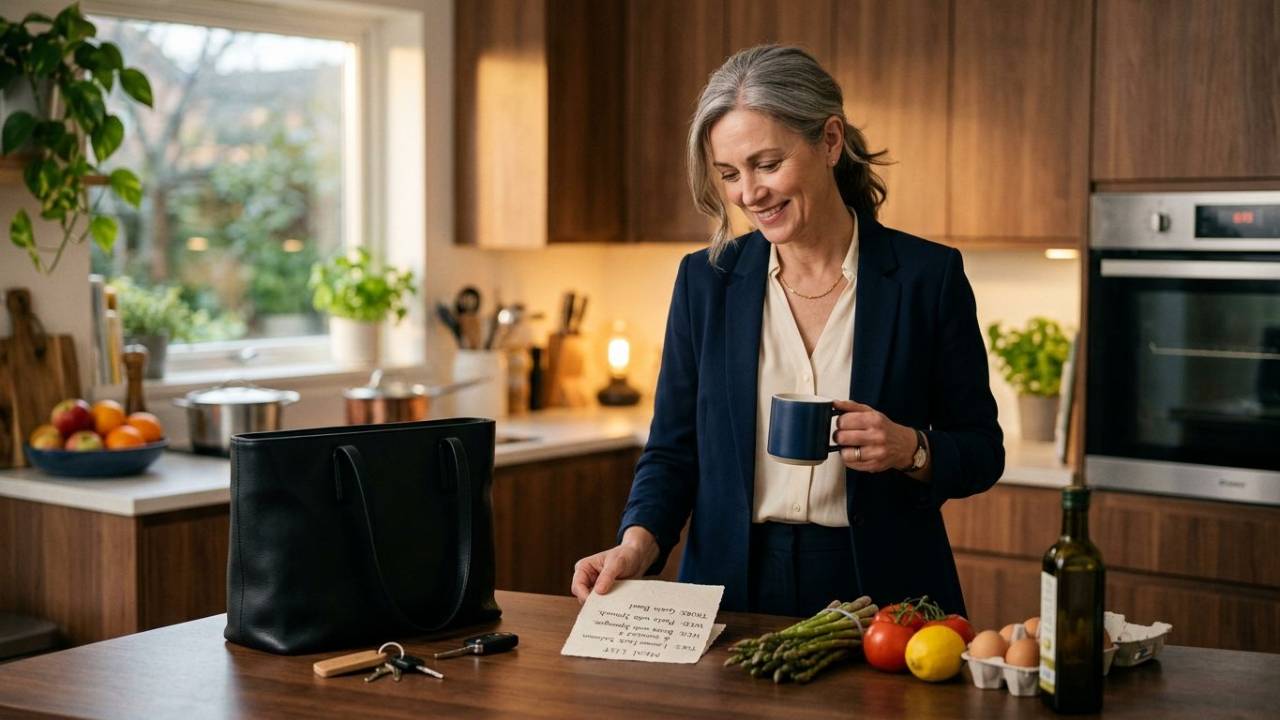
It is 6:18 p.m.
You have answered emails, solved work problems, made appointments, handled errands, responded to texts, remembered what everyone else needed, and made approximately four thousand tiny choices since breakfast.
Then someone asks:
“What’s for dinner?”
And your brain replies:
Absolutely not.
You open the refrigerator anyway.
There is food in there.
You know how food works.
You have made dinner hundreds, possibly thousands, of times.
Still, you stand there thinking:
“I don’t even know what to eat.”
I want you to stop interpreting this moment as proof you lack discipline.
Sometimes the problem is much simpler.
You are deciding too late.
What Is Decision Fatigue?
Decision fatigue is a term used to describe the strain people sometimes experience after repeated or difficult decision-making.
I want to be careful here because popular explanations often oversimplify the science.
You do not wake up every morning carrying exactly 47 excellent decisions, then run out at 5:12 p.m.
Human decision-making is more complicated.
A 2025 review focused on decision fatigue and food found surprisingly little direct research connecting the two in everyday eating situations. The authors described several plausible connections between cognitive strain and food choice, while emphasizing how much remains understudied.[1]
So I do not need you picturing a tiny decision battery draining inside your skull.
What matters in real life is easier to observe.
Choosing becomes harder when the choice itself is complicated, time is short, you are hungry, several people have opinions, useful options are unavailable, and your attention is already occupied elsewhere.
Dinner checks a lot of those boxes.
Food Decisions Are Bigger Than They Look
“What do you want for dinner?”
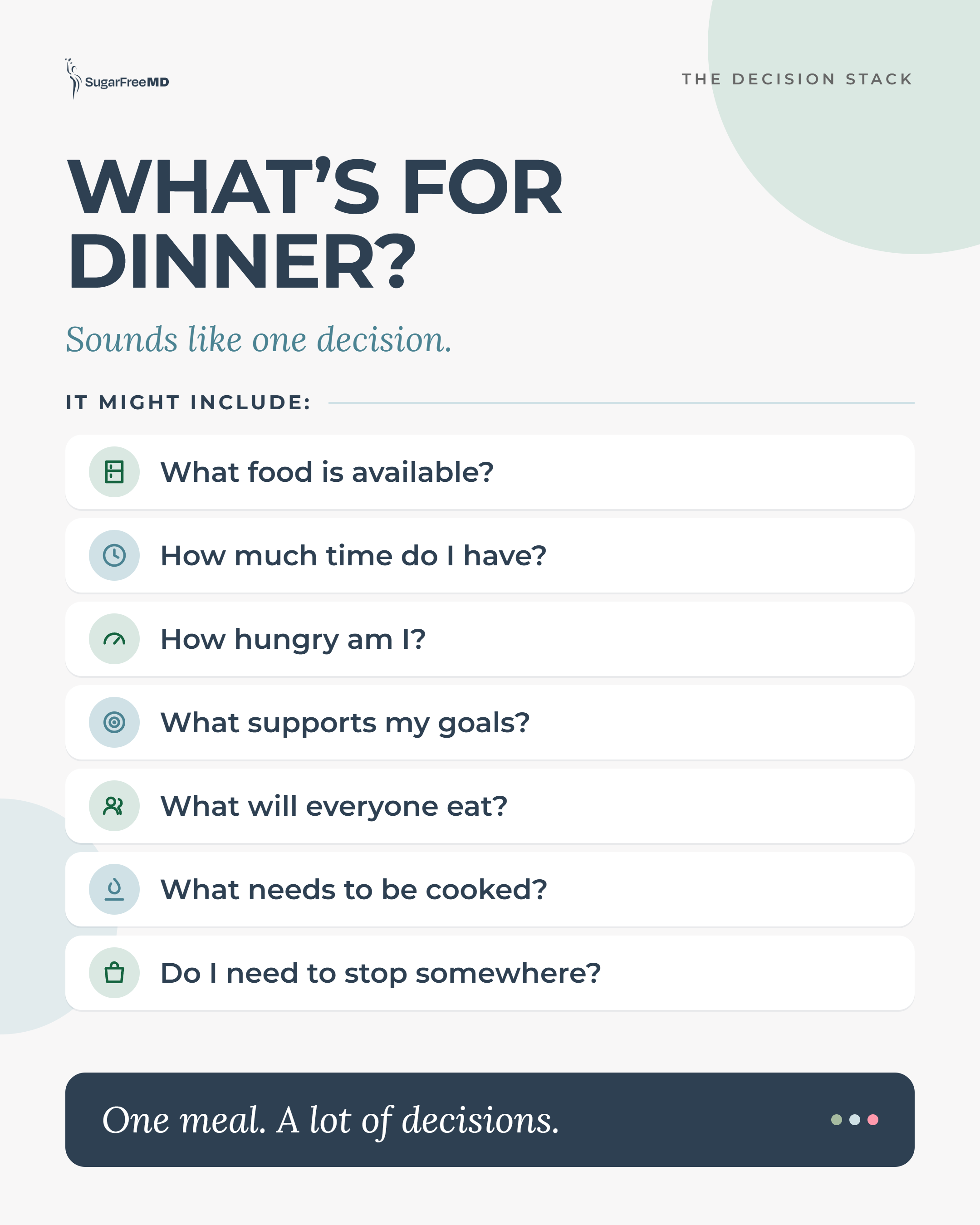
Sounds like one question.
It is not.
It is more like:
What food do we have?
What needs to be used before it goes bad?
How much time do I have?
How hungry am I?
What sounds good?
What supports my goals?
What will everyone else eat?
Who is cooking?
Do I need to stop somewhere?
Did I thaw anything?
How many dishes will this produce?
Is everyone going to complain?
Suddenly one tiny dinner decision has its own board meeting.
This is one reason food choices feel harder at the end of a full day.
A recent systematic review of reviews on food choice found factors such as availability, accessibility, time pressure, stress, price, and convenience influence what people eat.[2]
Your dinner choice is happening inside your life.
Of course the situation matters.
“I Know What to Eat. I’m Just Not Doing It.”
I hear some version of this all the time.
And I used to say it myself.
“I know what I should eat. I’m just not doing it.”
I want to challenge the second sentence.
Sometimes you are not refusing to follow through.
You reach a difficult moment without an easy enough option.
You finish work late.
You are hungry.
Dinner was supposed to involve several steps.
Nobody took anything out of the freezer.
Now your brain has to invent a new plan at the exact moment you have the least interest in inventing one.
So you grab something.
Order something.
Snack while figuring out dinner.
Or stand in front of the refrigerator for eight minutes before giving up.
Then you label the result:
“Inconsistent.”
I would label the missing piece differently.
No default.
Your Brain Loves an Easy Default
Familiar routines reduce how much active planning a behavior requires.
Think about brushing your teeth.
You are not standing in the bathroom every evening reviewing six oral-hygiene strategies.
You already know what happens.
Food routines work similarly.
Not because every meal needs to become boring or identical.
Because a familiar starting point removes friction.
Research on health-habit formation supports repetition as an important part of increasing automaticity over time, although the timeline differs widely between people and behaviors.[3]
This is why I love routines.
A routine answers a question before the question becomes urgent.
Monday dinner does not need a committee meeting if Monday dinner already has a familiar answer.
Indecision Creates Its Own Work
There is another layer here.
Sometimes we think refusing to decide saves us from making the wrong decision.
It does not always save mental energy.
The unresolved choice often keeps following us around.
What am I going to make?
Should I order groceries?
Should I prep?
Should I try a different eating plan?
Should I cook tonight?
Should I stop somewhere?
You have not made one decision.
You have carried the decision for six hours.
This is one reason small decisions are useful.
Instead of deciding your entire eating life for the next six months, decide Tuesday dinner.
Done.
You have removed one open tab from your brain.
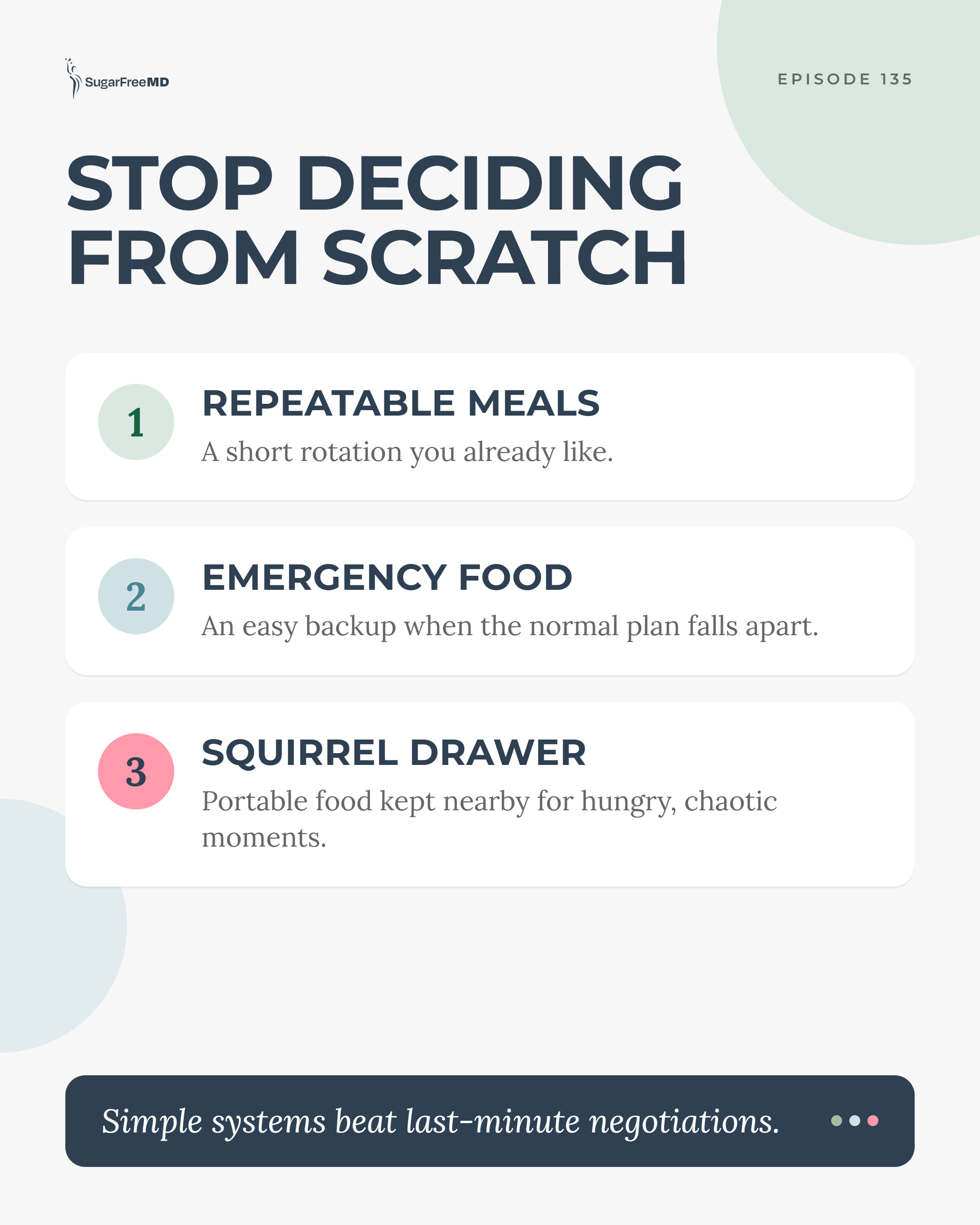
Stop Deciding From Scratch
One of the most useful shifts I teach around food is this:
Stop treating every meal like a blank sheet of paper.
You do not need infinite options.
You need enough reliable options.
There is an important scientific nuance here too. Research on “choice overload” does not show more choices are always worse. Effects depend on factors such as how difficult the decision is, how complex the options are, and how certain you feel about your preferences.[4]
Translation for your kitchen:
Twenty dinner options might feel delightful Saturday afternoon when you are relaxed and browsing recipes.
Twenty dinner options might feel terrible Wednesday at 7 p.m. when you are hungry and everyone is asking questions.
Context matters.
So give yourself a smaller decision when life is full.
System 1: Build Repeatable Meals
You do not need a brand-new breakfast every morning.
You also do not need an entirely original lunch every day.
Pick a few meals you like and rotate them.
For example:
Two or three breakfasts.
Two or three lunches.
A handful of dinners.
Then repeat them often enough for those choices to feel familiar.
This is not a forever contract.
You are allowed to change your breakfast.
Nobody from SugarFreeMD is coming to your house to enforce oatmeal until retirement.
You are reducing daily decision pressure.
One of my favorite routine examples from the podcast is incredibly ordinary.
Red beans and rice on Monday.
Tacos on another familiar night.
The point is not those foods.
The point is Monday already has an answer.
Variety Does Not Need to Happen Every Day
There is often a thought underneath meal planning:
“I don’t want to eat the same things.”
Fair.
Food is enjoyable.
Variety matters to many people.
But variety does not require reinventing every meal.
Think in rotations.
Week one has a few favorites.
Next week you swap one dinner.
Season changes?
Change the rotation.
Tired of a breakfast?
Replace it.
Your food routine is a short menu, not a prison sentence.
The sweet spot is enough choice to enjoy your food without requiring constant invention.
System 2: Keep Emergency Food
Your normal plan is not always going to happen.
Please plan for this fact instead of being surprised every single time life behaves like life.
Emergency food is your:
“I did not plan this perfectly, but I still have an option.”
It might be something frozen.
Something requiring almost no preparation.
A reliable grocery-store combination.
A familiar restaurant order.
Something already assembled.
The exact food depends on your needs, preferences, budget, health considerations, and household.
The important part is having an answer before the hard day arrives.
Your emergency meal should feel easier than abandoning the plan.
Your Backup Meal Is Part of the Plan
Women often treat emergency food as the inferior choice.
The “real plan” was cooking.
The freezer meal feels like failure.
No.
The freezer meal was Plan B.
You are following your plan.
This distinction sounds small, but it changes the story.
Instead of:
“I messed up dinner.”
Try:
“Tonight is an emergency-meal night.”
Done.
No guilt.
No dramatic Monday restart.
No need to prove anything tomorrow.
System 3: Build a Squirrel Drawer
This is one of my favorite names because it is slightly ridiculous and incredibly practical.
A Squirrel Drawer is a stash of reliable food kept somewhere useful.
Your office.
Your bag.
Your car, when storage conditions are appropriate.
Your travel bag.
A desk drawer.
The point is simple.
Do not wait until you are extremely hungry and stranded before asking yourself what to eat.
Keep something available.
In Episode 91, I talked about how busy weeks, travel delays, forgotten lunches, and schedule changes often leave us making food decisions under pressure.
Your Squirrel Drawer answers:
“What if the day goes sideways?”
You already know.
There is food.
Do Not Wait Until You Are Desperate to Make the Plan
Think about the difference between these two moments.
Sunday afternoon:
“What are three easy dinners we like?”
Tuesday at 7:16 p.m.:
“I am starving, everyone is hungry, and I have 14 minutes before we leave again. What should I cook?”
Same brain.
Different conditions.
Move important food decisions toward the easier moment.
This is the same reason advance planning works in behavior-change research.
Implementation intentions use a simple structure:
“When X happens, I will do Y.”
Meta-analytic research on eating behavior suggests these specific plans support healthy eating, especially when the desired response is clear and concrete.[5,6]
Your version might be:
“When clinic runs late, I use my freezer dinner.”
“When errands overlap lunch, I eat the food packed in my bag.”
“When I forget my lunch, I order one of my two familiar options.”
“When nobody has dinner ideas, Thursday defaults to our regular Thursday meal.”
You are giving Future You fewer problems to solve.
The Phone-It-In Plan Is Still a Plan
Some weeks deserve your full routine.
Other weeks need the phone-it-in version.
Travel delays happen.
Children get sick.
Work explodes.
Appointments run late.
Groceries remain unordered.
I do not want the response to be:
“Forget it. This week is ruined.”
I want:
“What is my easiest reasonable option?”
This is where safety nets matter.
A safety net is a pre-decided solution for a predictable problem.
Not perfection.
Not your dream dinner.
Enough support to prevent one chaotic moment from taking the rest of the week with it.
Make Healthy Eating More Boring in the Best Possible Way
There are parts of health I want to become boring.
I want grabbing your backup food to feel ordinary.
I want your repeat breakfast to require almost no thought.
I want your default restaurant order to feel obvious.
I want the emergency dinner to stop feeling like a crisis.
Boring means familiar.
Familiar often means easier to repeat.
And repetition matters more than building a Pinterest-worthy menu every week.
Your health does not need endless novelty to count.
One Decision Often Makes the Next Decision Easier
This is another reason I like starting small.
You do not need to figure out breakfast, lunch, dinner, snacks, travel, holidays, and restaurant eating in one sitting.
Pick one problem.
Dinner tends to fall apart?
Start there.
Pick three dinners.
Stock one emergency dinner.
Done.
Afternoons are the issue?
Build one portable backup option.
Breakfast is chaotic?
Choose one repeat breakfast for workdays.
One decision closes one loop.
Then you build from there.
What If Your Family Wants Different Food?
This is where simple structure helps again.
You do not need seven completely separate dinner plans.
Try a predictable framework.
For example:
One night has a familiar protein.
One night uses leftovers.
One night is a freezer or convenience night.
One night rotates between two family favorites.
People still have choices.
You have fewer decisions.
And if your household needs different foods because of allergies, medical needs, preferences, or other circumstances, build the same principle around your reality:
Which parts of the meal stay predictable?
Start there.
Convenience Is Not a Character Flaw
I want to say this clearly because women often make food much harder than necessary in the name of doing it “right.”
Bagged vegetables count as food.
Pre-cooked components count.
Frozen options count.
Rotisserie chicken counts if it works for you.
Individual portions count.
Prepared ingredients count.
Restaurant food exists.
Convenience has trade-offs depending on the food, cost, nutrition, and your individual needs.
But the presence of convenience does not make a meal morally inferior.
Current research on food-choice drivers repeatedly identifies time and convenience as meaningful influences on eating behavior.[2]
Work with reality.
Do not build an eating system requiring free time you do not have.
Reduce Decisions, Not Your Life
The goal is not removing every food choice.
You still get preferences.
You still get spontaneity.
You still get restaurants, celebrations, vacations, new recipes, and meals you have never eaten before.
We are reducing unnecessary repeated decisions.
Breakfast does not need to be exciting every Tuesday.
Emergency food does not need to win an award.
Your Squirrel Drawer does not need a brand identity.
They need to make your life easier.
Save your decision-making energy for the choices where you want it.
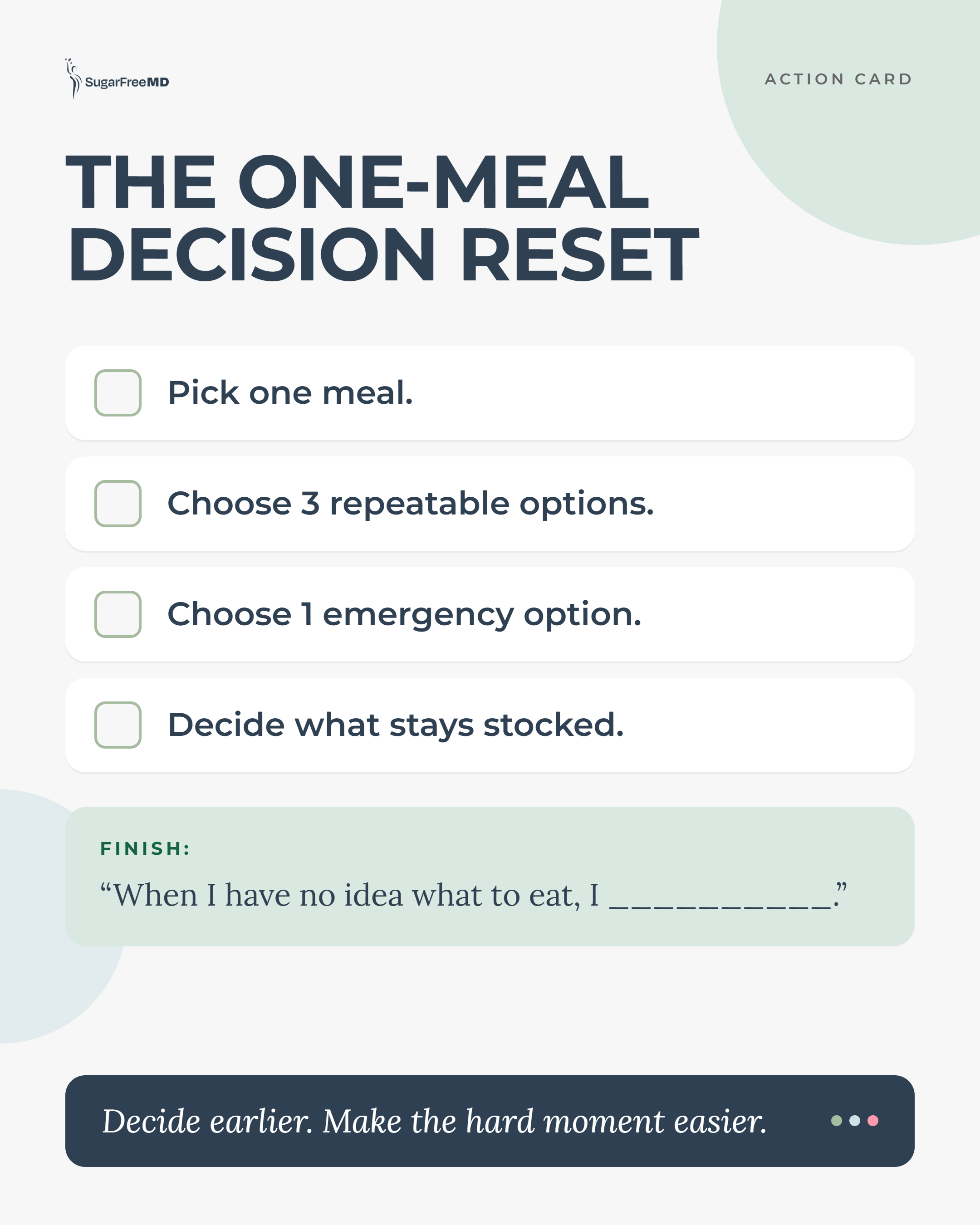
Try the One-Meal Decision Reset
Do this sometime today.
Pick the meal causing the most stress.
Not your entire food plan.
One meal.
Then answer four questions.
1. What are three repeatable options?
Choose foods you already eat and enjoy.
2. What is the emergency version?
What happens when the normal meal does not fit the day?
3. What needs to stay stocked?
Write a short grocery list.
4. What is the “I’m stuck” rule?
Finish this sentence:
“When I have no idea what to eat, I __________.”
Give yourself an answer.
You have now removed several future negotiations.
Frequently Asked Questions
Is decision fatigue around food scientifically proven?
Decision fatigue has been studied across several settings, but direct evidence involving everyday food choices remains limited. A 2025 narrative review described plausible links between cognitive burden and food choices while emphasizing significant research gaps.[1] It is best treated as a useful framework rather than a complete explanation for eating behavior.
Why is deciding what to eat harder at night?
Dinner often combines hunger, time pressure, accumulated responsibilities, limited ingredients, family preferences, and less available attention. Food-choice research identifies time pressure, stress, availability, accessibility, and convenience as important influences on eating decisions.[2]
Do I need to meal plan every meal?
No. A small rotation of repeatable meals often removes enough daily decision-making to help. Start with the meal causing the most friction.
Is eating the same breakfast every day unhealthy?
Repeating a meal does not automatically make the overall diet inadequate. Your nutritional needs depend on the full pattern of what you eat, along with individual health needs. A repeatable meal rotation still leaves room for variety across the week.
What should I keep as emergency food?
Choose foods matching your dietary needs, preferences, budget, storage situation, and health goals. The best emergency option is one you reliably keep available and are willing to eat on a difficult day.
What if my food plan falls apart anyway?
Use the easiest available safety net, then continue. One difficult meal does not require a new week, stricter rules, or punishment.
References
- Brasington N, Beckett EL, Pristijono P, Akanbi TO. The Effect of Decision Fatigue on Food Choices: A Narrative Review. Nutrients. 2025;17(24):3901. DOI: 10.3390/nu17243901.
- Parkes B, Morrish N, Frew E, Cornelsen L, Smith R, Medina-Lara A. Do the Drivers of Food Choice Differ Between Healthier and Less Healthy Foods? A Systematic Review of Reviews. Nutrition Reviews. 2026;84(8):1673-1695. DOI: 10.1093/nutrit/nuaf202.
- Singh B, Murphy A, Maher C, Smith AE. Time to Form a Habit: A Systematic Review and Meta-Analysis of Health Behaviour Habit Formation and Its Determinants. Healthcare. 2024;12(23):2488. DOI: 10.3390/healthcare12232488.
- Chernev A, Böckenholt U, Goodman J. Choice Overload: A Conceptual Review and Meta-Analysis. Journal of Consumer Psychology. 2015;25(2):333-358. DOI: 10.1016/j.jcps.2014.08.002.
- Adriaanse MA, Vinkers CDW, De Ridder DTD, Hox JJ, De Wit JBF. Do Implementation Intentions Help to Eat a Healthy Diet? A Systematic Review and Meta-Analysis of the Empirical Evidence. Appetite. 2011;56(1):183-193. DOI: 10.1016/j.appet.2010.10.012.
- Carrero I, Vilà I, Redondo R. What Makes Implementation Intention Interventions Effective for Promoting Healthy Eating Behaviours? A Meta-Regression. Appetite. 2019;140:239-247. DOI: 10.1016/j.appet.2019.05.024.
Want to Go Deeper?
Listen to Episode 135 of Weight Loss Made Simple, Stop Deciding What to Eat Every Day:
https://weightlossmadesimple.buzzsprout.com/2259978/episodes/19161527-135-stop-deciding-what-to-eat-every-day
Build a Food System You Don’t Have to Reinvent Every Day
Most women I work with do not need another lecture about what they “should” eat.
They need help making supportive choices easier on the days when work runs late, the refrigerator looks uninspiring, and everybody wants an answer at the same time.
This is exactly the kind of real-life troubleshooting we work through inside SugarFreeMD Lifestyle Support Monthly.
Inside the Membership, we focus on habits, consistency, realistic systems, and what to do when your normal plan stops fitting your actual day.
You do not need more food rules.
You need fewer moments where everything depends on making the perfect decision under pressure.
Learn more about Lifestyle Support Monthly:
https://www.sugarfreemd.com/LSM
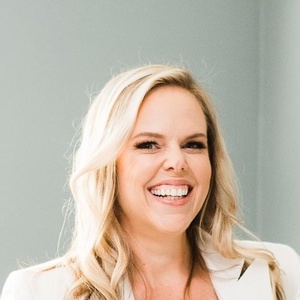
Dr. Stacy Heimburger
Author
I'm a doctor and an advanced certified life and weight loss coach. I am board certified in internal medicine as well as lifestyle medicine and have additional training in anti-aging medicine. I'm passionate about helping women over 40 use a holistic approach to lose weight for the last time.
