
Bare-Minimum Habits: How to Stay Consistent When Life Gets Busy

You planned to walk for 30 minutes.
Then work ran late.
You planned dinner.
Then somebody needed to be picked up, the groceries never got ordered, and suddenly it was 7:42 p.m.
You planned to journal before bed.
Then you got into bed tired enough to consider sleeping in your clothes.
And this is usually where the thought appears:
“Well, today was a wash. I’ll get back to it tomorrow.”
I want to give you another option.
Do less.
Yes. I am a doctor telling you to lower the bar.
On purpose.
Because the problem on a chaotic day is often not that you cannot do anything.
The problem is that the full version of your plan no longer fits, and your brain has decided anything smaller does not count.
That is where bare-minimum habits become incredibly useful.
They give you another version of success.
Your Plan Probably Works Beautifully on the Easy Days
Most of us build health plans for a fairly cooperative version of life.
You slept reasonably well.
You know what your workday looks like.
The refrigerator has food in it.
No one calls from school.
No flight gets delayed.
Nobody gets sick.
You have enough time and mental space to execute the routine.
Wonderful.
Then life changes.
Your schedule gets packed.
A meeting runs long.
Travel happens.
The weekend has almost no structure.
Your energy drops.
Now the routine that worked perfectly Monday suddenly feels impossible.
That does not automatically mean you are inconsistent.
It might mean you only have one version of the plan.
And that version was designed for your easiest days.
Bare Minimum Is a Strategy, Not Slacking
When I first teach this idea, women sometimes hear “bare minimum” and immediately translate it into:
Lazy.
Not enough.
Taking the easy way out.
That is not what I mean.
Think of a tightrope walker.
The safety net underneath her is not the performance.
Nobody bought a ticket to watch her lie in the net.
The net is there because falling is possible.
Your bare-minimum habit works the same way.
It is not your aspirational routine.
It is the safety net underneath it.
If the full routine works today, wonderful. Do it.
If the day starts crumbling around you, you already know the smaller version that still counts.
That changes everything.
A Baseline Is What You Return to on the Hardest Week
I also use the word baseline.
Your baseline is the minimum level of self-care you return to even when the week has gone completely sideways.
Not your best week.
Not your Pinterest week.
Not the week where you slept eight hours, meal prepped, exercised every morning, drank all the water, meditated, and somehow organized the junk drawer.
I am talking about the week where life is on fire.
What do you still do to take care of yourself?
That is your baseline.
And I want it to feel calm.
“This is what I do.”
Not:
“I HAVE TO DO THIS EVEN THOUGH EVERYTHING IS TERRIBLE.”
Different energy.
Why Doing Less Helps You Keep Going
Health habits become stronger through repetition.
A 2024 systematic review of health-habit formation found that repeated behaviors became more habitual over time, although the timeline varied enormously between people and behaviors. The review also found factors such as frequency, timing, individual choice, and behavioral regulation influenced habit strength.[1]
This is one reason I care more about repeatability than impressiveness.
The three-minute walk you repeat has more behavioral value than the elaborate routine you repeatedly abandon.
Your bare minimum keeps the behavior in your life.
It also gives you something else:
Evidence.
“I was busy, and I still did something.”
“I traveled, and I still took care of myself.”
“I had a hard week, and I did not completely disappear from my own life.”
That evidence matters because consistency builds self-trust.
Your Brain Is Going to Tell You It Does Not Count
Expect this.
You planned a 30-minute workout.
You stretched for three minutes.
Your brain says:
“That wasn’t exercise.”
You planned beautifully balanced meals.
You ate your backup snack because work exploded.
Your brain says:
“That wasn’t the plan.”
You intended to meditate for ten minutes.
You took three slow breaths before dinner.
Your brain says:
“Please. That barely counts.”
You get to decide what counts.
If the purpose of your bare-minimum plan is maintaining connection and continuity on a difficult day, then the three-minute stretch did exactly what it was supposed to do.
The mistake is grading your emergency plan against your ideal-day plan.
They have different jobs.
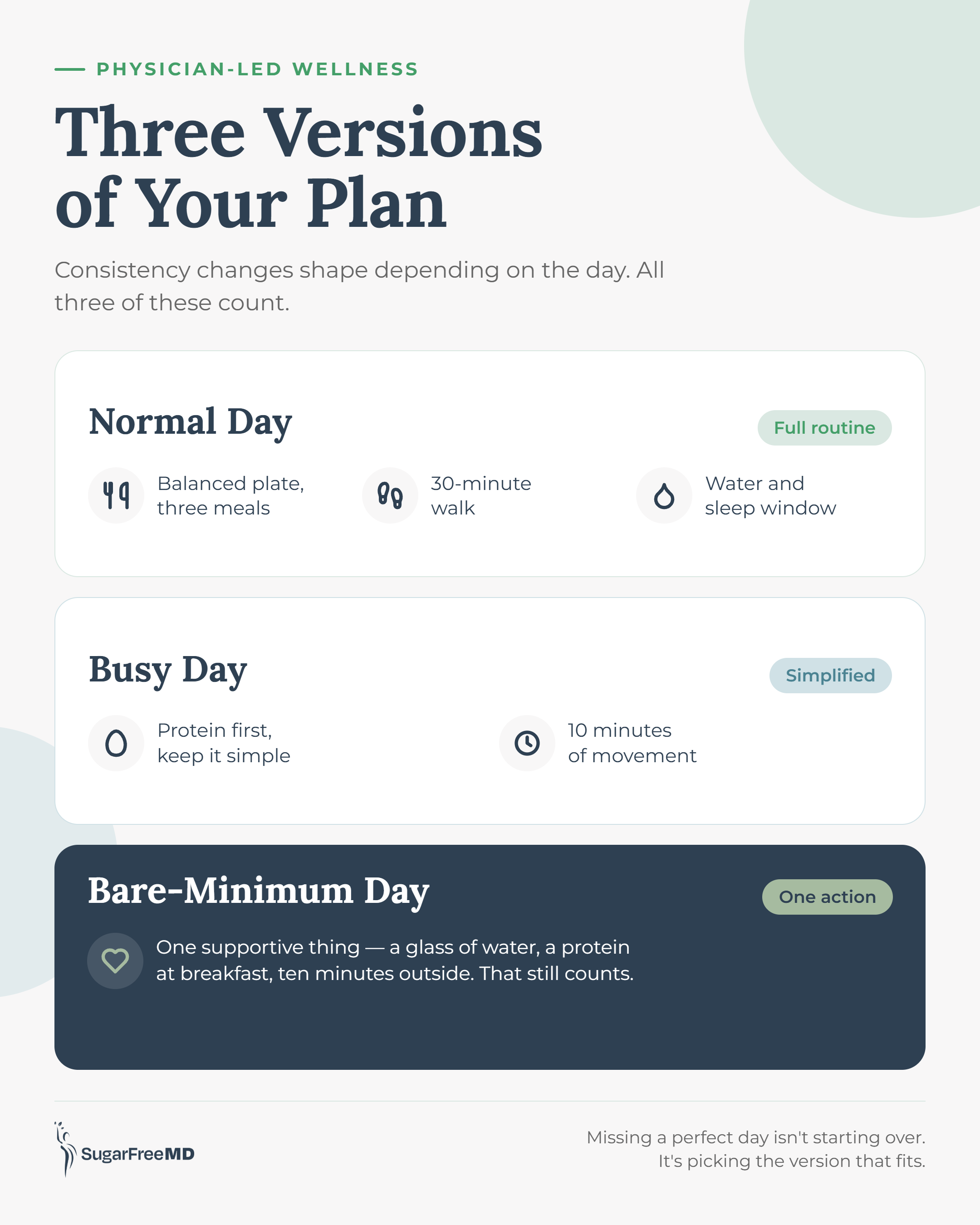
Build Three Versions of Your Plan
Most women have a Normal Day Plan.
I want you to add two more.
1. Your Normal-Day Plan
This is your fuller routine.
Maybe it includes:
- Your normal meals
- Planned movement
- Food preparation
- A regular sleep routine
- Mindfulness or journaling
- Whatever habits currently support you
Use this plan when the day has enough space.
2. Your Busy-Day Plan
This is the version for the day where time and attention are limited.
Make it simple, fast, and pre-decided.
For example:
Normal movement: 30-minute walk
Busy-day movement: 10-minute walk
Normal dinner: meal you cook at home
Busy-day dinner: reliable freezer meal or pre-decided restaurant option
Normal mindfulness: 10 minutes
Busy-day mindfulness: one minute before entering the house after work
You are not failing the normal plan.
You are successfully following the busy-day plan.
That sentence matters.
3. Your Bare-Minimum Plan
This is your floor.
You use it when you are sick, overwhelmed, traveling, exhausted, dealing with a family crisis, or having one of those days where you are surprised everyone made it to bedtime.
It needs to be almost embarrassingly easy.
If it still feels difficult, make it smaller.
The bare minimum might be:
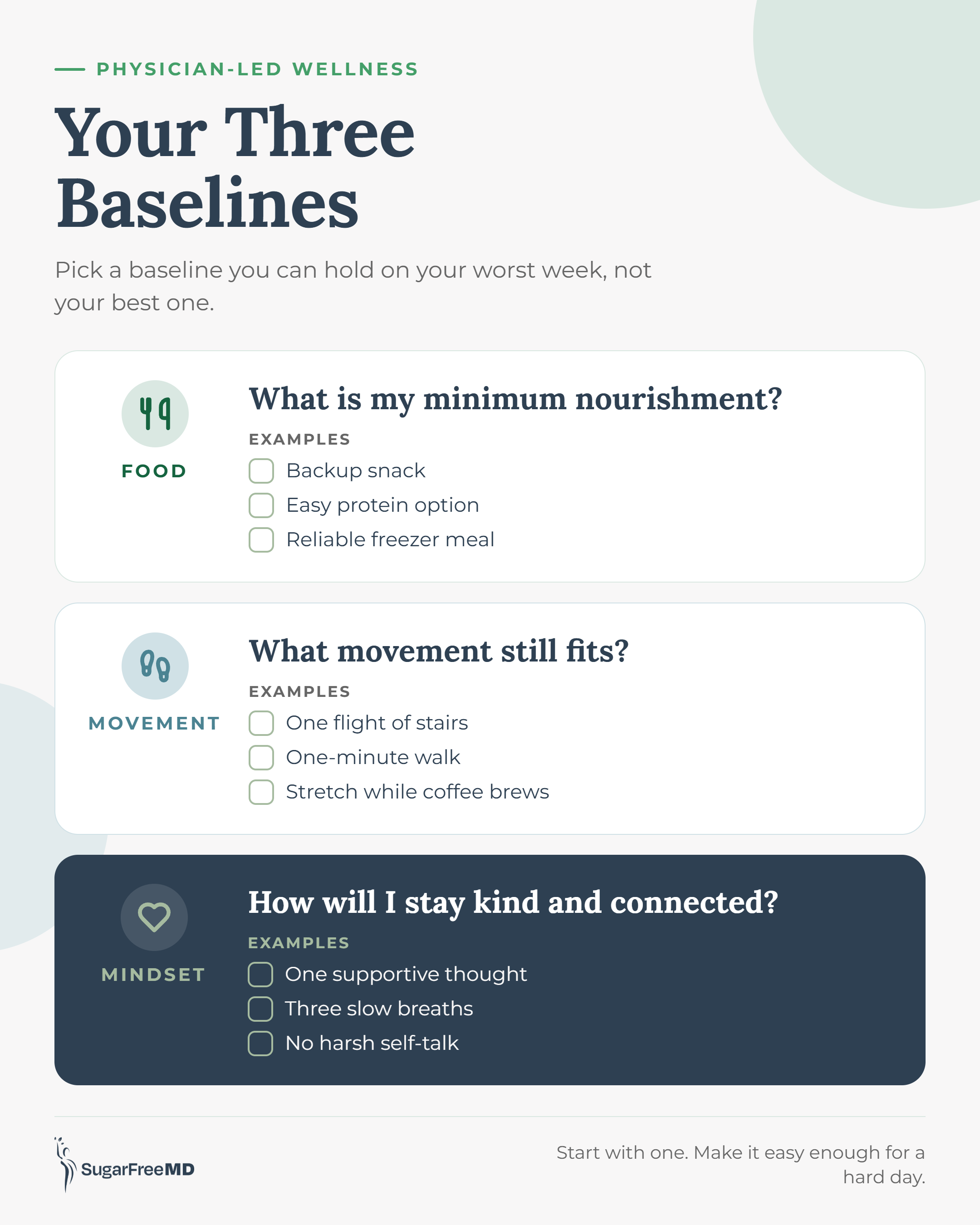
- One flight of stairs
- One minute of movement
- A stretch while the coffee brews
- One protein-containing food you keep available
- Filling your water bottle
- One pause before eating
- One deep breath
- Going to bed at your normal time
- Reading one supportive thought
- Refusing to speak harshly to yourself
That is enough for the plan you designed for the hardest day.
Start With a Food Baseline
Food gets chaotic quickly when life gets chaotic.
You miss lunch.
Now you are starving at 4 p.m.
There is no plan.
You grab whatever is easiest.
Then you decide the problem was your discipline.
I would rather solve the predictable problem earlier.
One of my own food baselines is remarkably unglamorous.
I keep nuts in my car.
My husband makes fun of me.
I also keep backup food at work.
Why?
Because sometimes work runs late.
Sometimes lunch does not happen when I thought it would.
Sometimes I need enough food to keep myself from reaching the point where every decision becomes:
“Feed me immediately.”
Your food baseline does not need to be a full meal plan.
It might be:
“I keep one reliable snack in my bag.”
“I keep protein available at work.”
“I have one easy freezer meal.”
“I eat enough during the day that I do not reach dinner completely ravenous.”
Think minimum nourishment.
What helps you avoid adding physical misery to an already difficult day?
Build a Movement Baseline
Movement is another place where all-or-nothing thinking gets loud.
If the workout was supposed to be 45 minutes, five minutes feels pointless.
It is not.
Inside SugarFreeMD, I talk about Opportunities to MOVE, or OTMs.
Movement does not only count when you change clothes, enter a gym, start a watch, and produce an impressive sweat situation.
Your bare-minimum movement might be:
- Take one flight of stairs
- Park farther away
- Walk one lap around the office
- Stretch while brushing your teeth
- Walk the dog on the short route
- March during part of a call
- Do five squats while coffee brews
- Set a one-minute movement timer
I have a baseline myself at the hospital: I take the stairs.
It is simple.
I do not need to negotiate it every time.
That is exactly what makes a baseline useful.
Research also suggests beneficial habits help people pursue longer-term goals with less reliance on effortful inhibition. In six studies, stronger habits involving behaviors such as exercise, healthy eating, and sleep helped explain the relationship between self-control and positive outcomes.[2]
You do not have to win a giant motivation battle every time you move.
Make some movement normal.
Do Not Forget Your Mindset Baseline
Food and movement get most of the attention.
Mindset is often the first thing we abandon.
Your week gets hard, and suddenly the way you talk to yourself becomes:
“This is ridiculous.”
“I am so inconsistent.”
“I should be doing better.”
“Why can’t I handle this?”
That is not helping.
A mindset baseline might be incredibly small.
Maybe you put one sentence on your mirror.
“I take care of myself even on hard days.”
Maybe you take three slow breaths.
Maybe you practice gratitude.
Maybe your entire mindset baseline is:
“I do not speak meanly to myself today.”
That counts.
Because one of the fastest ways to turn a hard day into a hard month is deciding the hard day says something terrible about you.
A Bare-Minimum Habit Should Feel Easy
If your minimum requires a color-coded calendar, two alarms, special equipment, 40 minutes, and excellent emotional stability, I have some disappointing news.
It is not your minimum.
Make it easier.
In Episode 136, I suggested using an eight-out-of-ten-easy test.
Look at the plan.
How easy does it feel?
Eight out of ten?
Nine?
Ten?
Good.
Four?
Shrink it.
Your hardest-day plan needs to fit your hardest day.
This is also where advance planning helps. Research on implementation intentions, simple “when X happens, I will do Y” plans, has found useful effects for goal-directed behavior, including healthy eating and physical activity.[3,4]
So decide before the difficult moment.
“When work runs late, I will use my backup food.”
“When I miss my normal walk, I will walk around the block.”
“When I am traveling, I will stretch before I get on the plane.”
“When I feel too overwhelmed for my routine, I will switch to my bare-minimum plan.”
Future You does not need another lecture.
She needs instructions.
Your Busy-Day Plan Is Not a Failed Normal-Day Plan
This distinction is worth repeating.
Suppose your normal plan includes:
A home-cooked dinner.
A 30-minute walk.
Ten minutes of journaling.
Then Tuesday happens.
Work runs long.
Your child needs something.
You have three unread texts and a school email asking for an item your child apparently needs tomorrow morning even though this is the first time you have heard of it.
You use your freezer meal.
Walk for seven minutes.
Take three breaths before bed.
Your brain says:
“Ugh. I barely did anything.”
No.
You followed the Tuesday-Is-On-Fire Plan beautifully.
That is a success.
We have to stop grading chaotic days by calm-day standards.
Bare Minimum Prevents the Start-Over Spiral
Without a minimum, the sequence often looks like:
The plan breaks.
You do nothing.
You feel guilty.
You decide you are inconsistent.
You promise to restart tomorrow.
Tomorrow becomes Monday.
Monday becomes next month.
A bare-minimum habit interrupts this sequence.
The plan breaks.
You switch plans.
You do the smaller version.
You have evidence that you stayed connected.
Then returning to your normal routine is an adjustment rather than a dramatic comeback.
That is a much easier relationship with consistency.
If the restart cycle feels familiar, read Why You Keep Starting Over With Weight Loss, and How to Stop.
What About Weekends?
Weekends are a sneaky version of busy.
They might not feel busy in the same way as work.
They are often simply less structured.
You wake up later.
Meals move around.
There are social plans.
You are running errands.
You do not want an elaborate schedule because it is the weekend and you would like everyone to leave you alone for five minutes.
Fair.
You still benefit from a few anchors.
Maybe your weekend baseline is:
- Eat a satisfying breakfast
- Take a walk sometime before lunch
- Carry your water bottle
- Pause before the first bite of dinner
- Use your normal bedtime within a reasonable range
You do not need to schedule Saturday in 15-minute increments.
Give the day enough structure that your habits have somewhere to land.
Bare Minimum Also Works During Travel
Travel is another place where women often suspend every habit and promise to restart when they get home.
Instead, decide what travels well.
Maybe you:
- Walk the airport before boarding
- Bring a reliable snack
- Take your water bottle
- Pause before eating
- Stretch in your hotel room
- Keep one normal morning anchor
Your baseline should travel better than your full routine.
That is part of the design.
What If You Are Actually Sick?
Bare minimum does not mean ignoring your body.
If you are ill, recovering from surgery, injured, or dealing with a medical issue, your health needs may change.
Sometimes the supportive choice is rest.
Sometimes your movement baseline becomes nothing because rest is what your body needs.
Sometimes your food plan changes because you are nauseated or have different medical instructions.
This concept is not permission to override legitimate physical limits.
The question remains:
“What does taking care of myself look like today?”
The answer changes.
That is flexibility.
Pick One Before You Pick Five
You do not need a food baseline, movement baseline, mindset baseline, hydration baseline, sleep baseline, clutter baseline, travel baseline, and twelve other things by tonight.
Please do not turn bare minimum into another giant project.
Pick one.
Choose the area that disappears first when life gets busy.
Maybe movement goes first.
Start there.
Maybe you forget to eat until you are frantic.
Start there.
Maybe your self-talk becomes brutal.
Start there.
Get one minimum so simple and familiar that you know exactly what to do.
Then add another if it helps.
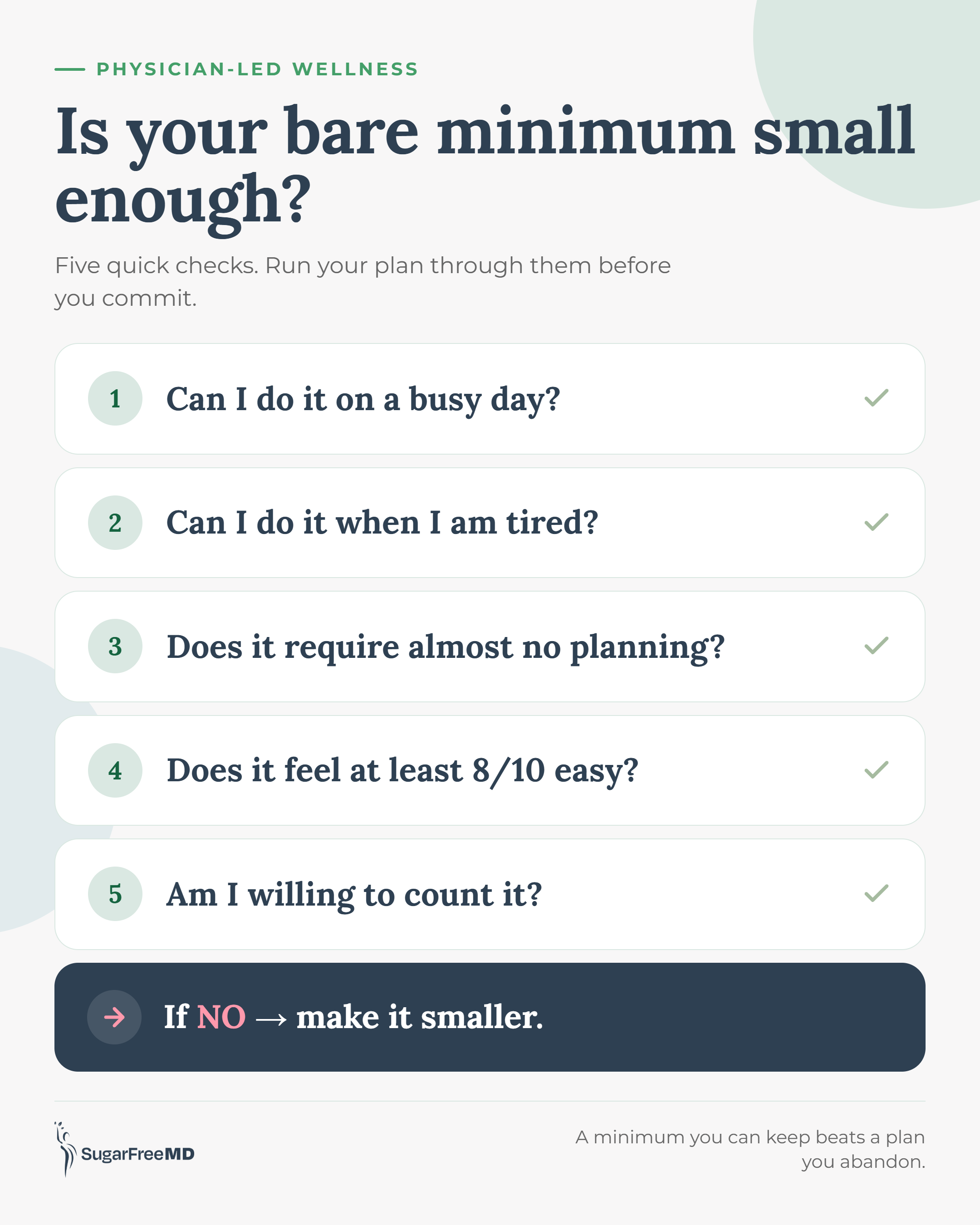
Your Bare-Minimum Habit Test
Take one habit you currently want to maintain.
Then ask:
1. What is my normal version?
Write down what you do on a regular day.
2. What is my busy-day version?
What shorter or simpler version fits a packed schedule?
3. What is my bare-minimum version?
What is the smallest version you are willing to count on a truly difficult day?
4. Does it feel at least eight out of ten easy?
If not, shrink it.
5. What will trigger it?
Attach it to something that already happens.
After I brush my teeth.
When I arrive at work.
Before I eat dinner.
When I get into the car.
When my coffee brews.
6. What will I tell myself afterward?
Try:
“I kept the promise.”
Not:
“That barely counted.”
Because your interpretation of the action matters too.
Consistency Does Not Mean Doing the Same Amount Every Day
I want to change your definition of consistency.
Consistency is not:
Thirty minutes every day.
Perfect meals every day.
Eight glasses every day.
Your complete routine every day.
Consistency is staying connected to yourself across different versions of your life.
Some days you have capacity for more.
Some days you have less.
Your plan should know the difference.
That is why I love baselines.
You do not have to wait until life settles down.
You already know what to do when it does not.
And on the hardest day, the goal might simply be:
“I did not quit on myself.”
That counts.
Frequently Asked Questions
What is a bare-minimum habit?
A bare-minimum habit is the smallest version of a supportive behavior you intentionally count during a difficult day. It serves as a safety net, rather than replacing your fuller routine permanently.
Is doing the bare minimum being lazy?
No. The purpose is strategic. You are deciding in advance how to stay connected to a behavior when your normal routine does not fit the day.
How small should a bare-minimum habit be?
Small enough to do on one of your hardest realistic days. If the habit still creates resistance or requires too much planning, reduce it again.
Should I have bare-minimum habits for food and exercise?
You might. I often teach food, movement, and mindset baselines, but you do not need all three at once. Start where your routine tends to disappear first.
Do small habits actually matter?
Small repeated actions help maintain continuity and provide opportunities for habits to strengthen over time. Habit-formation research also shows substantial individual variation, so there is no universal number of days required for a habit to become automatic.[1]
What is the difference between a busy-day plan and a bare-minimum plan?
A busy-day plan is a simplified version of your routine for predictable time pressure. A bare-minimum plan is the floor you use during unusually difficult days when even the busy-day version does not fit.
What if I miss my bare minimum too?
You return at the next opportunity.
The minimum is a support tool, not another perfection rule.
Missing it does not mean you failed.
It means today gave you information.
Adjust the plan if needed and continue.
References
- Singh B, Murphy A, Maher C, Smith AE. Time to Form a Habit: A Systematic Review and Meta-Analysis of Health Behaviour Habit Formation and Its Determinants. Healthcare. 2024;12(23):2488. DOI: 10.3390/healthcare12232488.
- Galla BM, Duckworth AL. More Than Resisting Temptation: Beneficial Habits Mediate the Relationship Between Self-Control and Positive Life Outcomes. Journal of Personality and Social Psychology. 2015;109(3):508-525. DOI: 10.1037/pspp0000026.
- Carrero I, Vilà I, Redondo R. What Makes Implementation Intention Interventions Effective for Promoting Healthy Eating Behaviours? A Meta-Regression. Appetite. 2019;140:239-247. DOI: 10.1016/j.appet.2019.05.024.
- Belanger-Gravel A, Godin G, Amireault S. Impact of Implementation Intentions on Physical Activity Practice in Adults: A Systematic Review and Meta-Analysis of Randomized Clinical Trials. DOI information available through PubMed.
Want to Listen Instead?
Listen to Episode 113 of Weight Loss Made Simple, Bare-Minimum Habits That Actually Work:
https://weightlossmadesimple.buzzsprout.com/2259978/episodes/18351596-113-bare-minimum-habits-that-actually-work
Build Habits That Have Somewhere to Go When Life Gets Messy
Knowing your bare minimum is one thing.
Using it on the Tuesday where everything goes wrong is another.
That is exactly the gap we work on inside SugarFreeMD Lifestyle Support Monthly.
Inside the Membership, we focus on realistic habits, consistency, real-life troubleshooting, and having somewhere to reset instead of disappearing from your plan whenever the week changes.
You do not need to execute every habit perfectly.
You need a system flexible enough to keep supporting you when life is not.
Dr. Stacy Heimburger
Author
I'm a doctor and an advanced certified life and weight loss coach. I am board certified in internal medicine as well as lifestyle medicine and have additional training in anti-aging medicine. I'm passionate about helping women over 40 use a holistic approach to lose weight for the last time.
