
What to Do After You Overeat—Without Starting Over Tomorrow

You ate more than you planned.
Maybe dinner turned into seconds and dessert.
Maybe you stood in the kitchen eating bites you barely noticed.
Maybe one cookie became six.
And then comes the thought:
“Well, I already blew it. I’ll start tomorrow.”
That sentence sounds harmless.
It often does more damage than the overeating itself.
Because once you decide the day is ruined, your brain has a reason to keep going.
You might eat foods you were planning to avoid because tomorrow is now the official restart.
You might tell yourself you need to “get it all out of your system.”
Then tomorrow arrives and you respond by becoming stricter.
Less food.
More rules.
More exercise.
A promise to be “good.”
And the whole cycle quietly resets.
I want you to practice something different.
You do not need to start over.
You need to return.
One Overeating Episode Does Not Ruin the Day
If you dropped one egg on the kitchen floor, would you pick up the carton and smash the other eleven beside it?
Of course not.
You would clean up the egg and continue making breakfast.
Yet food gets treated differently.
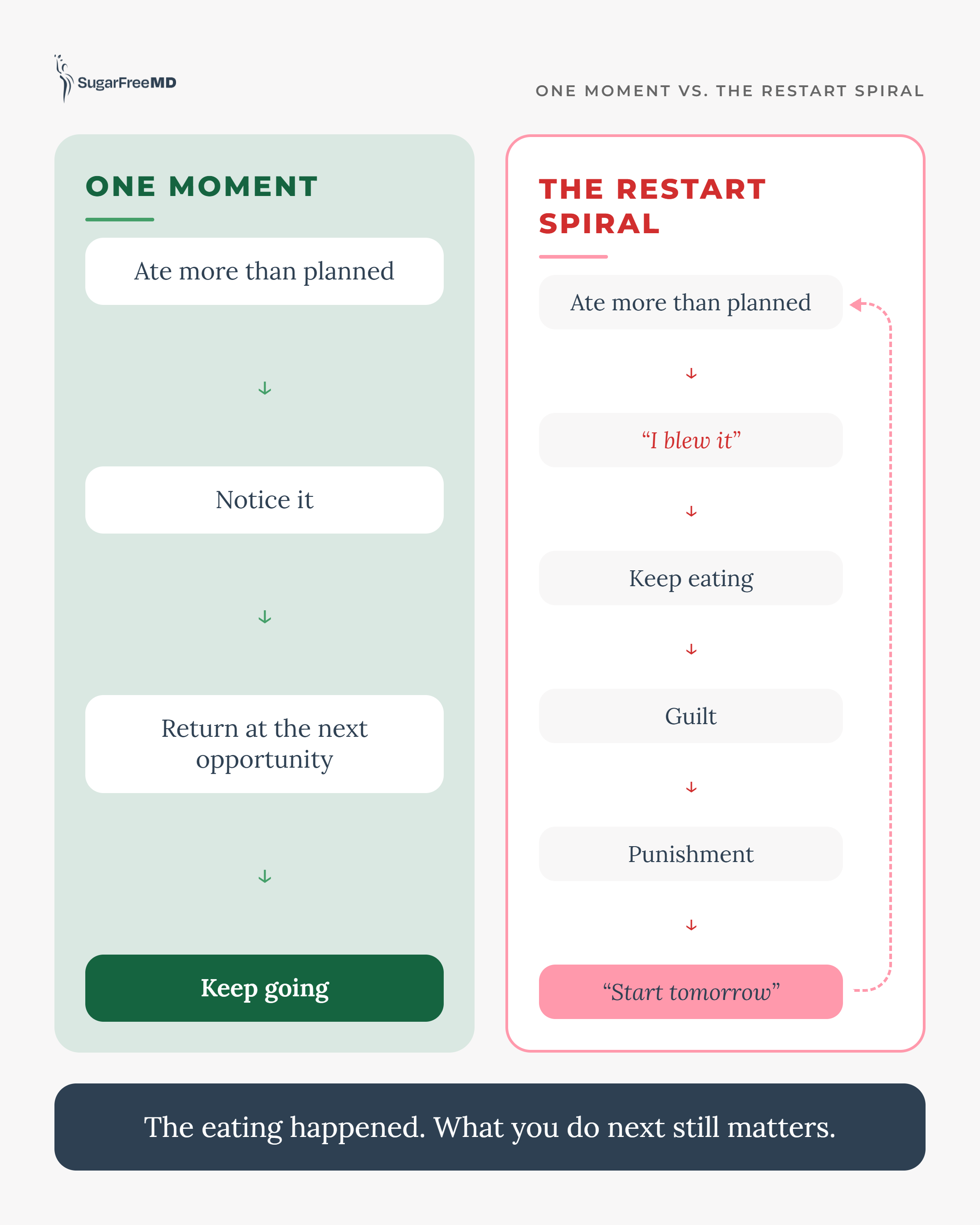
You eat one thing you did not plan, then your brain says:
“Forget it. Today is ruined.”
That is all-or-nothing thinking dressed up as logic.
The first eating decision is one event.
The “I ruined everything” story turns it into a pattern.
I used to experience this myself.
One unplanned eating moment could easily become:
“Well, I already messed up. I might as well eat everything I have been avoiding.”
Then came guilt.
Then harsh self-talk.
Then another plan to start fresh.
If this happens to you, I want you to know where the useful work begins.
It begins after the moment.
Stop Trying to Undo What You Ate
The first instinct after overeating often involves compensation.
Skip breakfast tomorrow.
Fast until dinner.
Work out harder.
Cut carbohydrates.
Eat almost nothing the next day.
Try to erase what happened.
I do not want you keeping score like this.
You ate.
That happened.
Now we continue.
If lunch was larger than planned, your next step is not punishment at dinner.
Eat the normal dinner you intended to eat.
If you had an unplanned dessert, you do not owe the treadmill an apology workout.
Return to your usual routine.
This matters because punishment keeps the entire event emotionally charged.
Now the overeating means you have to pay something back.
I would rather make the event boring.
“I ate more than I planned.”
Period.
Now what is next?
Start With the Facts
After overeating, your brain may offer a full documentary about your personality.
“I have no discipline.”
“I always do this.”
“I have no control around food.”
“I ruined everything.”
“I will never figure this out.”
Those are interpretations.
Start with facts instead.
“I ate three cookies at 3 p.m.”
“I had seconds at dinner even though I felt satisfied.”
“I ate chips while watching television.”
Facts give you something to work with.
Judgment gives you another uncomfortable feeling.
And another uncomfortable feeling often makes emotional eating harder, not easier.
Research on dietary lapses supports this distinction. Higher self-compassion after a lapse has been associated with less negative emotion and greater perceived control over weight-management behavior in the hours afterward.[1]
Compassion is not pretending the choice did not matter.
It is responding in a way that keeps you engaged.
Do Not Make Guilt the Next Trigger
This pattern matters:
You feel stressed.
You eat for relief.
Then you judge yourself for eating.
Now you feel guilty.
And your brain wants relief from the guilt too.
Food may become attractive again.
So the cycle looks like:
Stress → Food → Temporary Relief → Guilt → More Discomfort → More Desire for Relief
This is why beating yourself up after overeating is such an unhelpful recovery strategy.
You are adding fuel to the feeling you are trying to escape.
Pause before solving anything.
Take a few breaths.
Step outside.
Change rooms.
Put your hand over your chest and slow down for a minute.
Listen to music.
Take a short walk.
You are giving your nervous system time to settle before deciding what comes next.
No big intervention.
No dramatic reset.
Just enough space to stop the spiral.
Ask What You Needed in the Moment
Once the emotional intensity comes down, become curious.
What was happening?
Were you physically hungry?
Tired?
Stressed?
Overstimulated?
Celebrating?
Lonely?
Bored?
Rushed?
Did you skip lunch?
Were you surrounded by a food you find difficult to ignore?
Did you have the thought, “I deserve this”?
Did you need a break?
Sometimes overeating has a clear emotional trigger.
Sometimes you were simply much hungrier than you realized.
Sometimes the food tasted great and you kept eating.
Sometimes you were distracted.
No single explanation applies to every episode.
Your job is to understand your episode.
That is far more useful than deciding you are “bad at food.”
Remember the 3 F’s of Eating
One SugarFreeMD framework I use is the 3 F’s of Eating.
We eat for Fuel, Feelings, and Flavor.
Fuel
Your body needed food.
Maybe you went too long without eating or your earlier meals did not satisfy you.
That is information.
Feelings
Food was helping you change an emotional state.
Stress.
Overwhelm.
Comfort.
Celebration.
Loneliness.
Relief.
Again, information.
Flavor
You wanted the food because it tasted good.
Humans enjoy food.
Also information.
You do not need to turn every episode into a psychological investigation.
Sometimes the answer is simple.
But asking which F was involved helps move you from judgment toward understanding.
Choose the Next Best Thing, Not the Perfect Thing
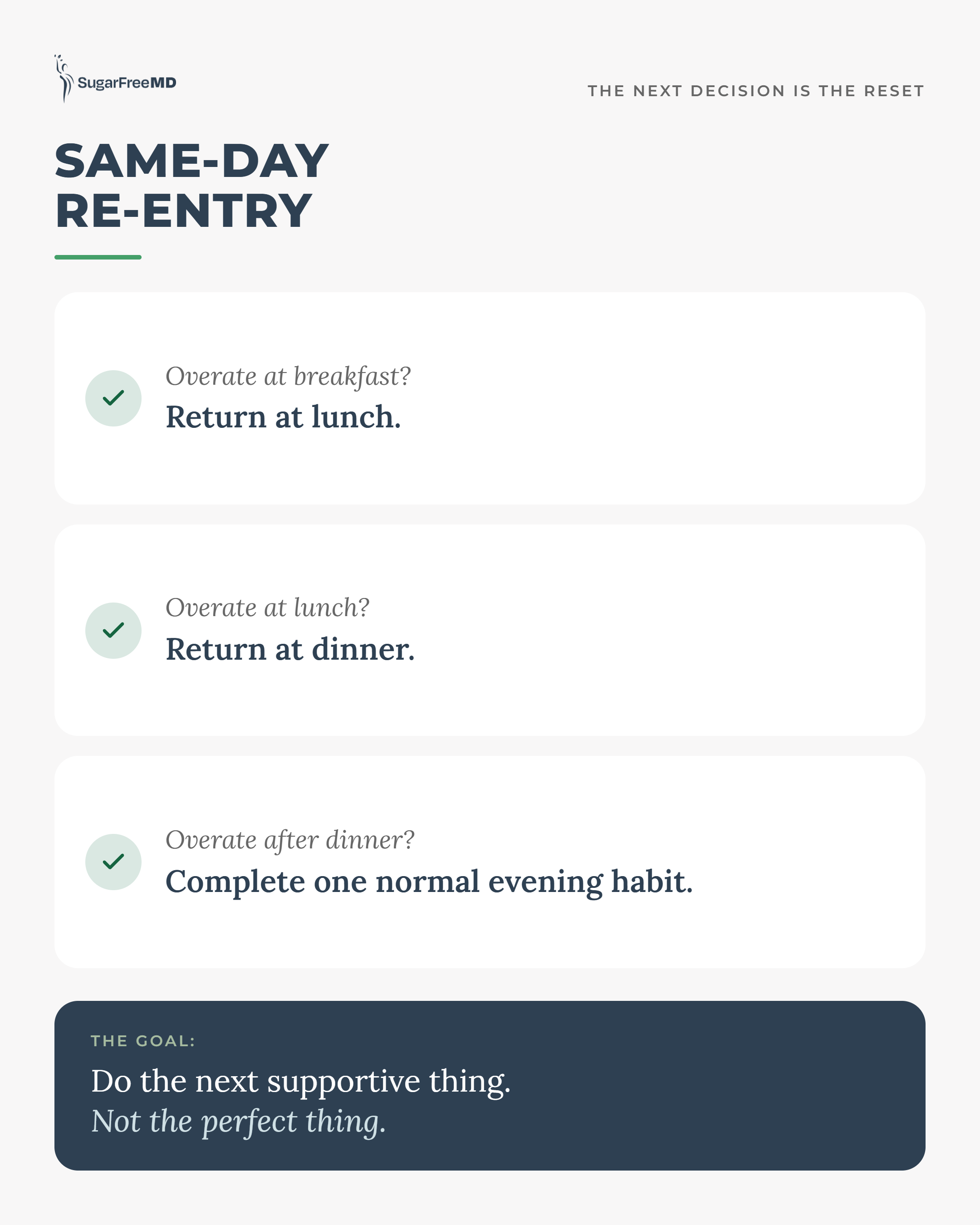
This is where Same-Day Re-Entry comes in.
You do not wait until tomorrow.
You do not wait until Monday.
You do not wait until the first of the month because apparently your body only accepts supportive choices on aesthetically pleasing calendar dates.
You choose the next available supportive action.
If you overate at lunch, eat your normal planned dinner.
If you ate more than intended in the afternoon, your next action might simply be drinking water because you were already planning to stay hydrated.
If the overeating happened after dinner, finish another normal evening anchor.
Brush your teeth.
Stretch.
Take your medication as prescribed.
Prepare what you need for tomorrow.
Go to bed.
The supportive action does not need to compensate for the food.
It simply reminds you:
“I am still participating in my health today.”
That is the point.
Use a Minimum Reset Step
After overeating, a complete return sometimes feels strangely heavy.
Your brain begins imagining an entire perfect day.
Perfect meals.
Workout.
Water.
Sleep.
Everything back in order.
No wonder tomorrow starts sounding easier.
Shrink the return.
Ask:
“What is one small supportive action available right now?”
It might be:
Drink a glass of water.
Add protein to your next meal.
Take a three-minute walk.
Write down what happened.
Prepare tomorrow’s breakfast.
Turn off the kitchen lights.
Go to bed at your normal time.
One small action interrupts the restart story.
You are no longer someone waiting to begin again.
You have already returned.
Same-Day Re-Entry Protects Momentum
One of the most important skills I teach is returning during the same day whenever possible.
If breakfast went differently than planned, lunch is another opportunity.
If lunch was difficult, dinner is another opportunity.
If the eating happened at night, another health-supportive action still exists before bed.
The goal is not a perfect six-hour turnaround.
The goal is avoiding unnecessary delay.
Every time you say, “I’ll start tomorrow,” you practice restarting.
Every time you make one supportive choice now, you practice returning.
I want you practicing the second skill.
Consistency is not staying perfectly on track.
It is shortening the distance between disruption and return.
Treat the Overeating Episode as Data
Once you feel calm, review the situation.
Not while you are still calling yourself names.
Later.
Ask four simple questions:
What happened?
Stick to the facts.
What was I feeling or experiencing?
Think physical hunger, stress, fatigue, boredom, celebration, distraction, or overwhelm.
What did I actually need?
Food?
Rest?
A more satisfying meal?
Connection?
A break?
Fun?
Less stimulation?
What would I try if the same situation happened again?
This is where the episode turns into useful information.
Maybe you realize you need an afternoon snack before a late meeting.
Maybe you notice eating from the children’s plates is a recurring trigger.
Maybe parties go better when you arrive fed instead of ravenous.
Maybe you need to stop working through lunch.
Maybe stressful evenings need a transition ritual before you enter the kitchen.
You do not need a better punishment plan.
You need a better response plan.
Build a Safety Net Before the Next Hard Moment
A safety net is a pre-decided response for a predictable problem.
You already know some of your difficult situations.
Use them.
“When work runs through lunch, I will use the backup food in my desk.”
“When I notice myself eating while cleaning the kitchen, I will step away for five minutes.”
“When I arrive at a party hungry, I will eat something satisfying before deciding about dessert.”
“When I hear ‘I already blew it,’ I will choose one supportive action before making another food decision.”
Advance planning strategies, often called implementation intentions, show modest benefits for healthy eating behavior in research.[2,3]
Your safety net does not need to prevent every overeating episode.
Its job is to give you another option when the familiar pattern appears.
Do Not Turn “Never Miss Twice” Into Another Perfection Rule
You will hear people say:
“Never miss twice.”
I like the idea as a momentum reminder.
I do not like it as another rule to use against yourself.
If you overate yesterday and again today, you did not fail the recovery plan.
Return now.
If the pattern lasted a week, return now.
If it lasted a month, return now.
The date does not change the skill.
Your next supportive choice is still available.
What If You Notice the Pattern Mid-Bite?
Great.
That counts.
You do not have to notice before eating for awareness to matter.
Maybe you catch yourself halfway through the chips.
Pause.
Ask what is happening.
Then decide whether you want to keep eating.
You do not need to spit out the food, throw everything away, or turn the rest of the evening into a test of character.
Awareness arrived.
Use it.
The more often you practice noticing the pattern, the earlier you may begin recognizing it.
At first, awareness happens after overeating.
Then during.
Then before.
That progression is behavior change.
What If You Overeat Because You Were Actually Hungry?
Then I want you paying attention to the hunger.
Were you under-eating earlier?
Did you skip a meal?
Was lunch too small?
Did you arrive at dinner extremely hungry?
Sometimes what gets labeled “overeating” is the predictable result of trying to eat too little earlier in the day.
Do not respond to that information by restricting even more tomorrow.
Look at the pattern.
A recovery plan should address what happened, not punish you for the result.
What About the Scale the Next Morning?
If you weigh yourself after eating more than usual, the number might look different.
Body weight fluctuates from day to day for several reasons, including food and fluid intake, sodium, carbohydrate storage, bowel contents, and hormonal changes.
Do not use one morning’s scale reading as evidence that you ruined your progress.
More important, do not let the number trigger another punishment cycle.
If weighing yourself makes the recovery process harder, step away from the scale and focus on your next normal health-supportive behavior.
Self-Compassion Is Not Letting Yourself Off the Hook
Women sometimes hear “be compassionate” and think I mean:
“It doesn’t matter what I do.”
No.
Compassion sounds more like:
“That happened. I do not need to attack myself. What do I want to learn?”
A meta-analysis involving almost 30,000 participants found self-compassion positively associated with health-promoting behavior.[4]
Research focused specifically on dietary lapses has also found greater self-compassion associated with stronger intentions and self-efficacy to continue pursuing goals after a lapse, along with less negative emotional reaction.[1,5]
Self-compassion does not guarantee weight loss.
It gives you a more useful emotional position from which to continue.
That matters.
Your After-Overeating Recovery Plan
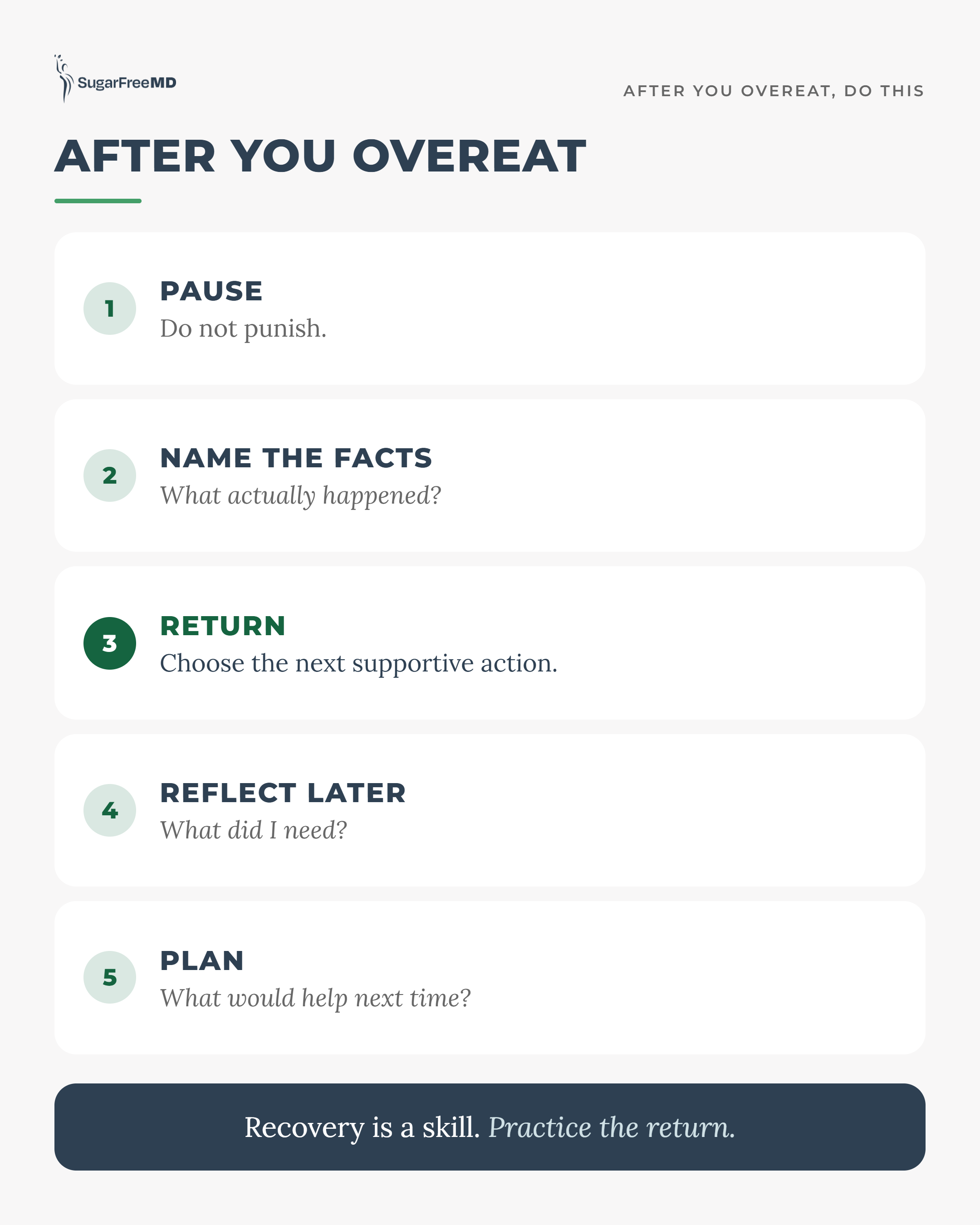
The next time you eat more than planned, keep the sequence simple.
Pause.
State what happened without judgment.
Settle yourself before making another decision.
Return to your normal plan at the next opportunity.
Do one minimum supportive action if a full routine feels hard.
Later, ask what you learned.
Then build one safety net for the next similar situation.
That is recovery.
No detox.
No punishment.
No waiting for Monday.
Frequently Asked Questions
Should I skip my next meal after overeating?
Usually, no. Do not use meal skipping as punishment or compensation. Return to your normal eating pattern and respond to physical hunger and fullness as they arise.
Should I exercise more after overeating?
Avoid using exercise as penance for eating. Return to the movement you normally planned rather than trying to “burn off” the food.
What should I eat the day after overeating?
Return to your usual nourishing meals. There is no special detox meal required. Focus on normal eating, hydration, and the habits you already use to support yourself.
Why do I keep overeating after I already feel guilty?
Guilt adds another uncomfortable emotional state. If food has been a familiar source of comfort or relief, the guilt itself may become another trigger. Interrupt the shame response and focus on curiosity before deciding what comes next.
How do I stop one overeating episode from turning into a whole weekend?
Use Same-Day Re-Entry. Make one supportive choice at the next available opportunity rather than declaring the rest of the day lost. Avoid adding stricter rules for the following day.
What if overeating feels out of control?
If episodes involve frequent loss of control, significant distress, secrecy, compensatory behaviors, or concern about binge eating, speak with a qualified healthcare or mental-health professional. Those patterns deserve individualized evaluation rather than more self-punishment.
References
- Frayn M, Livshits S, Knäuper B. The role of self-compassion and its individual components in adaptive responses to dietary lapses. Appetite. 2023;190:107009.
https://pubmed.ncbi.nlm.nih.gov/37619622/ - Adriaanse MA, Vinkers CDW, De Ridder DTD, Hox JJ, De Wit JBF. Do implementation intentions help to eat a healthy diet? A systematic review and meta-analysis of the empirical evidence. Appetite. 2011;56(1):183-193.
https://pubmed.ncbi.nlm.nih.gov/21056605/ - Carrero I, Vilà I, Redondo R. What makes implementation intention interventions effective for promoting healthy eating behaviours? A meta-regression. Appetite. 2019;140:239-247.
https://pubmed.ncbi.nlm.nih.gov/31125588/ - Phillips WJ, Hine DW. Self-compassion, physical health, and health behaviour: a meta-analysis. Health Psychology Review. 2021;15(1):113-139.
https://pubmed.ncbi.nlm.nih.gov/31842689/ - Sirois FM, et al. Does self-compassion help to deal with dietary lapses among adults pursuing weight-loss goals? British Journal of Health Psychology. 2021.
https://pubmed.ncbi.nlm.nih.gov/33368932/
Want to Hear More About Bouncing Back?
Listen to Episode 111 of Weight Loss Made Simple, Bounce Back Fast After Overeating:
https://weightlossmadesimple.buzzsprout.com/2259978/episodes/18254230-111-bounce-back-fast-after-overeating
If Overeating Keeps Turning Into a Shame Spiral
One overeating episode does not require a new beginning.
Your most useful next step is often much smaller:
Come back.
Notice what happened.
Learn something.
Make the next supportive decision.
If the deeper problem is that food repeatedly becomes your source of comfort, relief, or escape, the End Emotional Eating Vault helps you work on the thoughts, feelings, urges, and emotional-eating patterns underneath those moments.
You do not need another punishment plan.
You need better tools for the moment after the urge wins.
Learn more about the End Emotional Eating Vault:
Dr. Stacy Heimburger
Author
I'm a doctor and an advanced certified life and weight loss coach. I am board certified in internal medicine as well as lifestyle medicine and have additional training in anti-aging medicine. I'm passionate about helping women over 40 use a holistic approach to lose weight for the last time.
