
Food Noise: Why You Can’t Stop Thinking About Food—and How GLP-1s May Help

You finished breakfast.
And you are already thinking about lunch.
Not because you necessarily feel hungry.
Your brain is reviewing what is in the refrigerator. Then it remembers the cookies at work. Then it wonders whether lunch will be “good enough.” Then it starts negotiating dinner.
By 10 a.m., food has already taken up far more mental space than you wanted to give it.
People have started calling this experience food noise.
And for a lot of women, finally having a name for it brings enormous relief.
Because when food occupies your thoughts all day, it is easy to assume the problem is you.
Why am I thinking about food again?
Why is everyone else able to leave the cookies alone?
Why does hunger feel so urgent?
Why do I feel calmer around food on a GLP-1 medication?
These are useful questions.
They are much more useful than:
“Why don’t I have more willpower?”
What Does “Food Noise” Mean?
Food noise is not currently a formal medical diagnosis.
It is a practical term people use to describe persistent, repetitive, or intrusive thoughts about food.
It might sound like:
“What am I eating next?”
“Is there anything sweet in the house?”
“I should not eat that.”
“I already ate too much.”
“Maybe I should skip lunch.”
“What is everyone ordering?”
“Do I need a snack?”
“Why am I hungry again?”
Sometimes the thoughts involve physical hunger.
Sometimes they involve cravings.
Sometimes they involve habit, emotion, reward, restriction, or the simple fact that highly appealing food is sitting three feet away.
Often, several of those things are happening together.
So I do not want you diagnosing every thought about food as “food noise.”
Thinking about food is part of being human.
The problem is when the mental chatter feels persistent, distracting, intrusive, or much louder than the situation seems to require.
Hunger and Food Noise Are Not the Same Thing
Your body is supposed to tell you when it needs food.
Hunger is useful.
We do not need to eliminate hunger.
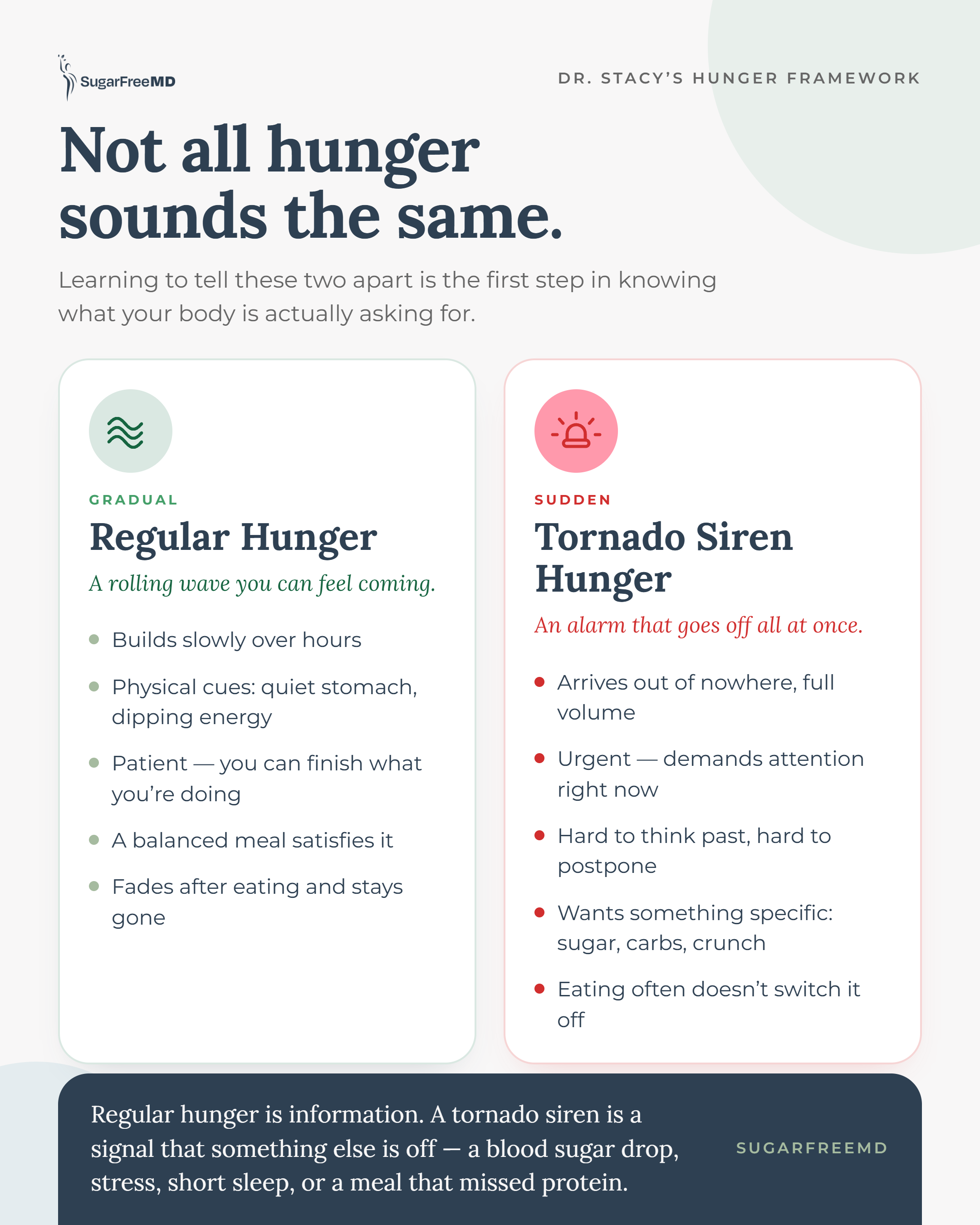
One framework I have used for years is the difference between what I call regular hunger and Tornado Siren Hunger.
Regular Hunger Feels More Like a Wave
Regular physical hunger often builds.
You notice a small signal.
Maybe your stomach feels empty.
Maybe food starts sounding appealing.
You have enough mental space to think:
“I should eat soon.”
If you are busy, the feeling might fade into the background for a bit and return later.
The signal gets louder over time.
It is information.
Tornado Siren Hunger Feels Like an Emergency
Tornado Siren Hunger feels different.
FOOD.
NOW.
Everything else gets pushed aside.
The sensation or mental drive feels urgent and demanding.
Sometimes there is obvious physical hunger underneath it.
Other times, the intensity seems disconnected from what your body should reasonably need in that moment.
Maybe you ate a full meal an hour ago.
Maybe the feeling appeared immediately after a stressful conversation.
Maybe seeing one particular food suddenly made eating feel like the most important task in the building.
That is where I want you to become curious.
Not judgmental.
Curious.
Intense Hunger Has More Than One Possible Cause
Hunger and appetite are regulated by a complicated network involving the gastrointestinal tract, brain, nervous system, hormones, learned cues, sleep, stress, food exposure, prior eating, and many other factors.
Which is a physician way of saying:
Your appetite is more complicated than “just say no.”
Some of our appetite signals are influenced by hormones such as ghrelin, which is involved in meal-related hunger signaling, and leptin, which helps communicate information about longer-term energy stores.
But I do not want you reducing every craving to one hormone.
Human eating behavior is far more layered than that.
Your thoughts about food might become louder because you are physically hungry.
Or sleep deprived.
Or stressed.
Or surrounded by highly rewarding food.
Or coming out of another restrictive diet.
Or emotionally activated.
Or repeating a learned routine.
This is why I would rather move from willpower to understanding.
Instead of:
“What is wrong with me?”
Ask:
“What is contributing to this signal?”
That question gives us somewhere to go.
Restriction Sometimes Makes Food Mentally Louder
You know what happens when I tell you not to think about a purple elephant.
Purple elephant.
There it is.
Food restriction sometimes works similarly from a mental standpoint.
You make a long list of foods you cannot have.
You start measuring every bite.
You stretch the time between meals even though you are hungry.
You spend half the day trying not to think about eating.
Then you are shocked that food has become a major topic in your brain.
This does not mean every dietary boundary creates food noise.
It means repeated restriction, hunger, food rules, and mental monitoring may keep food at the center of your attention.
This is one reason I am much more interested in building a nourishing, repeatable structure than asking you to spend your whole day resisting food.
Food Noise Is Also About Reward and Attention
Food does more than provide calories.
It smells good.
It tastes good.
It is social.
It is comforting.
It is easy to anticipate.
And the brain pays attention to things it expects to be rewarding.
That is normal physiology.
The trouble starts when food-related cues seem to grab your attention constantly.
A box of cookies in the break room does not merely register as:
“Cookies.”
It becomes:
“Cookies. Cookies. Cookies. Cookies. Are we having one? We should not. Maybe one. What if they are gone later? We already had lunch. Who brought them? Cookies.”
That is exhausting.
And this is one reason reducing food noise feels so different from simply “being less hungry.”
People often describe having more mental space.
Where GLP-1 Medications Enter the Conversation
GLP-1 stands for glucagon-like peptide-1.
GLP-1 receptor agonists are a class of medications used for several indications, including type 2 diabetes and, for certain medications and patients, chronic weight management.
Tirzepatide works on both GIP and GLP-1 receptors.
These medications influence appetite regulation and food intake through several physiological pathways.
Clinical trials with semaglutide have found lower hunger, fewer food cravings, greater fullness, better control of eating, and lower energy intake compared with placebo.[1,2]
Research on tirzepatide has also found reductions in appetite, perceived hunger, cravings, overeating tendencies, and reactivity to food cues.[3]
That does not mean every person has the same experience.
It also does not mean GLP-1 treatment erases every thought about food.
But it helps explain why some people say:
“I finally understand what everyone meant when they said they forgot about the snacks in the cabinet.”
Do GLP-1s Actually Reduce Food Noise?
This is where I want to be precise.
The clinical research on appetite and cravings is much stronger than the research specifically using the term food noise.
“Food noise” is still an emerging research concept.
A 2026 retrospective survey of 550 U.S. adults taking injectable semaglutide for weight management found substantially lower self-reported Food Noise Questionnaire scores after treatment compared with participants’ recollection of their pre-treatment experience.[4]
That is interesting.
It is also retrospective research based on participants remembering how they felt before treatment.
So I would not treat that study as the final answer.
The authors themselves called for prospective research.
For now, the best-supported statement is this:
GLP-1-based treatments reduce appetite and food cravings for many people. Emerging research suggests they also reduce the persistent food-related mental chatter people describe as food noise.
Quieting Food Noise Is Not the Same as Never Feeling Hungry
This distinction matters.
When someone has lived for years with what I call Tornado Siren Hunger, quieter hunger might feel like no hunger at all.
Imagine spending years listening to a fire alarm.
Then someone turns it off and knocks gently on the door.
You might not notice the knock right away.
That does not necessarily mean the signal disappeared.
The signal might simply be quieter.
This is why I encourage people to pay attention.
What does hunger feel like now?
Does it arrive gradually?
What happens if you wait ten minutes?
Are you physically hungry, mentally interested in food, emotionally activated, or responding to a cue?
You are learning a new language.
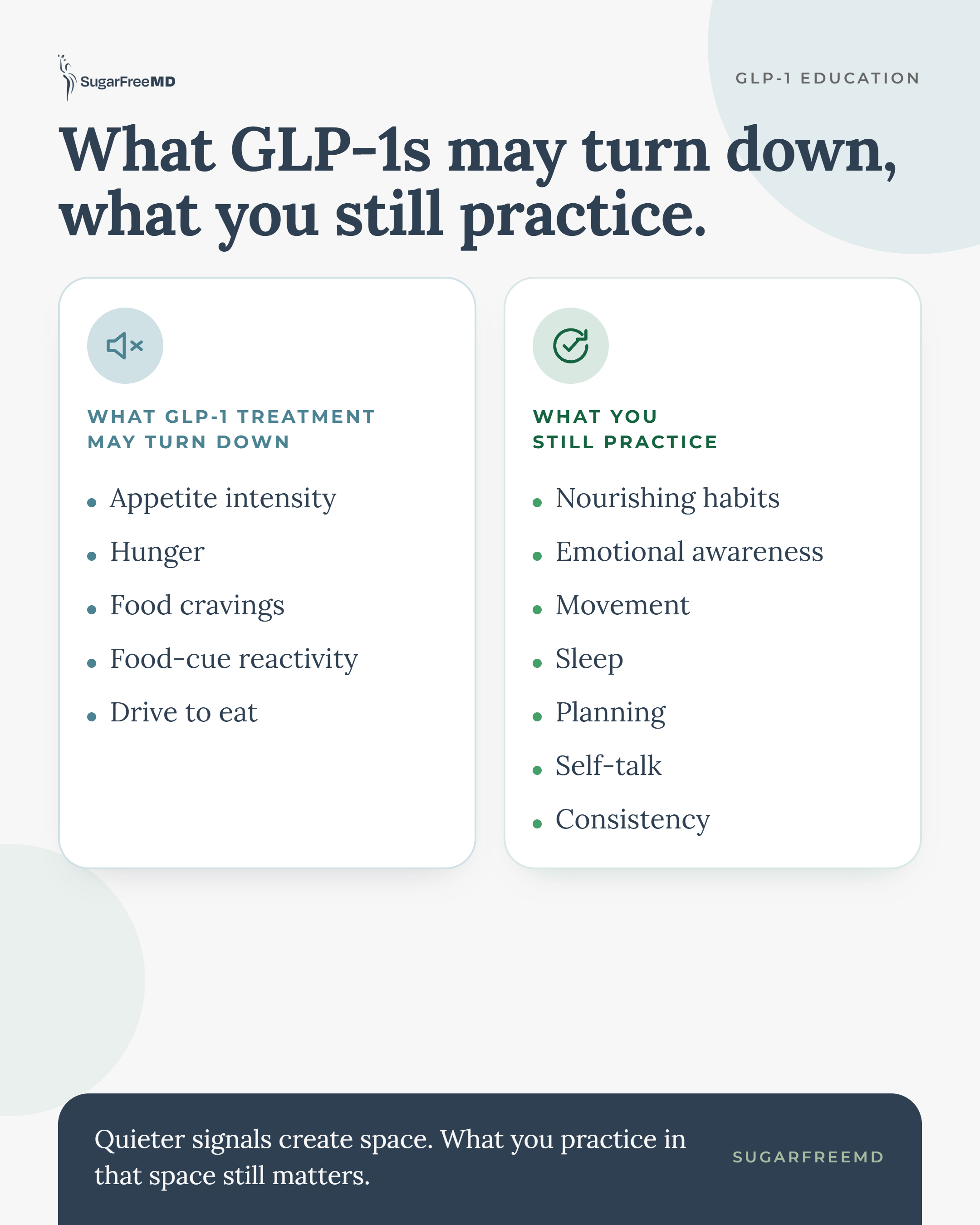
GLP-1s Do Not Do the Habit Work for You
This is one of the most important lessons I have learned while working in this space.
Medication might lower hunger.
It might reduce cravings.
It might quiet some of the mental chatter.
What it does not automatically do is build your habits.
It does not decide what foods you keep in your house.
It does not teach you what to do when you are stressed.
It does not build your movement routine.
It does not repair years of all-or-nothing thinking.
It does not automatically change how you talk to yourself after an imperfect meal.
In Episode 100 of my podcast, I described medication as helping create space for the thought work.
I still believe that is the useful way to think about it.
Less noise may create more room.
What you practice in that room still matters.
Use the Quieter Space to Learn
If your food thoughts become quieter, resist the urge to turn that space into another perfection project.
You do not need to become “perfect” because you are taking medication.
Instead, use the quieter space to become curious.
Notice Physical Hunger
What does physical hunger feel like when it is not screaming?
Where do you notice it first?
How quickly does it build?
Notice Fullness
Do you recognize satisfaction earlier?
Do you naturally leave food behind?
Does your normal portion look different?
Notice Food Cues
What happens when food is nearby?
Does it still grab your attention?
Does it feel easier to decide rather than react?
Notice Emotional Eating
When you are upset, does food still become the first solution your brain offers?
If yes, that does not mean the medication “failed.”
It means emotional eating is a different layer of the work.
Notice Your Habits
Are you eating enough nourishing food?
Are you planning?
Are you moving?
Are you sleeping?
Are you building routines that support the person you want to be?
The medication might lower one barrier.
Your life still needs a workable system.
What If Food Noise Starts Coming Back?
This is a common fear.
Someone experiences relief from intense hunger or constant food thoughts, then notices hunger getting louder again.
The immediate thought is:
“Oh no. It is all coming back.”
First, hunger is not failure.
Humans get hungry.
A returning appetite does not automatically mean something has gone wrong.
What matters is the pattern.
Ask:
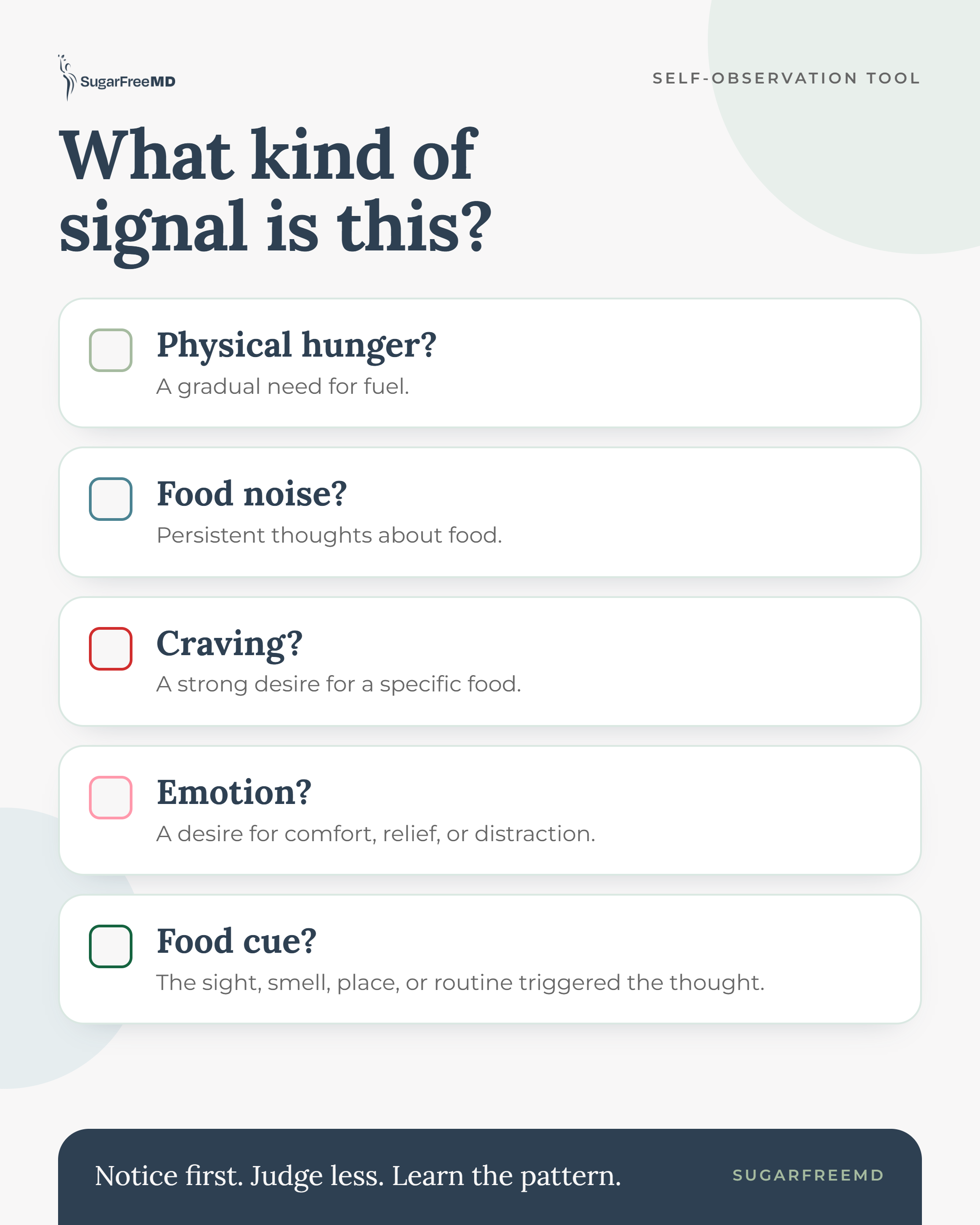
Is this gentle hunger?
Is this Tornado Siren Hunger?
Is this a craving?
Is this an emotional urge?
Is food occupying more mental space again?
Has anything changed in sleep, stress, eating patterns, medication, health, or routine?
If you take a GLP-1-based medication and notice a meaningful change in appetite, side effects, or treatment response, discuss it with your prescribing healthcare professional rather than changing treatment on your own.
GLP-1 Medication Is Not Right for Everyone
These are prescription medications.
They have approved indications, known adverse effects, precautions, and contraindications.
For example, current U.S. prescribing information for semaglutide and tirzepatide products used for chronic weight management includes important warnings and contraindications, including a boxed warning related to thyroid C-cell tumors seen in rodents and contraindication in people with a personal or family history of medullary thyroid carcinoma or MEN 2.[5,6]
This is why deciding whether medication fits your situation belongs in a conversation with a qualified healthcare professional who knows your medical history.
This article is education.
It is not a medication recommendation.
What If You Are Not Taking a GLP-1?
You still have useful places to start.
You do not need medication to begin observing your hunger and food thoughts.
Try this for one week.
When food pops into your mind, pause and ask:
1. Am I physically hungry?
Notice your body.
2. How urgent does the signal feel?
Is it a gentle wave or a tornado siren?
3. What happened right before I thought about food?
Stress?
Boredom?
Seeing food?
A routine?
A smell?
An emotion?
4. What do I expect the food to do for me?
Fuel me?
Comfort me?
Entertain me?
Give me a break?
5. What happens if I wait a few minutes?
You are not trying to prove you do not need food.
You are learning your pattern.
And if you are hungry, please eat.
Hunger is not a character flaw.
Stop Making Food Noise a Moral Issue
This is the part I want you to keep.
If your brain talks about food constantly, shame is not going to make the volume lower.
If hunger feels urgent, calling yourself undisciplined does not teach you what is driving it.
If a medication reduces the noise, that does not mean you cheated.
And if you still have emotional eating or old habits after the noise gets quieter, that does not mean medication failed.
These are different pieces of the same bigger picture.
Food freedom is not never thinking about food.
Food freedom is having enough space around food that you get to participate in the decision.
That is what we are working toward.
Frequently Asked Questions
Is food noise the same as hunger?
No. Hunger is a physiological signal related to the need for food. Food noise describes persistent or intrusive thoughts about food. The two often overlap, but food noise may also involve cravings, habits, food cues, emotions, or mental restriction.
Is food noise a medical diagnosis?
No. Food noise is an emerging term rather than a formal medical diagnosis. Researchers have recently started developing tools to measure the experience more consistently.
Why do GLP-1 medications reduce food thoughts?
Research shows semaglutide and tirzepatide reduce appetite, hunger, cravings, food intake, and responsiveness to food cues in many people. Those effects likely contribute to the quieter food-related mental experience some patients describe.
Does everyone taking a GLP-1 lose their food noise?
No. Treatment response differs from person to person. Hunger, cravings, emotional eating, habits, food environment, and mental preoccupation also involve different mechanisms.
Does food noise returning mean my medication stopped working?
Not necessarily. Hunger normally fluctuates, and appetite is influenced by multiple factors. A meaningful change in treatment response or symptoms should be discussed with the prescribing healthcare professional.
Do I still need healthy habits if a GLP-1 reduces my appetite?
Yes. Medication does not automatically establish nourishing eating patterns, movement, sleep routines, emotional skills, or other behaviors that support long-term health.
Want to Go Deeper?
Listen to Episode 90 of Weight Loss Made Simple, Tornado Siren Hunger vs. Regular Hunger: How GLP-1 Medications Help You Reconnect with Your Body’s Signals.
Start Understanding the Signal Instead of Fighting It
If hunger, cravings, or food thoughts feel loud, I want you to start by getting curious about the signal rather than immediately blaming yourself.
That is the kind of work we talk about in How to Stay Out of the Pantry at Night, my free weekly live teaching.
Pantry is a place to learn how hunger, food urges, stress, habits, and real-life behavior fit together, without adding more shame or another rigid food plan.
You do not need louder rules.
You need a better understanding of what your brain and body are telling you.
Join the free Pantry teaching.
Medical Disclaimer
This article is for educational purposes and is not a substitute for individualized medical advice. Talk with your healthcare professional about recommendations specific to your health and medications.

Dr. Stacy Heimburger
Author
I'm a doctor and an advanced certified life and weight loss coach. I am board certified in internal medicine as well as lifestyle medicine and have additional training in anti-aging medicine. I'm passionate about helping women over 40 use a holistic approach to lose weight for the last time.
