
Weight Loss Plateaus: Why the Scale Stops Moving and What to Do Next

The scale was moving.
Maybe slowly, but it was moving.
Then one morning you step on it and see the same number.
A few days later?
Same.
Next week?
Basically the same.
And this is usually when the brain becomes an extremely dramatic weight-loss consultant.
“Cut breakfast.”
“Stop eating carbs.”
“Add another workout.”
“Maybe nothing works anymore.”
“Clearly my metabolism is broken.”
Before you redesign your entire life because the scale has been boring for ten days, I want you to do something much less exciting:
Collect better information.
A weight-loss plateau can be frustrating. It is also a normal place to stop, look at what is actually happening, and decide whether anything needs to change.
You do not need to panic.
You need a useful audit.
First: A Flat Scale Is Not Automatically a Plateau
Weight loss is not linear.
That is one of the least emotionally satisfying facts about weight loss, but it is still true.
Your scale does not measure body fat alone.
It measures everything contributing to your body weight at that moment, including water, food in your digestive tract, and other normal day-to-day changes.
You can follow the same routine for several days and see:
Down.
Up.
Same.
Up.
Down.
That does not mean your body gained and lost meaningful amounts of fat every 24 hours.
It means the scale is noisy.
Menstrual-cycle-related fluid shifts can change scale weight, for example. In one study of women with regular cycles, body weight was about 0.45 kg higher during menstruation, largely because of increased extracellular water.[5]
Higher sodium intake, changes in carbohydrate intake, bowel contents, travel, and other ordinary factors can also affect what you see.
So I do not diagnose a plateau from Tuesday morning.
Or even necessarily from one or two flat weeks.
In my own teaching, I use roughly a month without meaningful movement in the trend while you believe you are consistently following your plan as a practical point to investigate.
That is not a universal medical definition.
It is simply a useful checkpoint.
Look at the Trend, Not the Tuesday
This is where zooming out matters.
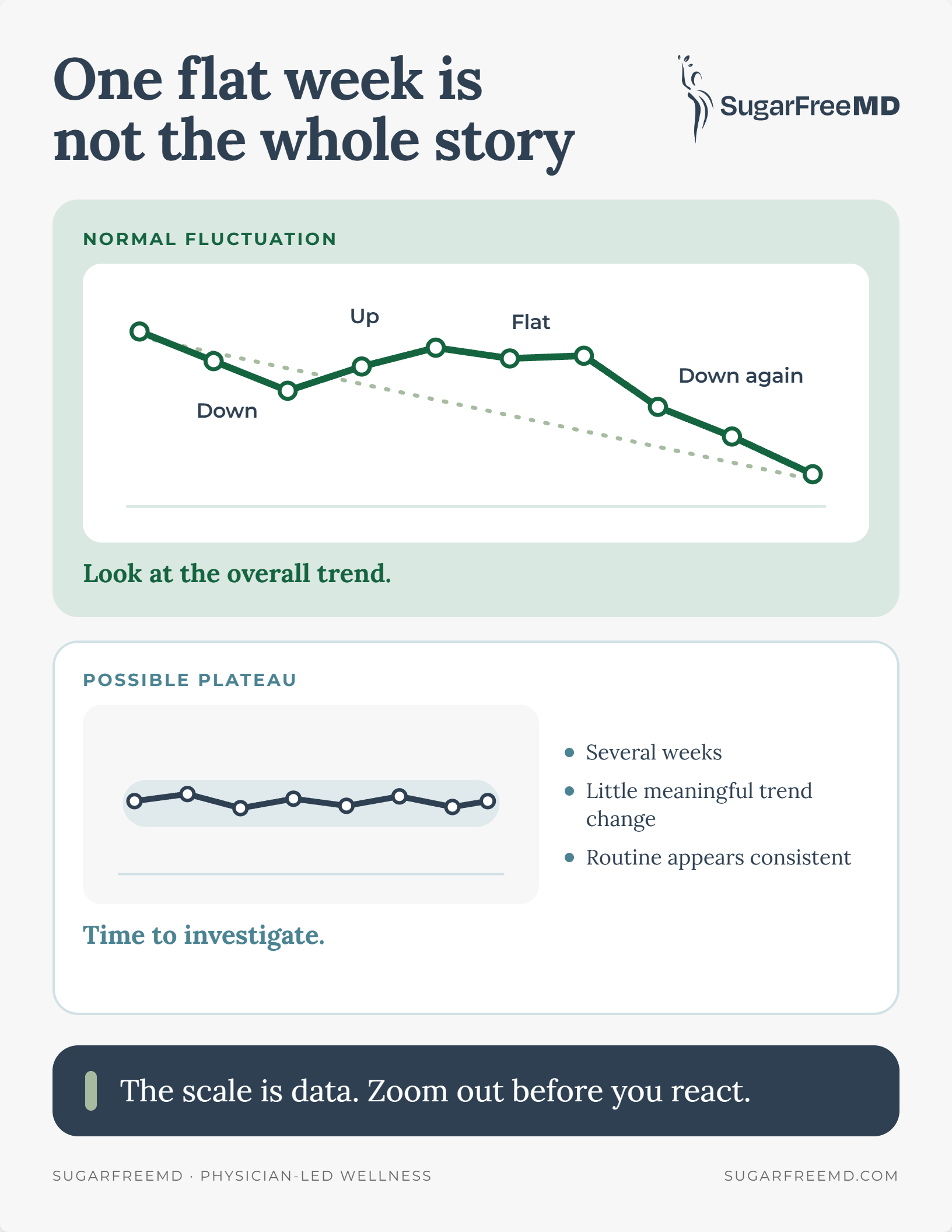
Imagine the scale looked like this:
Week 1: down
Week 2: flat
Week 3: slightly up
Week 4: down again
That is different from:
Month 1: essentially the same average
Month 2: essentially the same average
The first pattern may simply be normal fluctuation inside continued progress.
The second deserves a closer look.
This is also why I do not want one unusual weigh-in deciding whether your entire plan works.
The scale is one data point.
Use enough data to see the pattern.
Why Do Weight-Loss Plateaus Happen?
There is no single reason.
And no, the answer is not automatically:
“Your body went into starvation mode.”
As body weight decreases, several things can change.
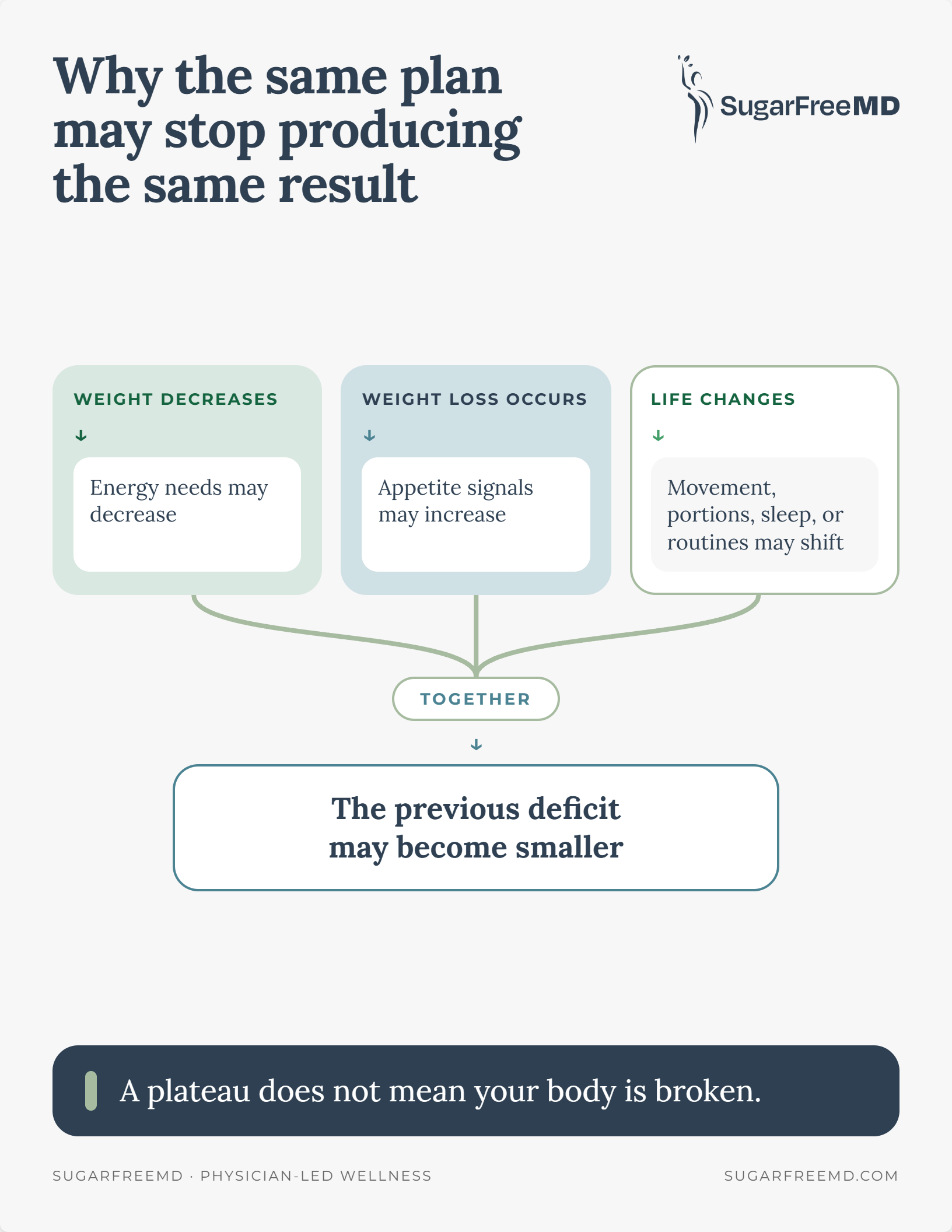
A Smaller Body Generally Requires Less Energy
If you weigh less than you did several months ago, your body does not have exactly the same energy requirements it had at your starting weight.
A smaller body generally costs less energy to maintain and move through the world.
So a routine that created a meaningful energy deficit earlier may eventually create a smaller deficit.
At some point, energy intake and expenditure may get close enough that body weight stabilizes.
That is not your metabolism betraying you.
That is physiology.
The Body Can Adapt to Weight Loss
There can also be metabolic adaptation beyond what we would predict from having a smaller body.
This is often called adaptive thermogenesis.
I want to put this into perspective because the internet tends to go directly from “metabolic adaptation exists” to “weight loss destroyed my metabolism.”
Those are not the same statement.
A systematic review of 33 studies found evidence of adaptive thermogenesis in many studies after weight loss, but the effect was smaller or nonsignificant in better-designed studies and often diminished after a period of weight stabilization.[2]
So yes, adaptation can happen.
No, that does not mean your metabolism is permanently broken.
Appetite Can Get Louder
Weight loss also affects biological systems that help regulate appetite and energy balance.
A 2025 meta-analysis involving 127 studies found changes in several appetite-related gut hormones after weight loss, including an increase in total ghrelin overall.[4]
Another review describes weight-loss-related changes in both appetite and energy expenditure that can favor returning toward a previous body weight.[3]
Translation:
Maintaining the exact same behavior can become harder after you have lost weight.
You may feel hungrier.
Portions can gradually increase.
Snacking can become more frequent.
Foods that once felt easy to skip become more interesting.
This is physiology interacting with behavior.
It is not evidence that you suddenly stopped caring.
A Plateau Does Not Mean Your Metabolism Is Broken
I want this section to be extremely clear.
Your metabolism is not an appliance.
It did not stop working.
Your body is continuously adjusting energy use, appetite, movement, temperature regulation, digestion, and other processes.
Weight loss changes the system.
That makes sustained weight loss biologically more complicated than simply repeating the same mathematical calculation forever.
A 2024 physiological modeling paper on weight-loss plateaus demonstrated how feedback between weight loss, appetite, energy intake, and expenditure can eventually bring weight to a new equilibrium.[1]
That is a much more useful way to think about a plateau.
Your body reached a place where the current inputs and outputs are producing relative stability.
Now we investigate.
Not punish.
Before You Change Anything, Ask: Am I Actually Doing the Same Thing?
This is one of the questions I ask first.
And I mean it without judgment.
Human beings drift.
A serving gets slightly bigger.
The handful of nuts becomes a more enthusiastic handful.
A bite while making dinner becomes several bites.
Weekends get looser.
You stop planning lunch because you have made lunch successfully for six months and think you no longer need the plan.
Movement quietly decreases because work is busy.
Nothing dramatic happened.
There may simply be small differences between what you were doing earlier and what you are doing now.
This is why Episode 92 comes back to something very simple:
Know what you are actually doing.
Not what you think you are probably doing.
Not what you did three months ago.
What is happening now?
Use a Short Plateau Audit, Not a Lifetime of Tracking
You do not need to start obsessively measuring every crumb.
That is not what I teach.
But if you genuinely do not know whether your eating pattern has changed, a short period of neutral observation can help.
For several days, you might simply write down:
- What you ate
- When you ate
- Snacks
- Drinks that contain meaningful energy
- Little bites and tastes you normally forget
- Whether you were physically hungry
- Whether portions looked different than usual
You are not building a case against yourself.
You are collecting information.
The tone matters.
A food record used as punishment usually becomes miserable very quickly.
A food record used like a scientist’s notebook can answer useful questions.
Recheck Portions Without Creating More Restriction
Portions are allowed to change.
Your hunger is allowed to vary.
This is why I prefer experimentation over rigid portion rules.
Ask:
“Am I regularly finishing meals comfortably satisfied?”
“Have my portions slowly become larger without me noticing?”
“Am I routinely going back for more because I am still hungry, or because the food is there?”
“Am I arriving at meals so hungry that it is difficult to notice satisfaction?”
The goal is not to eat the smallest amount possible.
The goal is to find an amount that supports your health and leaves you appropriately satisfied.
If your usual portions have gradually shifted upward, you can experiment with adjusting them.
Then observe.
No drama required.
Look at the Structure of Your Meals
A plateau audit is also a good time to look at the quality and structure of what you are eating.
Not because one food has magical plateau-breaking powers.
Ask whether your meals generally contain foods that help with nourishment and satisfaction.
That may include:
- A meaningful source of protein
- Vegetables and/or fruit
- Fiber-rich foods
- Foods you genuinely enjoy
- Enough food that you are not spending the afternoon fighting intense hunger
Protein deserves some attention during weight loss because losing weight can include loss of lean mass, not just fat mass.
A 2024 systematic review and meta-analysis found that higher protein intake helped preserve muscle mass in adults with overweight or obesity during weight-loss interventions, although it did not consistently improve muscle strength or physical function.[6]
That does not mean “eat more protein and your plateau will disappear.”
It means maintaining muscle is an important part of the larger health picture while losing weight.
Check Your Movement—Including the Movement You Do Not Call Exercise
There is the workout.
And then there is the rest of your day.
Walking across a parking lot.
Taking the stairs.
Standing.
Cleaning.
Walking around the office.
Running errands.
Moving between rooms instead of sitting for long stretches.
Sometimes people maintain the same formal exercise program while their overall daily movement quietly decreases.
Maybe you are tired.
Maybe work got busier.
Maybe you are sitting more.
Maybe you stopped taking the lunchtime walk without really registering it.
So do not ask only:
“Did I exercise?”
Ask:
“How much am I moving through my whole day?”
This is one reason I teach Opportunities to MOVE, or OTMs.
Movement does not only count when you are wearing workout clothes.
Strength Training Matters Even When the Scale Is Boring
Resistance exercise deserves a place in a long-term weight-management plan because weight loss can include loss of fat-free mass.
The goal is not simply to make the scale smaller.
We want to support muscle and physical function too.
If you are strength training and your body composition is changing, there may also be periods where the scale tells a less interesting story than your strength, measurements, clothing fit, or physical capacity.
Again:
The scale is data.
It is not the entire health report.
Sleep and Stress Belong in the Audit—But Not Because “Cortisol Broke Weight Loss”
This is another area where social media tends to oversimplify things.
Stress matters.
Sleep matters.
But I do not want you deciding:
“My cortisol is high, therefore I cannot lose weight.”
Human physiology is more complicated than that.
Stress may affect:
- Sleep
- Hunger and appetite
- Food cravings
- Emotional eating
- Planning
- Movement
- Recovery
- How easy it feels to follow your normal routines
Poor sleep can do many of the same things.
So yes, ask:
“How am I sleeping?”
“What has my stress level looked like?”
“Has this changed how I eat or move?”
But do not turn cortisol into another villain you need to defeat before your body is allowed to change.
Hydration Is Important. It Is Not a Plateau Hack.
Drink enough fluid to support your health.
Absolutely.
But if your weight has been stable for six weeks, I am not going to tell you that one more enormous water bottle is the secret missing weight-loss strategy.
Hydration belongs in your basic self-care.
It is not magic.
This distinction matters because plateaus make us vulnerable to magical thinking.
We want one trick.
One supplement.
One timing change.
One food to remove.
One metabolic hack.
Usually, the better answer is less glamorous:
Review the pattern carefully.
Do Not Change Five Things at Once
This is one of the easiest ways to turn a plateau into chaos.
You get frustrated and decide:
No bread.
No dessert.
Intermittent fasting.
Ten thousand more steps.
New supplements.
New workout.
Earlier bedtime.
No restaurant food.
Everything changes Monday.
There are two problems.
First, this creates a much more difficult plan.
Second, if the scale changes, you have absolutely no idea which change mattered.
I would rather you run an experiment.
Choose one meaningful adjustment.
Examples might include:
- Returning to your planned lunch instead of grazing through the afternoon
- Reestablishing portions that had gradually increased
- Adding vegetables or another fiber-rich food to meals
- Making protein more consistent
- Restoring a walk that disappeared from your routine
- Returning to regular strength training
- Planning a reliable dinner for your busiest workday
- Protecting sleep if poor sleep has been disrupting the rest of your routine
Then keep the rest of your plan reasonably steady.
Observe what happens.
That is an experiment.
Give the Experiment Enough Time
Your body is not obligated to deliver a verdict tomorrow morning.
Remember where we started:
The scale is noisy.
If you change lunch on Tuesday and demand a lower number Wednesday, you have learned almost nothing.
Give the new pattern enough time to become a pattern.
Continue watching the overall trend.
The exact time needed depends on the situation, but the important point is this:
Do not make another major change every 48 hours because the scale has not applauded yet.
Maintenance Can Be Progress
This is something I talked about in Episode 92 that I think deserves much more attention.
Suppose your weight had been increasing.
Then you make changes.
And the increase stops.
The scale becomes stable.
Your brain may say:
“But I’m not losing.”
I might say:
“You just practiced maintenance.”
That matters.
Stopping a regain trend is different from continuing to gain.
Learning how to maintain a lower body weight is also a skill you eventually need if long-term weight loss is the goal.
Not every useful phase has to produce a dramatic downward line.
Sometimes holding steady is useful information.
Look for Progress the Scale Cannot Show You
This does not mean we pretend body weight never matters when weight loss is one of your goals.
It means we stop asking one metric to tell the entire story.
Ask whether:
- Your clothes fit differently
- Your waist measurement has changed
- You are stronger
- Walking feels easier
- Your endurance is improving
- You are sleeping better
- You recover faster from difficult days
- Your meals are more consistent
- You feel calmer around food
- You are maintaining habits you used to abandon
The scale can be useful.
It is not omniscient.
If you tend to discount anything that is not pounds lost, read What Progress Really Looks Like too.
What I Would Not Do During a Weight-Loss Plateau
I would not assume your metabolism is broken.
I would not starve yourself.
I would not punish yourself with exercise.
I would not remove entire food groups simply because the scale annoyed you.
I would not overhaul six habits at once.
I would not assume a single weekend erased months of progress.
And I would definitely not turn a plateau into proof that you are someone who “can’t lose weight.”
A plateau is a result.
Results give us information.
Information helps us decide what to test next.
The SugarFreeMD Plateau Audit
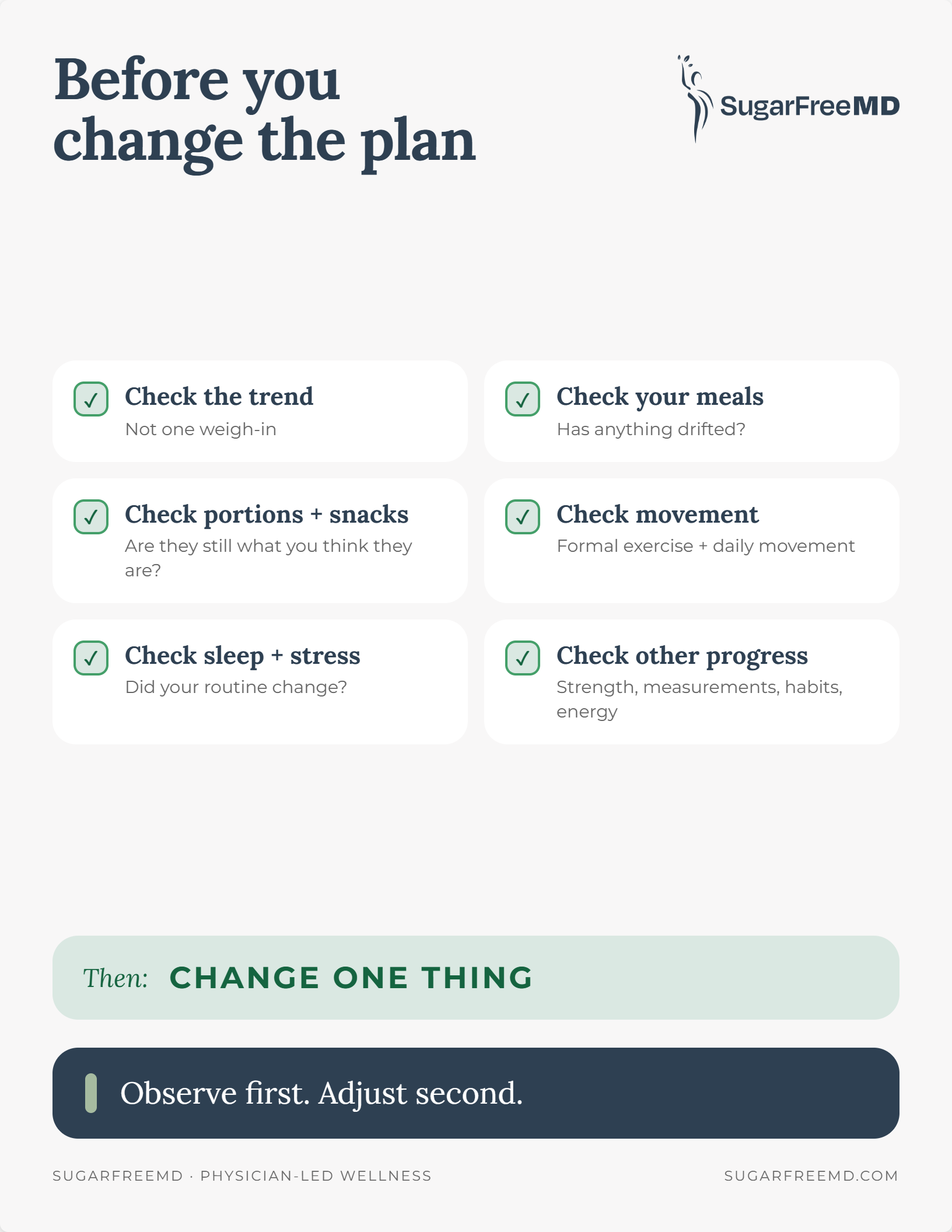
If your weight trend has truly been flat for several weeks, use this sequence.
1. OBSERVE
Is this actually a sustained plateau?
Look at several weeks of data rather than one or two weigh-ins.
2. AUDIT
Ask:
- Am I following the same plan I think I am following?
- Have portions changed?
- Has snacking changed?
- Did planning disappear?
- Am I eating satisfying meals?
- Am I moving as much as I used to?
- Am I strength training?
- Has sleep changed?
- Has stress changed my routines?
- Is there another measure showing progress?
3. CHOOSE ONE EXPERIMENT
Do not fix everything.
Choose one adjustment that makes sense based on your audit.
4. REASSESS
Give the change time.
Look at the trend again.
What happened?
5. CONTINUE OR ADJUST
If the change helped, keep going.
If nothing changed, you learned something.
Choose the next reasonable experiment.
That is how I want you thinking about a plateau.
Curiosity.
Not catastrophe.
When Should You Get Professional Help With a Plateau?
Sometimes an outside perspective is useful.
If you have consistently followed a reasonable plan, carefully reviewed the obvious variables, and your weight remains stalled, talking with a qualified healthcare professional can help you look at the broader context.
That is especially important if the weight change is unexpected or comes with new symptoms, medication changes, or other health concerns.
The goal is not to diagnose yourself from a scale trend.
It is to know when more information would be useful.
Frequently Asked Questions
How long does a weight-loss plateau last?
There is no universal medical duration that defines a plateau. A few flat days or even a couple of weeks may reflect normal weight fluctuation. I use roughly a month without meaningful trend change while consistently following the plan as a practical time to investigate what may need adjustment.
Is my metabolism broken if I stop losing weight?
No. Weight loss changes energy needs, appetite regulation, and sometimes energy expenditure beyond what would be expected from body-size changes alone. Adaptive thermogenesis can occur, but evidence suggests its magnitude varies and may be modest. A plateau does not mean your metabolism has stopped working.
Should I eat much less when I hit a plateau?
Not automatically. First confirm that there is a sustained plateau and review your current eating pattern, portions, movement, sleep, stress, and consistency. If an adjustment is needed, I prefer one reasonable experiment rather than a drastic restriction.
Can stress cause a weight-loss plateau?
Stress may influence sleep, appetite, cravings, emotional eating, activity, recovery, and your ability to follow your normal routine. That can contribute to a stall. It is overly simplistic, however, to assume every plateau is directly caused by “high cortisol.”
Why did my weight go up overnight?
An overnight increase is usually not enough information to determine a change in body fat. Fluid balance, sodium intake, carbohydrate storage, menstrual-cycle changes, gastrointestinal contents, and other short-term factors can change scale weight.
Can I make progress even when the scale is not moving?
Yes. Depending on what you are doing, progress may also show up as changes in body measurements, strength, endurance, physical function, habits, food relationships, or maintenance of previously lost weight. Look at the full pattern.
References
- Hall KD. Physiology of the weight-loss plateau in response to diet restriction, GLP-1 receptor agonism, and bariatric surgery. Obesity (Silver Spring). 2024;32(6):1163-1168. DOI: 10.1002/oby.24027. PMID: 38644683.
- Nunes CL, Casanova N, Francisco R, et al. Does adaptive thermogenesis occur after weight loss in adults? A systematic review. British Journal of Nutrition. 2022;127(3):451-469. DOI: 10.1017/S0007114521001094. PMID: 33762040.
- Rosenbaum M. Appetite, Energy Expenditure, and the Regulation of Energy Balance. Gastroenterology Clinics of North America. 2023;52(2):311-322. DOI: 10.1016/j.gtc.2023.03.004. PMID: 37197875.
- Jin Z, Li J, Thackray AE, et al. Fasting appetite-related gut hormone responses after weight loss induced by calorie restriction, exercise, or both in people with overweight or obesity: a meta-analysis. International Journal of Obesity. 2025;49(5):776-792. DOI: 10.1038/s41366-025-01726-4. PMID: 39929932.
- Kanellakis S, et al. Changes in body weight and body composition during the menstrual cycle. American Journal of Human Biology. 2023;35(11):e23951. DOI: 10.1002/ajhb.23951. PMID: 37395124.
- Kokura Y, Ueshima J, Saino Y, Maeda K. Enhanced protein intake on maintaining muscle mass, strength, and physical function in adults with overweight/obesity: A systematic review and meta-analysis. Clinical Nutrition ESPEN. 2024;63:417-426. DOI: 10.1016/j.clnesp.2024.06.030. PMID: 39002131.
Want to Go Deeper?
Listen to Episode 51 of Weight Loss Made Simple, Overcoming Weight Loss Plateau - Effective Strategies:
A Plateau Is a Place to Troubleshoot, Not a Reason to Quit
When the scale stops moving, I do not want your first move to be making your life harder.
Pause.
Look at the trend.
Check what is actually happening.
Choose one useful experiment.
Then keep going long enough to learn something.
If you understand the basics but the troubleshooting and consistency are the pieces that keep getting you, that is exactly the kind of work we do inside SugarFreeMD Lifestyle Support Monthly.
Inside the Membership, we focus on realistic habits, ongoing support, accountability, and adjusting when real life—or your results—do not follow the neat little plan you expected.
You do not need another dramatic restart because the scale got quiet.
You need a way to keep working the problem without quitting on yourself.
Learn more about Lifestyle Support Monthly:
https://www.sugarfreemd.com/LSM
Medical Disclaimer
This article is for educational purposes and is not a substitute for individualized medical advice. Talk with your healthcare professional about recommendations specific to your health and medications.

Dr. Stacy Heimburger
Author
I'm a doctor and an advanced certified life and weight loss coach. I am board certified in internal medicine as well as lifestyle medicine and have additional training in anti-aging medicine. I'm passionate about helping women over 40 use a holistic approach to lose weight for the last time.
