
Why Do I Eat When I’m Not Hungry? Understanding Emotional Eating

You finished dinner an hour ago.
Your stomach feels satisfied.
Then something happens.
An irritating email lands in your inbox. You have a frustrating conversation. You finally sit down after a long day. You feel bored. Or lonely. Or overwhelmed.
And suddenly, you want food.
You know you are not physically hungry, which makes the whole thing even more frustrating.
“Why am I doing this?”
This is the part of emotional eating I really want you to understand.
We tend to focus on the eating because that is the part we can see.
But the eating is usually the end of the story.
Something happened before you walked into the kitchen. There was a trigger. A thought. A feeling. An urge. And somewhere along the way, your brain learned that food could make that feeling easier for a minute.
Once we understand the whole sequence, eating when you are not hungry starts to make a lot more sense.
And when something makes sense, we can work with it instead of fighting ourselves.
First, Why Are You Eating?
Physical hunger is one reason we eat.
It is not the only reason.
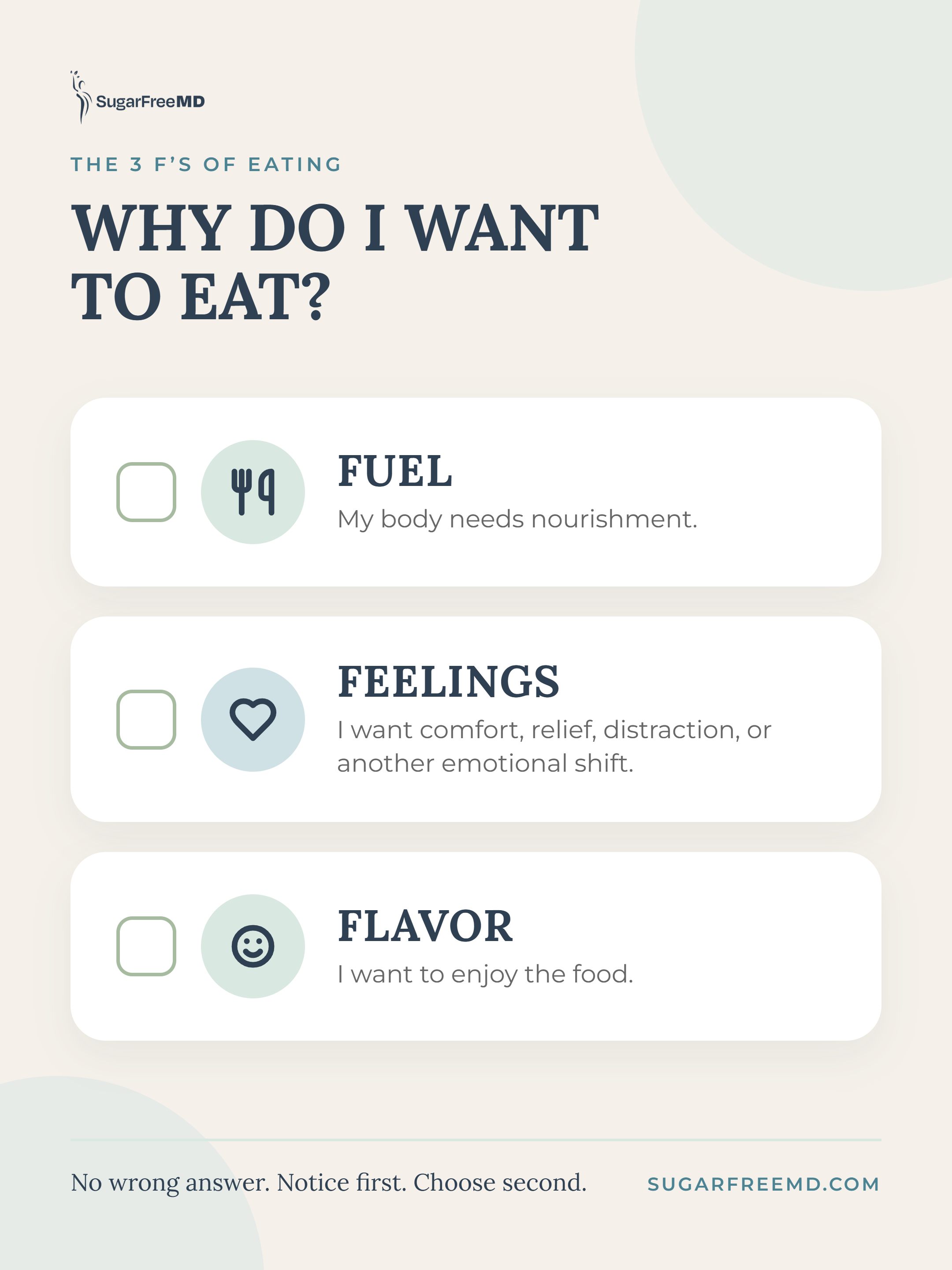
I like to teach what I call the 3 F’s of Eating:
Fuel
Your body needs nourishment.
You are physically hungry. Maybe it has been several hours since you ate. Maybe your last meal was not satisfying enough. Maybe you simply need food.
If you are hungry, eat.
We are not trying to become experts at ignoring hunger.
Feelings
You want food because you want to feel different.
Maybe you want comfort.
Relief.
Distraction.
Reward.
Something pleasant after an annoying day.
This is where emotional eating lives.
Flavor
Sometimes food just tastes good.
You want the cookie because you like cookies.
You want dessert because dessert is enjoyable.
That is allowed too.
There is no morality hiding inside these three categories.
Fuel is not “good.”
Feelings are not “bad.”
Flavor is not a failure.
I just want you to know what is driving the decision.
Because once you know why you want to eat, you have a much better chance of choosing what you actually need.
Emotional Eating Usually Has a Pattern
Let’s say you walk into the break room at work and see a box of cookies.
Thirty seconds ago, you were not thinking about cookies.
Now you are.
Your brain says:
“Those look really good.”
Then comes the urge.
And suddenly it feels very important that you eat a cookie immediately.
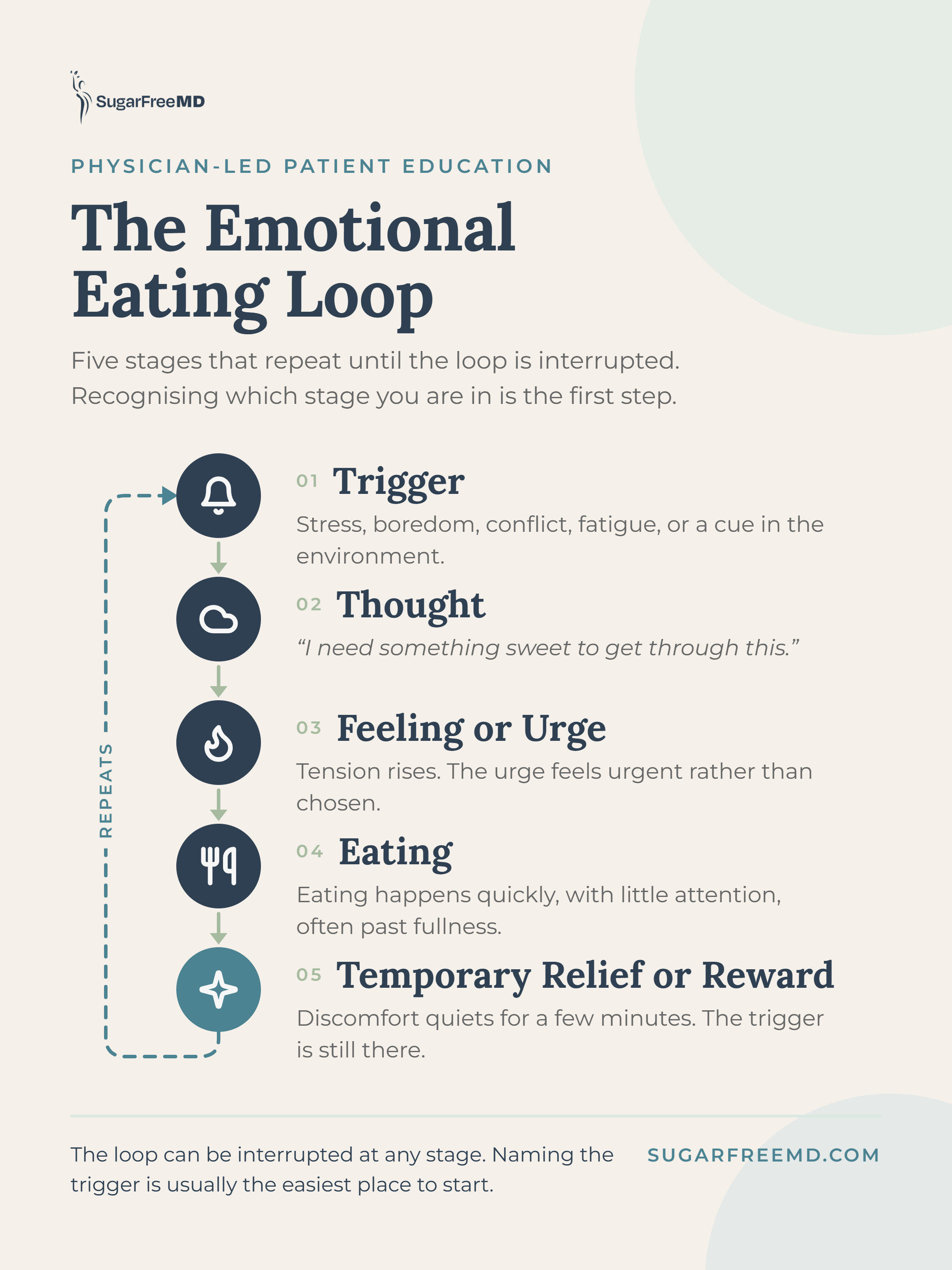
That is an example of an urge-reward loop.
It can look something like this:
Trigger → Thought → Feeling or Urge → Eating → Reward
The trigger might be seeing food.
But it could also be:
- Stress
- Boredom
- Frustration
- Anxiety
- Loneliness
- A difficult conversation
- A familiar time of day
- A smell
- A memory
- Watching someone else eat
- Finally getting home after a long workday
Our brains love familiar patterns.
If a certain trigger repeatedly ends with food and relief, the sequence gets easier and easier to repeat.
Eventually, it can feel automatic.
Trigger.
Urge.
Food.
Relief.
And then we say, “Why do I keep doing this?”
Because your brain learned the pattern.
That does not mean you are powerless.
It means we have a pattern to work with.
THINK → FEEL → DO
Another framework I use all the time is:
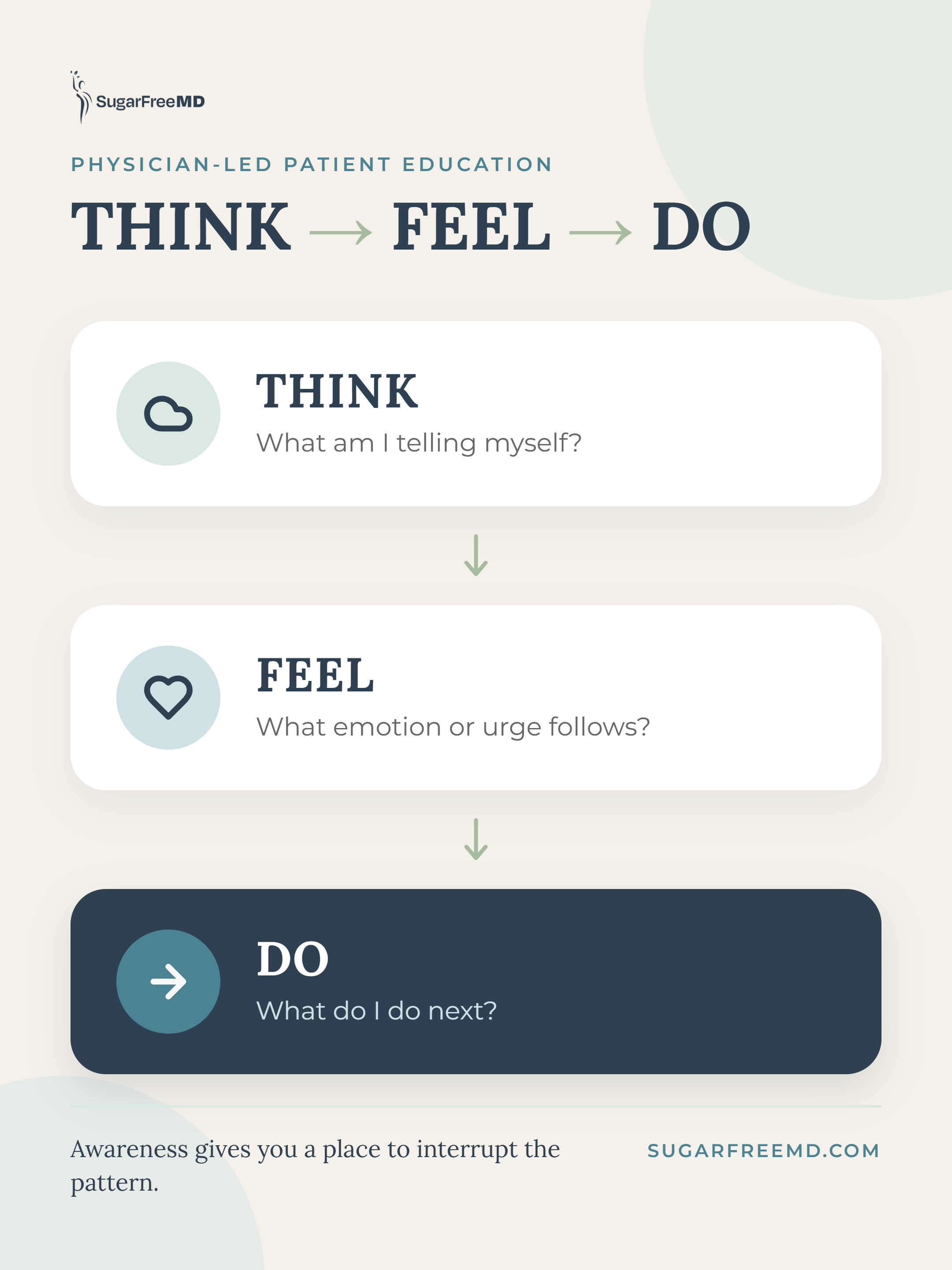
THINK → FEEL → DO
Something happens.
You have a thought about it.
That thought influences how you feel.
And how you feel influences what you do next.
Sometimes the thought happens so quickly that you barely notice it.
You finish a stressful meeting.
Your brain says:
“I cannot deal with one more thing.”
You feel overwhelmed.
You walk into the kitchen.
Or you are home alone at night.
Your brain says:
“This feels lonely.”
You feel sad.
You start looking for something comforting to eat.
The eating is the DO.
But that is not where the sequence started.
This is why trying to control only the food can feel so frustrating.
You are trying to change the last step while ignoring everything that created it.
What Is Buffering?
Another word I use when I teach emotional eating is buffering.
A buffer softens a sharp edge.
Emotionally, buffering means we use something outside ourselves to soften an uncomfortable feeling.
Food can do that.
So can:
- Scrolling
- Shopping
- Television
- Alcohol
- Staying constantly busy
- Other distractions
Let’s say you are anxious.
You eat something.
For a few minutes, you are focused on the food instead of the anxiety.
Or you are frustrated.
You sit down with chips and television.
Now your attention is somewhere else.
That is why buffering can be so appealing.
It works.
Temporarily.
Research supports a relationship between difficulty regulating emotions and emotional eating, although that does not mean every person who emotionally eats has an emotion-regulation disorder.[1]
It simply tells us emotions belong in this conversation.
And that is important, because emotional eating is often treated like a food problem when the food may actually be the tool your brain is using to manage something else.
Emotional Eating Works — for a Minute
I think this is one of the most important things to understand.
If emotional eating did absolutely nothing for you, you probably would not keep doing it.
Food may give you:
- Comfort
- Pleasure
- Distraction
- A reward
- A familiar ritual
- Something to look forward to
- A break
- Temporary relief from an uncomfortable feeling
So when you tell yourself:
“Just stop eating.”
You might actually be taking away the solution your brain has been using without addressing the original problem.
No wonder that feels hard.
The food is not always the real issue.
Sometimes food has become the solution.
So I want to know:
What problem is it solving?
The Feeling Is Still There After the Food Is Gone
Imagine you come home angry about something that happened at work.
You sit on the couch and eat chips.
For a few minutes, you are thinking about salt, crunch, television, whatever you are watching.
You are not thinking as much about work.
Then the chips are gone.
The work situation still happened.
The thoughts about it are still there.
And now you might add:
“I should not have eaten that.”
So anger turns into guilt.
And now guilt feels uncomfortable.
What does your brain already know how to do when you feel uncomfortable?
Eat.
And there we go again.
Trigger.
Discomfort.
Food.
Temporary relief.
Guilt.
More discomfort.
Another urge for relief.
This is why shame is such a terrible strategy for emotional eating.
It gives you another uncomfortable emotion to manage.
Negative Feelings Are Not Emergencies
Most of us do not love feeling sad.
Or anxious.
Or frustrated.
Or bored.
Or disappointed.
Of course we do not.
But somewhere along the way, we can start treating every uncomfortable emotion like something that needs to be fixed immediately.
I want to challenge that.
Sometimes sadness is appropriate.
Sometimes frustration makes sense.
Sometimes you are nervous because you are doing something new.
Sometimes you are disappointed.
Your first job does not always have to be:
“How do I make this feeling go away?”
Sometimes the better question is:
“Can I let myself feel this for a minute?”
That may sound incredibly simple.
It is not always easy.
But it is a skill.
Emotional Tolerance Gives You More Choices
Emotional tolerance means allowing an uncomfortable feeling to exist without immediately needing to escape it.
You do not have to like the feeling.
You do not have to decide anxiety is delightful.
Please do not.
You are just practicing:
“I feel uncomfortable, and I do not have to react immediately.”
That little pause creates space between FEEL and DO.
Maybe you notice:
“I am really angry because I think my coworker dismissed me.”
Or:
“I am lonely.”
“I am bored.”
“I am afraid this will not work.”
“I am disappointed.”
Now we have information.
And information gives us options.
An Urge Is Not an Instruction
Urges feel urgent.
That is sort of their whole personality.
But urgency does not mean you have to do what the urge says.
One analogy I have used on the podcast is a toddler demanding candy in the grocery store.
The toddler wants candy.
Very loudly.
You have options.
You can immediately give the toddler candy.
You can get into a giant wrestling match with the toddler.
Or you can let the toddler be unhappy for a minute without handing over control of the grocery cart.
An urge can be a little like that.
You do not have to fight with it.
You also do not have to obey it immediately.
You can notice it.
“There is the urge.”
Then give yourself a minute.
Not twenty minutes.
Not an hour-long meditation retreat.
Start with 60 seconds.
Ask:
- What happened right before this?
- What am I feeling?
- What am I thinking?
- Am I physically hungry?
- What am I hoping food will change?
- Where do I feel this urge in my body?
We are collecting information.
We are not putting ourselves on trial.
And If You Are Hungry? Eat.
I want to be very clear about this because I do not want you turning emotional-eating work into another restrictive food rule.
If you are physically hungry, eat.
Sometimes you will be hungry and emotional.
Sometimes you will want fuel, feelings, and flavor all at the same time.
Human beings are wonderfully inconvenient that way.
You do not need to perfectly categorize every eating decision.
The question is not:
“Am I allowed to eat?”
The question is:
“What is influencing my desire to eat right now?”
That keeps us curious instead of rigid.
Match the Response to What You Actually Need
You do not need fifty coping strategies saved in your phone.
Start with the emotion you actually have.
If You Are Stressed
Maybe you need quiet.
A short walk.
Some music.
A few breaths.
A few minutes without another person asking you something.
If You Are Lonely
You might need connection more than food.
Text someone.
Call someone.
Go sit with your family instead of standing alone in the kitchen.
If You Are Bored
Your brain might need stimulation.
Find something engaging instead of automatically making food responsible for entertaining you.
If You Are Angry
Name why.
Write it down.
Ask whether there is a conversation you need to have or a boundary you need to set.
If You Are Exhausted
Rest deserves consideration.
Sometimes you do not need another strategy.
You need to go to bed.
If You Want Flavor
Have the food intentionally.
Enjoyment is part of eating.
I am not trying to replace every cookie with deep breathing.
That sounds miserable.
I want you to have more than one tool.
You Can Interrupt the Loop in More Than One Place
Remember the pattern:
Trigger → Thought → Feeling or Urge → Eating → Reward
You do not have to change everything at once.
Pick a spot.
Change the Trigger
Maybe there is a food sitting directly in your line of sight every afternoon.
Move it.
That is not weakness.
That is using your environment.
Sometimes it is helpful to make an old pattern a little less automatic while you practice a new one.
Notice the Thought
Ask:
“What am I telling myself?”
Maybe the thought is:
“I deserve this after today.”
“I cannot handle this.”
“I need something.”
“I am already off track anyway.”
Once you see the thought, you can decide whether you want to keep practicing it.
Sit With the Feeling or Urge
Give yourself a minute before acting.
Again, the goal is not perfection.
We are practicing tolerating discomfort instead of immediately escaping it.
Reward the New Pattern
Your brain likes rewards.
Use that.
If you notice an urge and pause, count it.
Put a check mark somewhere.
Drop a bead into a jar.
Make a note on your phone.
The reward is evidence:
“I noticed what was happening.”
That matters.
Mindfulness Can Help You Notice the Pattern Earlier
Mindfulness fits beautifully into this work because emotional eating can happen very quickly.
Sometimes you realize what happened after you ate.
Then maybe next time you notice halfway through eating.
Eventually, you might notice while opening the pantry.
That is progress.
Current research on mindfulness and eating behavior is promising, but it is not magic. Some studies show benefits for certain eating behaviors and food intake, while effects specifically on emotional eating are smaller or inconsistent.[2,3]
I think the most useful way to think about mindfulness here is simple:
It helps you notice.
And you cannot change a pattern you never see.
Try This the Next Time You Want Food Without Hunger
Keep this simple.
1. Pause
Give yourself a minute.
2. Ask Which F Is Here
Fuel?
Feelings?
Flavor?
3. Find the Trigger
What happened right before the urge?
4. Name the Feeling
One word is enough.
Stressed.
Sad.
Lonely.
Angry.
Bored.
Frustrated.
Overwhelmed.
5. Choose What You Want to Do
You might eat.
You might not.
You might meet the emotional need another way first.
The win is that you noticed.
You interrupted autopilot.
That is where change starts.
What If You Emotionally Eat Anyway?
Then we learn something.
We do not punish.
We do not skip the next meal.
We do not create a bunch of new food rules tomorrow.
We do not turn one eating decision into a personality assessment.
Ask:
“What happened before I ate?”
“What was I feeling?”
“What did the food do for me?”
“When did I first notice the urge?”
“What could I try next time?”
Maybe today you noticed after you finished eating.
Great.
Next time, maybe you notice halfway through.
Eventually, you may notice before the first bite.
That is how awareness moves earlier in the loop.
You do not need to become perfect at emotional eating.
You need to become curious enough to understand your own pattern.
Frequently Asked Questions
Why do I eat even when I feel full?
Because physical fullness is only one influence on eating. You may also eat for comfort, distraction, reward, habit, pleasure, or relief from an emotion. Look at what happened immediately before the desire for food appeared.
Is emotional eating bad?
No. Emotional eating is a behavior, not a moral failure. Occasional emotional eating is different from a repeated pattern that causes significant distress or interferes with your health or quality of life.
How can I tell physical hunger from emotional hunger?
Look at when you last ate, what is happening in your body, what emotion is present, what triggered the urge, and what you hope the food will provide. Sometimes physical hunger and emotion overlap, and that is okay.
How do I stop using food for comfort?
First figure out what the food is providing. Is it quiet? Pleasure? Connection? Relief? Distraction? Then begin practicing another response to that need before automatically turning to food.
Will the urge eventually go away?
Urges change over time, but you do not need to sit there staring at the clock waiting for one to disappear. Practice noticing the urge without immediately fighting it or obeying it. The important skill is learning that an urge gives you information, not an order.
What if emotional eating feels completely out of control?
If eating episodes are frequent, highly distressing, secretive, compulsive, or involve a sense that you cannot stop, talk with a qualified healthcare or mental-health professional. Some eating patterns deserve individualized evaluation and support.
References
- Mendia J, Quiles Y, Pascual A, et al. Uncovering the association between broad emotional dysregulation and emotional eating: A meta-analysis. Appetite. 2026;221:108490.
https://pubmed.ncbi.nlm.nih.gov/41643943/ - Ahmadyar K, Zhang Q, Ferriday D, et al. Effects of mindfulness and mindful eating on food intake and appetite: A systematic review and meta-analysis. Clinical Psychology Review. 2026;128:102780.
https://pubmed.ncbi.nlm.nih.gov/42341365/ - Kao TSA, Ling J, Alanazi M, Atwa A, Liu S. Effects of mindfulness-based interventions on obesogenic eating behaviors: A systematic review and meta-analysis. Obesity Reviews. 2025;26(3):e13860.
https://pubmed.ncbi.nlm.nih.gov/39489689/ - Smith J, Ang XQ, Giles EL, Traviss-Turner G. Emotional Eating Interventions for Adults Living with Overweight or Obesity: A Systematic Review and Meta-Analysis. International Journal of Environmental Research and Public Health. 2023;20(3):2722.
https://pubmed.ncbi.nlm.nih.gov/36768088/
Want to Hear More About the Urge-Reward Loop?
I talk more about this pattern in Episode 27 of Weight Loss Made Simple, Breaking the Cycle: Understanding the Urge-Reward Loop.
If You Know You Are Not Hungry but Keep Reaching for Food
Knowing you are not physically hungry is helpful.
But sometimes it is not enough.
If emotional eating keeps showing up even when you understand what is happening, the End Emotional Eating Vault goes deeper into the thoughts, feelings, urges, and repeated patterns underneath that behavior.
This is the work of learning what food has been doing for you emotionally—and building more choices for those moments.
You do not need another reason to judge yourself around food.
You need tools that help you understand what is happening and practice something different.
Learn more about the End Emotional Eating Vault.

Dr. Stacy Heimburger
Author
I'm a doctor and an advanced certified life and weight loss coach. I am board certified in internal medicine as well as lifestyle medicine and have additional training in anti-aging medicine. I'm passionate about helping women over 40 use a holistic approach to lose weight for the last time.
