
How to Stop Nighttime Eating When You’re Not Actually Hungry

Dinner is over.
You ate enough. You are not physically hungry.
Then the house gets quieter, you finally sit down, and your brain says:
“I need something.”
Maybe it is chocolate.
Maybe it is chips.
Maybe you walk into the kitchen almost automatically and start looking through the pantry.
Then comes the frustrating part.
“Why am I doing this? I’m not even hungry.”
The answer might have less to do with food than you think.
Sometimes the original thought was completely reasonable:
“I need a break.”
“I want to relax.”
“I finally have a little time to myself.”
At some point, food became part of that break.
And after enough repetition, “I need a break” starts to feel a lot like “I need a snack.”
That distinction matters because a food rule does not solve a need for rest.
Start by Asking Why You Want to Eat
Eating after dinner does not automatically mean anything has gone wrong.
Sometimes you are hungry.
Sometimes you want something because you enjoy it.
Sometimes you want food because you want to feel different.
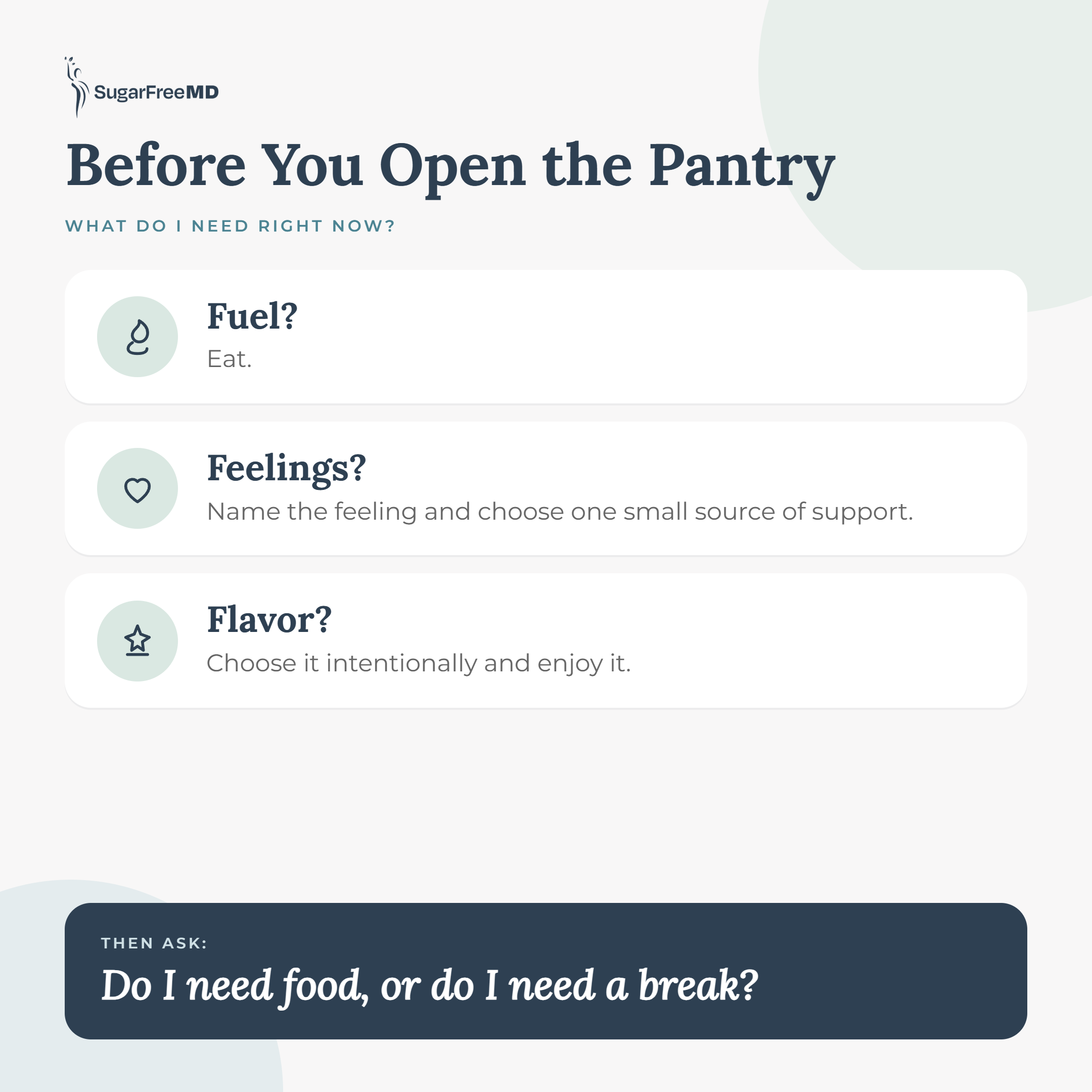
One SugarFreeMD framework I use to help sort this out is the 3 F’s of Eating:
Fuel
Your body needs nourishment.
Maybe dinner was not enough. Maybe you ate very little earlier in the day. Maybe several hours have passed and you are physically hungry.
If you are hungry, eat.
The goal is not to become better at ignoring physical hunger.
Feelings
You want food to change your emotional state.
You might want comfort, relief, distraction, reward, calm, or something pleasant after a stressful day.
Flavor
You simply want to enjoy something.
That is different from feeling as though you have no choice about eating it.
The point of the 3 F’s is not to judge the answer.
It is to understand what you are asking food to do.
The Thought Often Starts as “I Need a Break”
Imagine the end of a typical workday.
You have been answering questions, solving problems, making decisions, switching tasks, dealing with traffic, handling messages, and managing other people’s needs.
You get home.
More people need things.
Dinner needs attention.
The television is on.
Your phone is still buzzing.
Eventually, the day becomes quiet enough for you to notice how tired you are.
And your brain remembers:
This is when we eat something good.
This is when we pour the drink.
This is when we sit on the couch with chips.
This is what relaxing looks like.
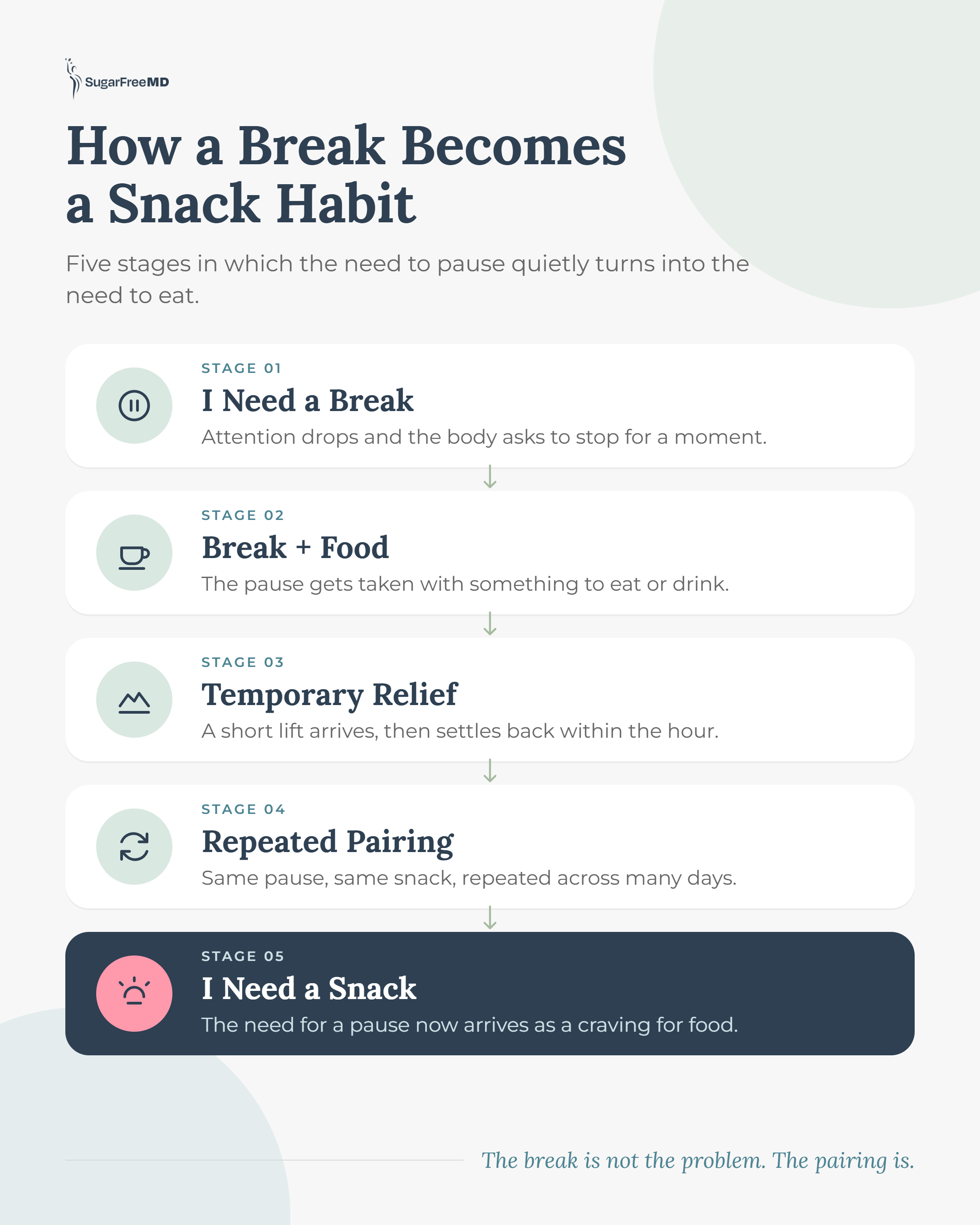
The original need was a break.
Food became part of the break.
Once you repeat the sequence enough times, the two start traveling together.
Stressful day → finally sit down → snack.
Kids go to bed → television goes on → dessert.
Kitchen gets cleaned → couch → chips.
That is why nighttime eating can feel strangely automatic even when your stomach is not asking for food.
Sometimes It Is Also an Overload Problem
The evening urge does not always begin at 9 p.m.
It might begin at 7 a.m.
A day full of constant input leaves little room for recovery.
You process:
- Emails
- Meetings
- Notifications
- Family needs
- Noise
- Decisions
- Traffic
- Screens
- Household tasks
- Unfinished work
- Other people’s emotions
By evening, you want something easy and pleasant.
Food qualifies.
This is especially important if you notice that nighttime eating becomes stronger in the middle of a busy week or after days when you never had a real pause.
Instead of asking:
“What is wrong with me?”
Try:
“What did my brain spend all day managing?”
That question gives you something useful to work with.
Food Can Become a Buffer
Another pattern underneath nighttime eating is buffering.
Buffering means using something outside yourself to soften an uncomfortable feeling.
Food might help distract you from:
- Stress
- Anxiety
- Frustration
- Boredom
- Loneliness
- Resentment
- Exhaustion
- Overwhelm
Scrolling, shopping, television, alcohol, and staying constantly busy can serve the same function.
The appeal makes sense.
You feel uncomfortable.
You eat something pleasurable.
Your attention shifts.
For a little while, the feeling becomes less noticeable.
The problem is that the original feeling or need often remains.
Research supports an association between difficulty regulating emotions and emotional eating. Stress also relates to changes in eating behavior, though people respond differently and stress does not produce the same eating response in everyone.[1,2]
So nighttime eating is not automatically an emotional-regulation problem.
But if food reliably appears when you need relief, the pattern deserves your attention.
Why More Willpower Usually Fails at Night
The standard response is:
“I need to stop eating after dinner.”
Then you make a rule.
Kitchen closed.
No snacks.
No sugar.
No eating after 7 p.m.
The problem is that the rule addresses the food while ignoring why you wanted it.
If the real thought is:
“I need a break.”
Your new rule says:
“You are also not allowed to have the thing you usually use for your break.”
Now you are stressed and deprived.
This is why willpower is not the fix.
A better question is:
“How else can I get the break I actually need?”
Identify Your Nighttime Sequence
Do not start by trying to fix it.
Study it.
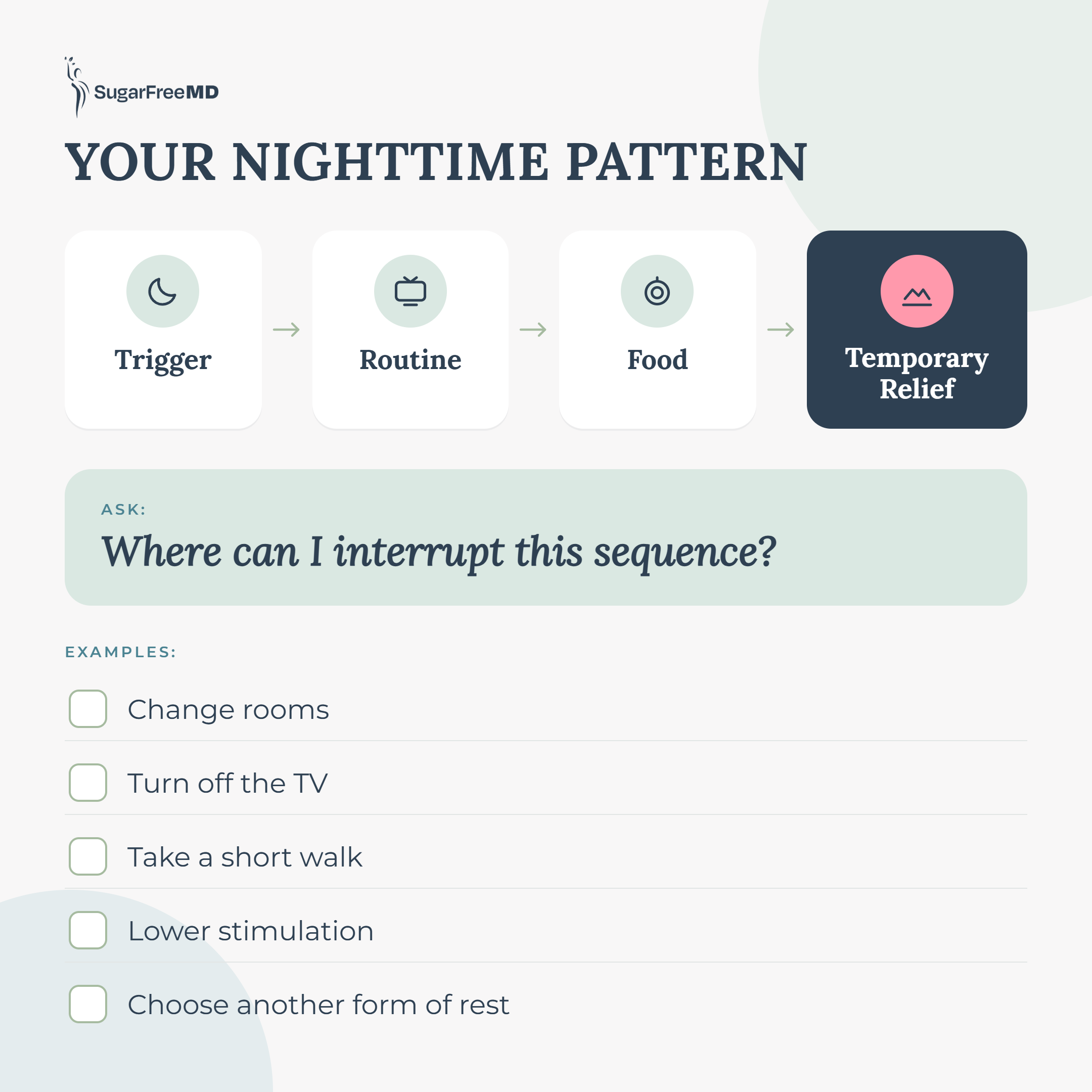
What happens before the food?
Your sequence might be:
Kids go to bed → couch → television → snack.
Or:
Finish dishes → open pantry → look for something sweet.
Or:
Work late → close laptop → order dessert.
Or:
Pour wine → start cooking → snack through dinner → keep eating afterward.
Write your sequence down.
Do you sit in the same place?
Watch the same show?
Eat the same food?
Have the same thought?
Do you feel the urge at roughly the same time?
Do you reach for food after a specific transition in your day?
The more clearly you see the pattern, the easier it becomes to change one piece of it.
Interrupt the Pattern Somewhere
You do not have to redesign your entire evening.
Find one point where you can interrupt the automatic sequence.
If the pattern is:
Kids go to bed → couch → television → chips
Try changing one step.
Kids go to bed → read in your bedroom for ten minutes.
Or:
Kids go to bed → take a short walk → couch.
Or:
Kids go to bed → make tea → talk with your partner.
If the pattern is:
Clean kitchen → pantry → dessert
Try:
Clean kitchen → turn off kitchen lights → leave the room.
If the pattern is:
Work ends → drive home listening to more information → arrive overloaded → snack
Try:
Work ends → quiet drive home → pause before entering the house.
The interruption does not need to be impressive.
Its job is to stop the whole routine from running without your awareness.
Change the Environment if It Helps
Sometimes the easiest interruption is environmental.
You might:
- Move a commonly eaten food somewhere less visible
- Stop eating directly from the package
- Turn off the kitchen lights after dinner
- Keep your phone away from the couch
- Set an evening reminder asking, “What do I need right now?”
- Tell your partner you are changing your nighttime routine
- Sit somewhere different
- Remove television from the eating part of the routine
This does not mean a food is forbidden.
You are making the old sequence less automatic while you practice something new.
If You Catch Yourself Mid-Snack, You Have Not Missed Your Chance
This part matters.
You do not have to recognize the pattern before eating for the practice to count.
Maybe you realize what is happening after opening the bag.
Maybe you are halfway through the snack.
Fine.
You noticed.
Now interrupt the pattern where you are.
Turn off the television.
Put down your phone.
Sit at the table.
Look at the food.
Notice the smell.
Notice the texture.
Notice the flavor.
Notice whether the next bite tastes as satisfying as the first.
If you want to continue eating, continue consciously.
Mindfulness is not a sneaky way to force yourself to stop.
It is a way to move from automatic behavior toward awareness.
Research on mindfulness-based approaches suggests potential benefits for food cravings and several eating behaviors, although effects vary across studies and the evidence is still developing.[3]
Awareness gives you information.
That is useful even if the snack still happens.
Build an Evening Routine That Actually Feels Like a Break
Once you begin interrupting the old pattern, ask a bigger question:
“What would an evening routine that genuinely restores me look like?”
Not the routine Instagram says you should have.
Yours.
Maybe it includes:
- Ten quiet minutes after the children go to bed
- Reading
- Stretching
- A short walk
- A shower
- Music
- Journaling
- A few minutes of meditation
- Talking with your partner
- Lower lights
- Putting your phone away
- Preparing for bed earlier
Choose something you would actually enjoy.
Your replacement routine needs to satisfy at least part of the original need.
If food represented pleasure, replacing it with another chore is unlikely to feel compelling.
If food represented quiet, find quiet.
If it represented reward, choose something enjoyable.
If it represented time alone, protect a small amount of time alone.
If it represented the end of the day, build another signal that tells your brain:
“We are done now.”
Use Transition Points as Reset Points
Some of the best places to change nighttime eating happen before the nighttime urge appears.
Look at transitions such as:
Work → commute
Commute → home
Dinner → evening
Children’s bedtime → personal time
Chores → bedtime
A brief reset at one of these points might prevent hours of accumulated overload from landing in the pantry.
Your reset might be:
- Ninety seconds of slow breathing
- A silent drive home
- A walk to the mailbox
- Three minutes outside
- Calm music while cleaning
- Sitting quietly before entering the house
- Putting your phone away during dinner
Keep it small.
A reset stops being restorative when it turns into another task you have to perform perfectly.
Practice Feeling a Feeling Without Immediately Fixing It
Sometimes food is not attached to a routine as much as it is attached to discomfort.
You feel frustrated.
You eat.
You feel bored.
You eat.
You feel anxious.
You eat.
One skill worth practicing is emotional tolerance.
That means allowing a feeling to exist for a little while before automatically trying to make it disappear.
Start small.
Name the emotion.
“I am frustrated.”
“I am lonely.”
“I am overwhelmed.”
Then stay there for a moment.
Take a few breaths.
Write one sentence about it.
Walk around the block.
Let yourself experience the feeling without treating it as an emergency.
You are teaching yourself:
“I can feel uncomfortable without immediately needing to change the feeling through food.”
You do not have to become amazing at this overnight.
Thirty seconds of awareness is still practice.
Ask What You Actually Need
When the pantry starts calling, try completing this sentence:
“I want food right now because I want to feel __________.”
Maybe the answer is:
- Relaxed
- Rewarded
- Comforted
- Distracted
- Calm
- Finished
- Entertained
- Less lonely
- Less stressed
Then ask:
“What else would give me 10 percent of that?”
Not 100 percent.
Ten percent.
Maybe you still eat afterward.
That is okay.
The goal is to build more than one tool for meeting the need.
What If You Are Actually Hungry?
Eat.
Seriously.
Nighttime eating is not automatically emotional eating simply because the sun went down.
Your hunger might make sense if:
- Dinner was small
- You ate too little earlier
- Several hours have passed
- Your activity level was higher
- Your schedule disrupted your normal meals
Do not turn this article into a reason to ignore your body.
The point is to distinguish:
“My body needs nourishment.”
from:
“My brain wants this familiar break.”
Sometimes the answer will be both.
Human behavior is allowed to be complicated.
What If You Eat the Snack Anyway?
Nothing dramatic needs to happen next.
Do not punish yourself.
Do not skip breakfast.
Do not make tomorrow stricter.
Do not decide you need to “get back on track” Monday.
Instead ask:
“Where did I notice the pattern?”
Maybe you noticed before eating.
Great.
Maybe you noticed halfway through.
Still useful.
Maybe you noticed afterward.
Also useful.
Awareness is how you start changing an automatic routine.
If guilt tends to turn one nighttime snack into several days of giving up, read Why You Keep Starting Over With Weight Loss, and How to Stop.
You do not need to undo tonight.
You need to learn from it.
Try This Tonight
Do not overhaul your evenings.
Do this instead.
Step 1: Identify the usual sequence
Write down what normally happens before you snack.
For example:
Dinner → dishes → kids to bed → couch → television → snack.
Step 2: Choose one interruption
Change one point in the sequence.
Maybe:
Couch → walk for five minutes.
Or:
Television → read for ten minutes.
Or:
Kitchen → lights off and leave the room.
Step 3: Decide what your break actually needs
Ask:
“Do I need quiet, comfort, reward, connection, entertainment, or rest?”
Step 4: Give yourself a small version of it
Keep the alternative easy.
You are building a new association, not another evening project.
Step 5: If you eat, eat on purpose
Remove the distractions.
Taste it.
Notice it.
Let the experience become conscious.
Then move on.
No punishment.
No restart.
The Goal Is Not to Become Someone Who Never Snacks at Night
The goal is awareness.
You want to know:
Am I hungry?
Am I eating for feelings?
Am I enjoying flavor intentionally?
Am I repeating an old routine?
Am I overloaded?
Do I need a break?
Once you know what is happening, you have choices.
That is the real shift.
The pantry no longer has to be the only place your day gets to stop.
Frequently Asked Questions
Why do I want to eat at night even though I am full?
Food might be linked to relaxation, comfort, reward, distraction, or an established evening routine. Stress and emotional states also influence eating differently across people. Look at what happens immediately before the urge rather than assuming it means you lack discipline.
How do I break a nighttime snacking habit?
Identify the sequence leading to the snack and interrupt one step. Change where you sit, what you do after dinner, where the food is stored, or how you transition into the evening. Repeat the new response consistently.
Should I stop keeping snack foods in my house?
Changing the food environment can help interrupt an automatic pattern, especially while you establish a new evening routine. It does not need to become a permanent rule or a judgment about whether the food is “good” or “bad.”
What if I notice I am emotional eating while I am already eating?
You still have an opportunity to interrupt the automatic pattern. Remove distractions, slow down, and notice the food and your emotional state. You do not need to throw the food away or punish yourself.
Is nighttime eating always emotional eating?
No. You might be physically hungry, intentionally enjoying food, or responding to emotion, habit, stress, or several factors at once. Start by identifying what is happening rather than treating all evening eating as the same behavior.
What should I do instead of eating after a stressful day?
Choose an activity that meets the underlying need. If you need quiet, reduce stimulation. If you need reward, choose something enjoyable. If you need connection, talk with someone. If you need rest, begin your evening wind-down earlier.
References
- Mendia J, Quiles Y, Pascual A, et al. Uncovering the association between broad emotional dysregulation and emotional eating: A meta-analysis. Appetite. 2026;221:108490.
https://pubmed.ncbi.nlm.nih.gov/41643943/ - Hill D, Conner M, Clancy F, et al. Stress and eating behaviours in healthy adults: A systematic review and meta-analysis. Health Psychology Review. 2022;16(2):280–304.
https://pubmed.ncbi.nlm.nih.gov/33913377/ - Allameh SA, Mokhtari Z, Hosseini E, Askari G. Effects of mindfulness-based interventions on food craving in adults: A systematic review and meta-analysis of controlled clinical trials. BMC Psychology. 2025;13:1022.
https://pubmed.ncbi.nlm.nih.gov/40999532/
Want to Go Deeper?
Listen to Episode 25 of Weight Loss Made Simple, Overcoming the Nighttime Snack Trap: A Guide to Mindful Eating.
Need Help With the Moment the Pantry Starts Calling?
If nighttime eating is where your day tends to unravel, come join me for How to Stay Out of the Pantry at Night.
It is my free weekly live teaching where we talk about the real-life reasons evening eating becomes difficult and how to build more supportive responses.
You do not need another rule telling you never to snack at night.
You need to understand your pattern and know what to do when it shows up.
Dr. Stacy Heimburger
Author
I'm a doctor and an advanced certified life and weight loss coach. I am board certified in internal medicine as well as lifestyle medicine and have additional training in anti-aging medicine. I'm passionate about helping women over 40 use a holistic approach to lose weight for the last time.
