
GLP-1s Can Help With Hunger—But They Don’t Automatically Change Your Habits

You start a GLP-1 medication and something feels different.
Food is quieter.
You eat a meal and actually feel finished.
The snack in the break room exists without becoming the main event of your afternoon.
You are not spending half the day negotiating with yourself about what you will eat next.
For someone who has dealt with intense hunger, cravings, or constant food thoughts for years, that shift can feel enormous.
It is also easy to assume the medication has now solved the entire problem.
It has not.
And I do not mean that as criticism of the medication.
I mean something much more practical.
Medication can change biology.
Habits still have to live inside your Tuesday.
GLP-1 Medications Can Lower the Pressure Around Eating
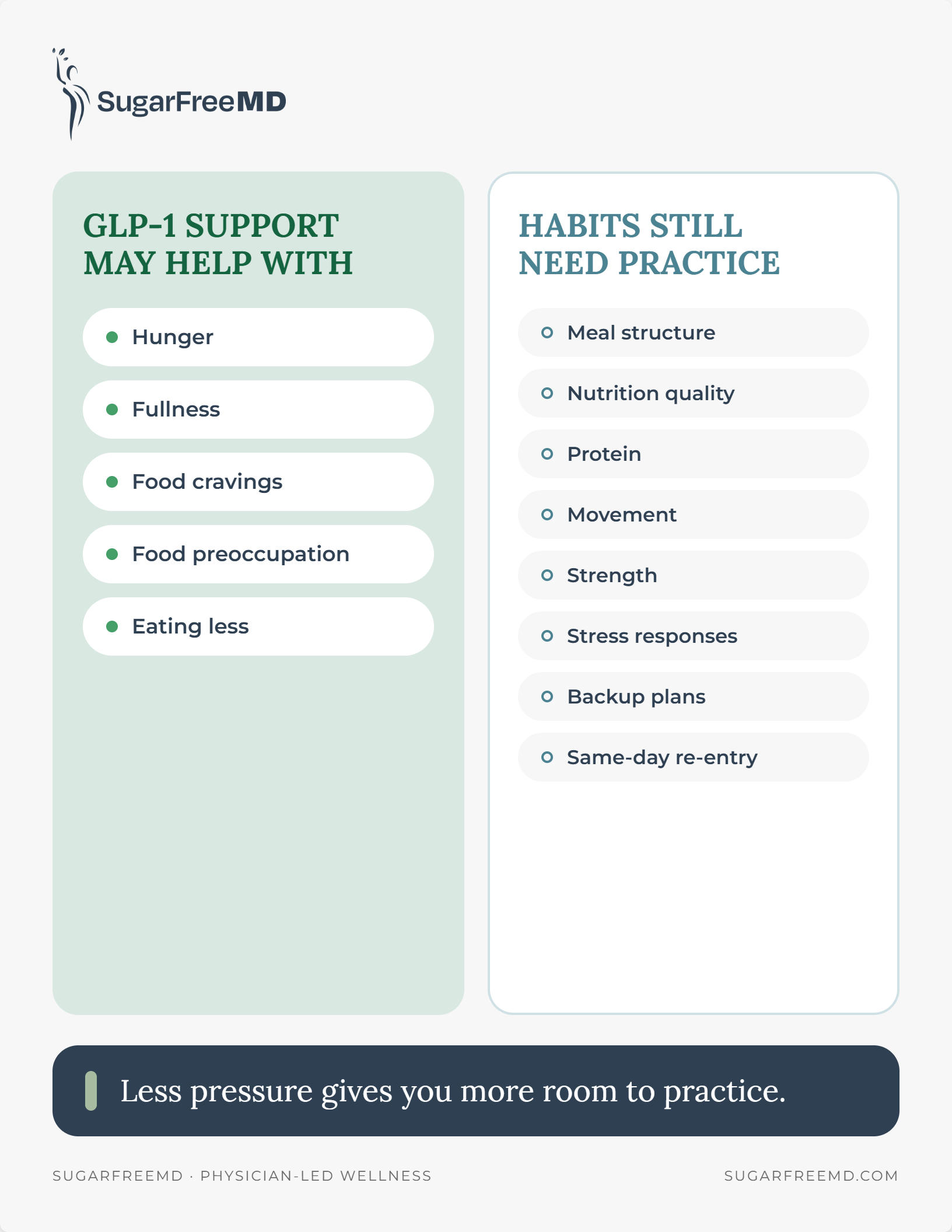
One reason GLP-1 medications help many people is that eating often feels less urgent.
Studies of semaglutide and tirzepatide have found reductions in hunger, appetite, food cravings, food preoccupation, and overall energy intake during treatment.
That matters.
If hunger used to feel like a tornado siren, having it come down several volume levels gives you space.
Instead of fighting with yourself at every meal, you may have more room to notice:
Am I hungry?
Am I satisfied?
What would support me here?
What happened before I wanted this snack?
What do I actually need right now?
That space is useful.
Use it.
Medication Does Not Pack Your Lunch
This is where the lifestyle piece enters.
A medication does not know your clinic ran late.
It does not know you forgot groceries.
It does not decide which protein source you keep at work.
It does not put your walking shoes beside the door.
It does not know Friday night has been your hardest eating night for six years.
It does not hear the thought:
“I already messed up, so I’ll just start again Monday.”
Those are habit and behavior-change problems.
GLP-1 treatment can make the environment inside your body easier to work with.
You still need a system for the environment outside your body.
Quieter Hunger Is an Opportunity to Practice
I do not want you hearing this as:
“Great. Now I have another giant list of things I have to do while taking medication.”
No.
Think of it as practice space.
Before medication, an urge might have felt like a fire alarm.
Now it might feel more like a notification.
You still notice it.
But there may be more room before you respond.
That is where behavior change can happen.
Trigger.
Pause.
Notice.
Choose.
Repeat.
The medication does not need to build the habit for you.
It gives you a less chaotic place to practice it.
Your Old Triggers Did Not Disappear
This is especially important with emotional eating.
Imagine work has been awful.
You get home frustrated.
For years, the familiar pattern has been:
Stress → kitchen → something sweet → temporary relief.
A GLP-1 might reduce the intensity of the food urge.
It does not erase the difficult workday.
It does not change your relationship with your boss.
It does not automatically teach you how to tolerate frustration.
It does not rewrite the thought:
“I deserve something after today.”
You may simply notice the urge feels quieter.
That is useful.
Now you can ask:
“What am I actually needing?”
Maybe you are hungry.
Maybe you skipped lunch.
Maybe you need quiet.
Rest.
Comfort.
A shower.
A walk.
Five minutes when nobody asks you another question.
If eating without physical hunger is a familiar pattern for you, read Why Do I Eat When I’m Not Hungry? Understanding Emotional Eating too.
Eating Less Is Not the Same Thing as Being Well Nourished
Lower appetite creates another challenge.
Sometimes women feel so relieved that they are not hungry all the time that eating enough nutritious food becomes an afterthought.
Less hunger does not automatically mean complete nutrition.
Current professional guidance around GLP-1 treatment emphasizes food quality, adequate nutrient intake, resistance exercise, sleep, stress support, and muscle preservation alongside medication.
That means having a few simple nutrition anchors becomes useful.
Not a perfect meal plan.
Not obsessive tracking.
An anchor.
Start With a Protein Anchor
One of the ideas I teach in Habits in the Wild is choosing one thing you can still do when the day becomes unpredictable.
With nutrition, protein often makes a useful anchor.
The question can be as simple as:
“Where is my reliable protein source today?”
Maybe it is:
- Greek yogurt
- Eggs
- Cottage cheese
- Chicken
- Fish
- Tofu
- Beans
- A protein shake you tolerate
- Leftovers
- Something simple you order regularly
The exact food is not the point.
The point is having an answer before the wild day arrives.
Protein matters because intentional weight loss can include some loss of lean tissue, not only fat mass.
That does not mean you need to become obsessed with grams.
It means your health goal should include maintaining strength and muscle, not just making the scale smaller.
Habits Need a Wild Version
Your nutrition plan has to work on the day you actually live.
Not the imaginary day where:
You sleep eight hours.
Work ends on time.
The kitchen is clean.
Everyone agrees on dinner.
Your appetite arrives on schedule.
You feel inspired to cook.
Nothing unexpected happens.
I call this the difference between habits in captivity and habits in the wild.
Captivity is the ideal day.
The wild is Thursday.
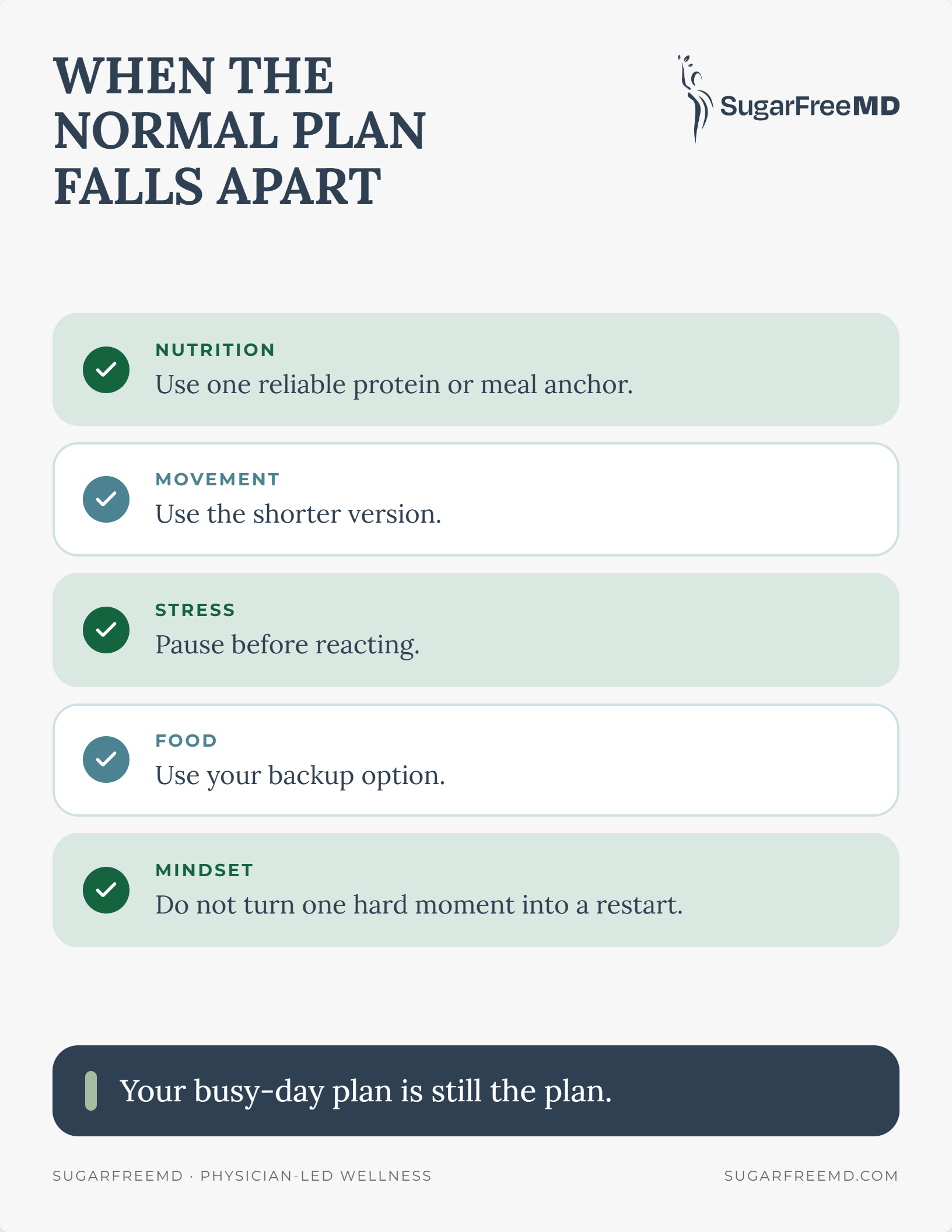
Real life needs both a normal plan and a backup.
For example:
Normal plan:
You prepare dinner.
Wild plan:
You use a reliable freezer meal or familiar takeout option.
Normal plan:
You eat your planned lunch.
Wild plan:
You use a backup protein or meal option stored at work.
Normal plan:
You complete your regular workout.
Wild plan:
You walk for ten minutes or do the minimum movement version.
The smaller plan is not failure.
It is the version built for a harder day.
Movement Still Matters
GLP-1 medication does not replace movement.
And movement is not punishment for eating.
Movement supports:
- Strength
- Cardiovascular health
- Physical function
- Mood
- Mobility
- Independence
- Muscle preservation
Resistance exercise deserves particular attention because weight loss can include some lean-tissue loss.
That does not mean you need an elaborate six-day training program.
Use the same system I use for every habit.
What is your normal version?
What is your busy-day version?
What is your bare-minimum version?
Then move between those versions as life changes.
Do Not Turn GLP-1 Treatment Into Another Perfection Project
This is an easy trap.
A woman who has spent years being perfectionistic around food starts medication and becomes perfectionistic around the medication instead.
Every meal has to be ideal.
Every gram of protein has to be perfect.
Every workout has to happen.
Every pound has to come off on schedule.
Any hunger means the medication stopped working.
Any difficult food moment means she failed treatment.
No.
Your job is still not perfection.
It is learning.
Appetite will not feel identical every day.
Your routine will not look identical every week.
There will still be travel.
Stress.
Dinners out.
Celebrations.
Low-energy days.
Forgotten lunches.
Moments where you eat differently than planned.
Medication does not remove your humanity.
You still need flexibility.
GLP-1s Are Not Cheating
I also want to address the shame piece.
Using medication for obesity does not mean you failed.
It does not mean you took the easy way out.
Obesity is a chronic disease influenced by biology, genetics, environment, behavior, medications, sleep, stress, social factors, and many other inputs.
Appropriate medical treatment is treatment.
You do not become more deserving of better health because you struggled harder to get there.
At the same time, medication does not make the rest of your health irrelevant.
Both can be true:
Medication support matters.
Lifestyle support matters.
You do not have to choose a team.
Why Habits Matter Even When the Medication Is Working
Suppose the medication is working beautifully.
Hunger feels manageable.
Weight is changing.
Why bother with habits?
Because health is bigger than appetite.
You are still building:
- A way to nourish yourself when you are not especially hungry
- A way to protect movement during a busy week
- A way to notice emotional triggers
- A way to recover after an imperfect meal
- A way to get enough rest
- A way to keep useful food available
- A way to stop interpreting every disruption as failure
- A way to trust yourself
Those skills matter whether your weight is changing quickly, slowly, or not at all.
Progress deserves more than one measurement.
Strength matters.
Energy matters.
Food confidence matters.
Consistency matters.
Recovery after setbacks matters.
Self-trust matters.
Habits Are Not a Promise You Will Eventually Stop Medication
This is one of the most important distinctions in this article.
Building excellent habits does not guarantee you will eventually stop a GLP-1.
And needing long-term medication does not mean the habit work failed.
Research after semaglutide withdrawal has shown substantial weight regain on average after treatment ended.
That reinforces something we already know about obesity:
It is a chronic condition.
Your medication plan belongs between you and your prescriber.
Do not reduce, stop, restart, or change medication because an article, podcast, friend, or social-media post convinced you that you “should” be able to maintain without it.
Lifestyle work supports your health.
It is not a test you pass to earn your way off treatment.
Five Habits Worth Practicing While Hunger Is Quieter
1. Build one reliable nutrition anchor
Know one meal component or food you can rely on when appetite or schedule feels unpredictable.
2. Keep backup food available
Do not wait until a chaotic afternoon to invent a plan.
3. Protect strength
Support your nutrition needs and include regular resistance activity when appropriate for you.
4. Notice triggers instead of only fighting urges
Stress, fatigue, boredom, habit, physical hunger, and emotional discomfort need different responses.
5. Build a safety net for your hardest day
Decide what still happens when your full routine falls apart.
The goal is not doing more.
The goal is having fewer moments where everything depends on making the perfect choice in real time.
A Simple GLP-1 Habit Audit
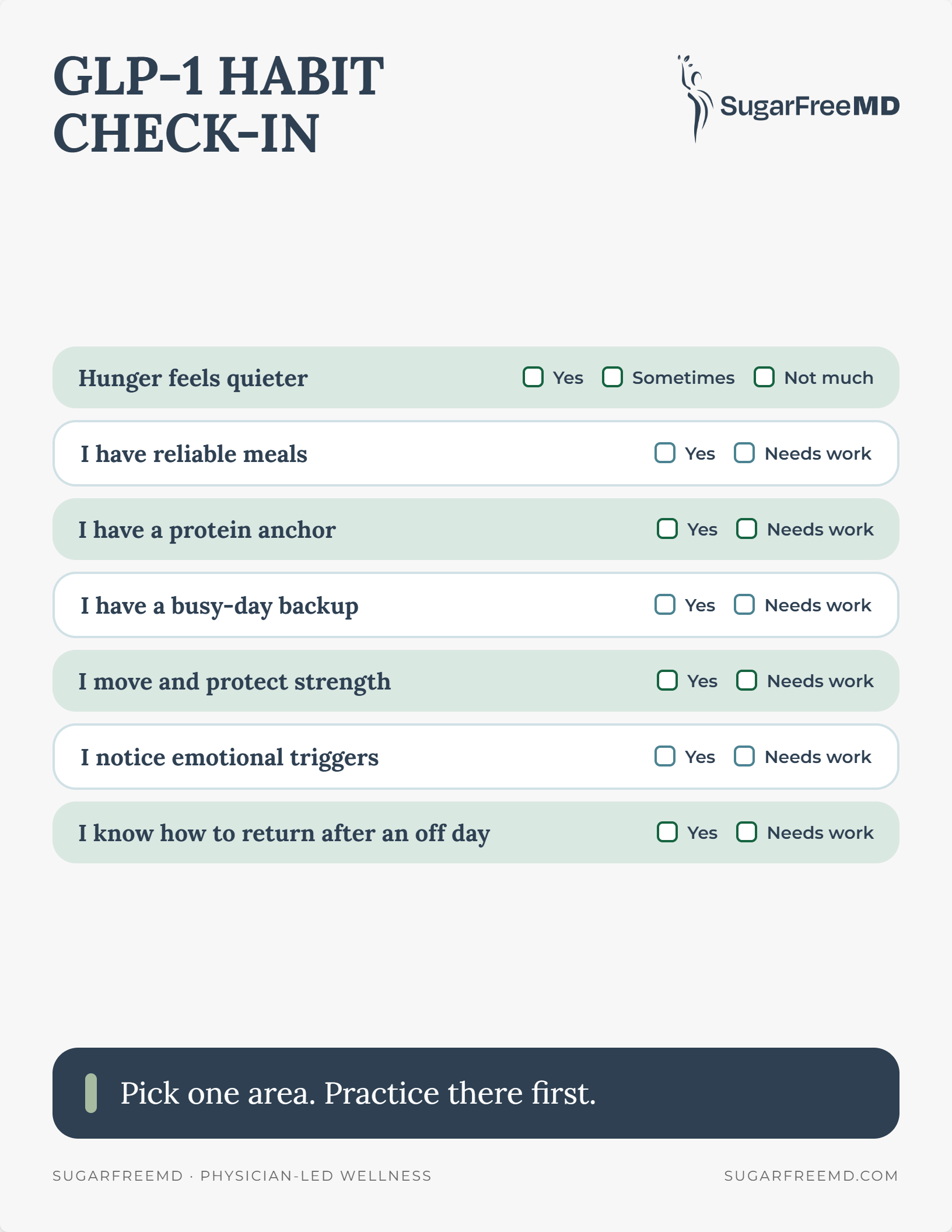
Ask yourself:
Where has medication made life easier?
Which food decisions feel quieter?
Which old patterns still show up?
What happens when work gets busy?
Do I have a reliable nutrition anchor?
What happens when I cannot follow my normal plan?
Am I protecting strength and movement?
Where do emotions still drive eating?
What is one habit I want to practice while I have more space?
Do not turn the answers into another overhaul.
Pick one.
Practice it.
Let repetition do its job.
Frequently Asked Questions
Do GLP-1 medications reduce hunger?
For many people, yes. Clinical trials of semaglutide and tirzepatide report reductions in hunger, appetite, cravings, food preoccupation, and energy intake. Individual responses vary.
Do healthy habits still matter if my GLP-1 medication is working?
Yes. Medication does not replace nutrition quality, movement, sleep, stress support, muscle preservation, or behavior skills.
What if I barely feel hungry on my GLP-1?
Very low appetite can make it harder to meet nutrition needs. If eating enough or tolerating food becomes difficult, talk with your healthcare professional or a registered dietitian familiar with GLP-1 treatment.
Does building good habits mean I will eventually stop my GLP-1?
No. Habit work does not guarantee medication discontinuation. Decisions about dose, duration, or stopping treatment belong with your prescribing clinician.
What habits matter most while taking a GLP-1?
Focus on sustainable nutrition, adequate protein for your individual needs, movement, resistance exercise, sleep, stress management, and realistic backup plans.
References
- Mozaffarian D, et al. Nutritional priorities to support GLP-1 therapy for obesity: A joint advisory from the American College of Lifestyle Medicine, American Society for Nutrition, Obesity Medicine Association, and The Obesity Society. Obesity. 2025.
https://pubmed.ncbi.nlm.nih.gov/40445127/ - Tronieri JS, Allison KC, DeRouen K, et al. Short- and long-term effects of semaglutide 2.4 mg on energy intake, appetite, and food reward: a 60-week randomized controlled trial. American Journal of Clinical Nutrition. 2026.
https://pubmed.ncbi.nlm.nih.gov/42323166/ - Martin CK, Carmichael OT, Carnell S, et al. Tirzepatide on ingestive behavior in adults with overweight or obesity: a randomized trial. Nature Medicine. 2025.
https://pubmed.ncbi.nlm.nih.gov/40555748/ - Laverde LP, Muñoz-Velandia OM, Alfonso D, Gómez Medina AM. Effect of GLP-1 receptor agonists at doses for obesity management on muscle health: systematic review and meta-analysis. International Journal of Obesity. 2026.
https://pubmed.ncbi.nlm.nih.gov/42321502/ - Wilding JPH, Batterham RL, Davies M, et al. Weight regain and cardiometabolic effects after withdrawal of semaglutide: The STEP 1 trial extension. Diabetes, Obesity and Metabolism. 2022.
https://pubmed.ncbi.nlm.nih.gov/35441470/
Want to Go Deeper?
Listen to Episode 123 of Weight Loss Made Simple, Habits in the Wild Series - Nutrition:
Use the Quieter Hunger to Practice
A GLP-1 does not need to do everything to be an excellent tool.
If it lowers the volume on hunger, cravings, or food preoccupation, use the space.
Practice the lunch plan.
Keep the backup food.
Build the strength habit.
Notice the stress trigger.
Return after the imperfect day.
Those are useful skills whether medication remains part of your treatment for months or years.
If the medication piece feels easier but consistency in real life is still where you get stuck, that is exactly the lifestyle side we work on inside SugarFreeMD Lifestyle Support Monthly.
The Membership focuses on habits, nutrition, movement, mindset, accountability, and real-life troubleshooting, including support for women using GLP-1 medications.
It is lifestyle support, not medication management.
Learn more about Lifestyle Support Monthly:
https://www.sugarfreemd.com/LSM
Medical Disclaimer
This article is for educational purposes and is not a substitute for individualized medical advice. Talk with your healthcare professional about recommendations specific to your health and medications.
Dr. Stacy Heimburger
Author
I'm a doctor and an advanced certified life and weight loss coach. I am board certified in internal medicine as well as lifestyle medicine and have additional training in anti-aging medicine. I'm passionate about helping women over 40 use a holistic approach to lose weight for the last time.
